















As AI and automation reshape industries, lifelong learning can help India build a future-ready workforce through continuous upskilling, reskilling, and flexible education pathways
Rashmi Ranjan Mohapatra
India stands at a defining moment in its development journey. With the world’s largest youth population and one of the fastest-growing economies, the country possesses an unprecedented demographic advantage. Yet this opportunity arrives at a time when artificial intelligence, automation, and digital technologies are transforming industries at a pace never witnessed before.
The old formula of education – a few years of study, earning a degree, securing a job, and work for life – is rapidly losing relevance. Skills now have shorter lifecycles. Entire professions are being reshaped by technology. New occupations are emerging even as existing ones evolve.
In this new reality, the greatest asset a nation can possess is not merely an educated workforce, but a workforce capable of continuously learning, adapting, and reinventing itself. The future will belong to societies that can systematically reskill, upskill, and re-credential their citizens throughout their lives. Lifelong learning is no longer an educational aspiration but a national economic necessity.
Growing Mismatch between Education and Employment
India’s higher education system was largely designed for an industrial-era economy. It assumes that learning happens primarily in educational institutions, follows a fixed timeline, and culminates in a degree that remains valuable for decades.
Today’s labour market tells a different story. Employers increasingly seek competencies rather than credentials. Fields such as artificial intelligence, data analytics, cybersecurity, electric mobility, advanced manufacturing, and digital commerce are evolving so rapidly that knowledge acquired at the beginning of a career may become outdated within a few years.
At the same time, millions of Indians remain excluded from traditional pathways of higher education. Working professionals struggle to return to classrooms while managing careers and families. Women often face interruptions in education and employment due to caregiving responsibilities. Rural learners encounter geographical and financial barriers. Gig workers and informal sector professionals possess valuable skills but lack formal recognition for their expertise. The challenge before India is not simply expanding access to education. It is creating an education system flexible enough to accommodate learning at every stage of life.
South Korea’s Lifelong Learning Revolution
A powerful example of this transformation can be found in the Republic of Korea. Recognising that learning occurs far beyond university campuses, South Korea established the National Institute for Lifelong Education (NILE), creating one of the world’s most innovative lifelong learning ecosystems. At the heart of this system lies the Academic Credit Bank System (ACBS), introduced under Korea’s Lifelong Education Act.
The principle is simple yet revolutionary. Learning acquired through university courses, vocational programmes, online platforms, workplace training, professional certifications, and prior work experience can all be formally recognised and accumulated as academic credits. Once learners accumulate the required credits, they are awarded accredited degrees equivalent to those earned through conventional university pathways. In effect, the system shifts the burden of flexibility from the learner to the institution.
Rather than forcing citizens to fit into rigid educational structures, the system adapts to the realities of people’s lives. Complementing this model is the Bachelor’s Degree Examination for Self-Education (BDES), which allows individuals to earn recognised bachelor’s degrees through demonstrated competency and rigorous examinations, even without attending a traditional university. For a country like India, where millions independently prepare for competitive examinations and professional certifications, such a framework offers valuable lessons in expanding educational access and mobility.
Why Lifelong Learning Matters for India’s Future
- Navigating the Age of AI and Automation
Technological disruption is no longer a distant possibility but an ongoing reality. Workers across sectors will increasingly need to refresh their skills every five to ten years. Lifelong learning institutions can become agile centres for continuous skill renewal, helping individuals remain relevant in rapidly changing industries. - Unlocking the Potential of the Informal Workforce
More than 80 percent of India’s workforce operates within the informal economy. Many possess years of practical expertise but lack formal qualifications. Recognition of Prior Learning can bridge this gap, converting experiential knowledge into academic and professional mobility. - Sustaining India’s Demographic Dividend
India’s young population is often described as its greatest strength. However, demographic advantage is not automatic. Without opportunities for continuous learning and adaptation, today’s demographic dividend can quickly become tomorrow’s employment challenge. Lifelong learning systems can help ensure that India’s workforce remains productive and competitive across decades. - Empowering Women’s Economic Participation
Among the most transformative benefits of lifelong learning is its potential to strengthen female workforce participation. Flexible and modular education pathways enable women to pause, resume, and advance their learning journeys without penalty. Such flexibility can create more inclusive opportunities for career progression and economic empowerment.
Building India’s Lifelong Learning Ecosystem
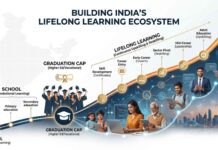
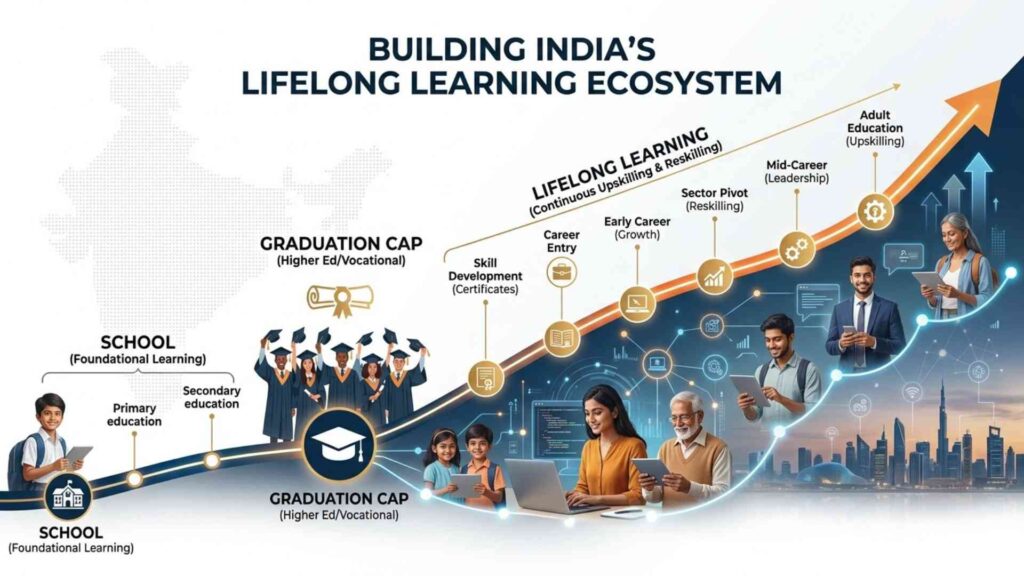
India has already taken important steps through the National Education Policy 2020. Initiatives such as the Academic Bank of Credits, SWAYAM, and Multiple Entry-Multiple Exit pathways have established a strong foundation.
The next phase requires integration, scale, and institutional innovation. A dedicated National Lifelong Learning Authority could oversee quality assurance, credit portability, and recognition frameworks across sectors. The Academic Bank of Credits can evolve into a universal learning wallet that captures learning acquired through universities, industry training programmes, military service, professional certifications, and micro-credentials.
Recognition of Prior Learning should become a mainstream pathway that enables technicians, healthcare workers, entrepreneurs, developers, and skilled professionals to convert verified workplace expertise into academic credits. India must also embrace stackable credentials, allowing learners to progress through flexible milestones—from short-term certifications to diplomas and eventually degree programmes.
Equally important is the recognition of industry-led learning. High-quality training delivered by leading corporations can become part of nationally recognised academic pathways. At the local level, cities and districts can transform community spaces, libraries, and public institutions into lifelong learning hubs that provide digital literacy, career counselling, and upskilling opportunities for citizens of all ages.
From Educational Reform to National Transformation
Lifelong learning has evolved from a progressive educational philosophy into a cornerstone of economic competitiveness. The nations that succeed in the coming decades will not be those that simply produce more graduates each year. They will be those that enable their citizens to continuously acquire new knowledge, develop new skills, and adapt to changing realities throughout their lives.
South Korea’s experience demonstrates that higher education can move beyond the confines of traditional institutions and become a dynamic public utility serving learners across an entire lifetime. India possesses the digital infrastructure, policy momentum, entrepreneurial energy, and human capital necessary to build such a system at scale.
The question is no longer whether lifelong learning is important. The real question is whether we can create an ecosystem where every Indian—regardless of age, geography, income, or background—has the opportunity to learn, relearn, and thrive in a rapidly changing world. The future of higher education will not be defined by the four-year degree alone. It will be defined by a nation’s ability to make learning a lifelong right, a lifelong opportunity, and a lifelong habit.
(Rashmi Ranjan Mohapatra serves as the Chief Executive Officer (CEO) of the World Skill Center, Bhubaneswar, a premiere skill development institution of India established by the Government of Odisha as part of its Skilled-in-Odisha vision. Widely recognized for his insights on talent development, leadership, and the future of work, he is a sought-after voice in the skilling and workforce transformation ecosystem. Views Expressed are Personal.)