



















NFHS-6 shows Odisha making progress on teenage pregnancy and child marriage, but sharp district-level disparities underscore the need for targeted interventions, stronger services, education and sustained community action
OdishaPlus Bureau
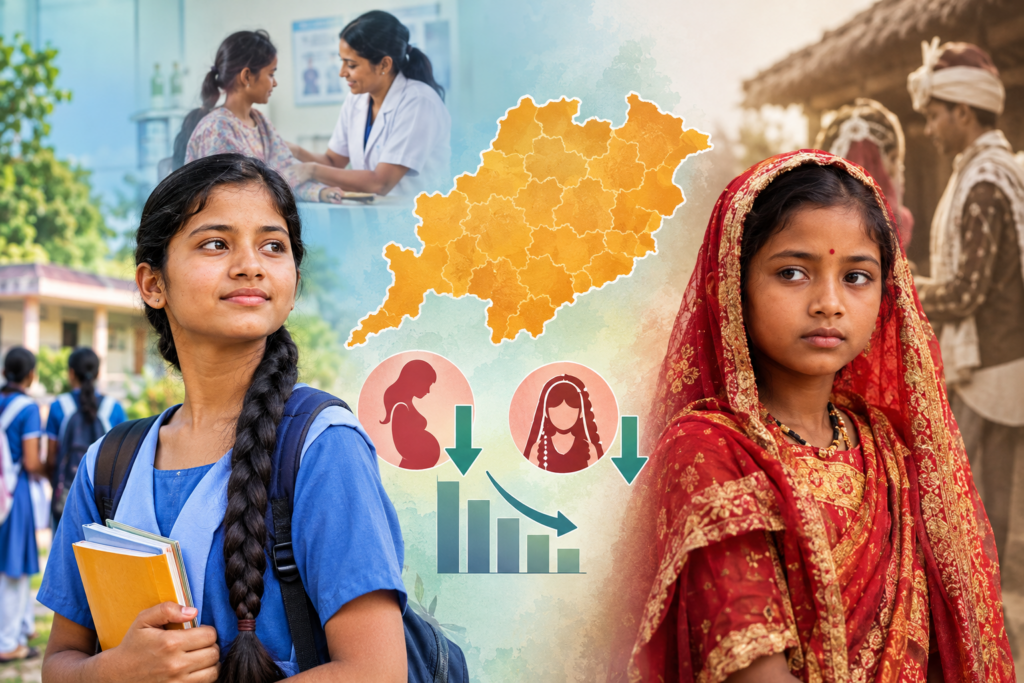
Odisha has recorded a decline in both teenage pregnancy/motherhood and child marriage, according to NFHS-6 data, but wide differences across districts continue to highlight areas requiring focused intervention.
Teenage pregnancy declines in 16 districts
The proportion of women aged 15–19 years who were already mothers or pregnant at the time of the survey declined from 7.5% in NFHS-5 to 6.5% in NFHS-6 in Odisha, marking a 1 percentage-point decline.
Of the state’s 30 districts, 16 recorded a decline, while 14 reported an increase.
Ganjam recorded the largest improvement, with the proportion falling from 11.4% to 2.7%, a decline of 8.7 percentage points. Kataka recorded the second-largest reduction, falling from 5.7% to 0.9% (-4.8 percentage points).
Other significant declines were reported in Boudh (-4.6), Nayagada (-4.0), Bhadrak (-3.8), Khordha (-3.4), Anugola (-2.6), Mayurbhanj (-2.4) and Jajpur (-2.2).
However, the trend moved in the opposite direction in 14 districts. Sambalpur recorded the largest increase, rising from 0.9% to 5.7%, an increase of 4.8 percentage points. Kalahandi (+3.7), Rayagada (+3.6), Kendujhar (+2.8), Malkangiri (+2.4), Jharsuguda (+2.3) and Dhenkanal (+2.2) also recorded notable escalation.
The NFHS-6 figures show considerable variation in the current levels across districts. Kendujhar has the highest proportion at 15.0%, followed by Mayurbhanj at 14.8%, Malkangiri at 14.1%, Rayagada at 12.8% and Dhenkanal at 11.5%.
At the lower end, Kataka recorded the lowest figure at 0.9%, followed by Baragada and Kendrapada at 1.7% each, and Balangir and Khordha at 1.9% each.
The combination of relatively high levels and an upward trend makes districts such as Kendujhar, Malkangiri and Rayagada particularly important from a policy and programme perspective.
Child marriage declines, but 12 districts remain above state average
Separate NFHS-6 data on child marriage among women aged 20–24 years show that 18.6% of women in Odisha were married before the age of 18, down from 20.5% in NFHS-5. This represents a decline of 1.9 percentage points.
Despite the overall improvement, 12 of Odisha’s 30 districts recorded levels above the state average of 18.6%.
Malkangiri reported the highest proportion at 33.1%, followed by Anugola at 30.2%, Nabarangpur at 27.1%, Mayurbhanj at 26.9% and Nayagada at 25.0%.
Rayagada also recorded a high proportion at 24.8%, while Dhenkanal stood at 24.0% and Baleshwar at 23.0%.
At the other end, Jharsuguda recorded the lowest proportion at 9.7%, followed by Jajpur at 11.0%, Kendrapada at 11.6%, Subarnapur at 12.3% and Jagatsinghapur at 12.5%.
Koraput recorded the largest decline in child marriage, with the indicator falling from 35.5% in NFHS-5 to 20.9% in NFHS-6—a reduction of 14.6 percentage points. Nabarangpur (-12.3), Nayagada (-10.7), Boudh (-10.3), Gajapati (-9.4) and Ganjam (-4.3) also recorded substantial declines.
However, several districts saw an increase. Baragada recorded the largest rise at 6.3 percentage points, followed by Rayagada (+5.7), Anugul (+5.2), Sambalpur (+3.0) and Bhadrak (+2.7).
The NFHS-6 findings indicate that while Odisha has made progress at the state level, the pace and direction of change remains uneven. The data point to the need for district-specific strategies that address adolescent pregnancy, early marriage, education, access to reproductive health services and broader social and economic factors influencing the lives of adolescents and young women.