




















Aparna Sen’s cinema blends humanism, feminism, and politics, creating stories that resonate with women’s struggles and India’s changing society
Satya Narayan Misra
Daughter of the famous film critic ChidanandDasgupta who founded the Calcutta film society in 1947 along with SatyajitRay , with film stints with the likes of Ray, Ghatak& Sen , the seeds of a film maker was planted in Aparna early in life ; to make 36, Chowrangi Lane in 1981 , possibly her best directorial debut like Satyajit in PatherPanchali. She is always wary of being labelled a feminist, but prefers to be called a ‘humanist’. Yet t there is no mistaking of the fact her cinema largely deals with the world of women. Though her films are often spoken in the same breath as RituparnoGhosh , whose films are often women centric , they deal with larger issues like rape, sexuality . family and so on. However, they do not deal with the women’s issues in the intimate , sympathetic and empathetic manner in which Aparna’s films do .
Portrayal of Woman
36, ChowrangiLane epitomises, the way portrayal of women has been interiorised. The obsessive way in which the camera follows Miss Stoneham right from the beginning is a good example of this. The film portrays the plight of a lonely Anglo Indian women in a society that cares very little for questions for female subjectivity and self-fulfilment. Even as earlyas Parama,made in 1985 , one can see the way camera ever so obsessively follows the eponymous Parama around , a woman’s shackled life under patriarchy and her bid to break free. In Yugant (1995) , the primary concern is the breakdown of a marital relationship against the backdrop of environmental concerns. What is unusual is that her women characters usually find a way out of their dilemma by accepting their lot like Stoneham or by taking a bold stand like Anasuya and Paromita , who prefer to walk out of their respective marriages , rather than compromise .
Aparna’s World of Films
Some of the issues that feature prominently in Sen’s films are politics, female camaraderie, fundamentalism, marginalization and unequal relationships.Ritwick , Mrinal and Satyajit have often been referred to as forbearers of socially conscious and politically heightened cinema. However, film makers like GautamGhose, Rituparno and Aparna churned out films that mirrored a society battling deprivation, glaring gender gaps and human complexities. Several of Apaarna’s films such as Arshinagar , Mr & Mrs Iyer and GhawreBaireAaj are a direct take on politics . While Ray’s oeuvre was subtle and oblique, Aparna’s approach is far more direct. In fact, in her last film GhawreBaireAaj she takes to the screen to delineate what she calls ‘changing idea of India’ . Without naming the party., she hits and hits very hard. Quite clearly Sunil Khilnani’s eponymous book ‘The Idea of India’ strikes a deep chord in her.
Subtle Handling
Sen’s films are visually magnificent, but in a subtle way. Take, for instance, a film like Mr & Mrs Iyer (2002) with panoramic shots as exposition-visually beautiful shots accompanied by a haunting tune that stays with you as the bus makes its way down to the valley. And amidst the chaos, MeenakshiIyer will suddenly discover her humanity and of love with Raja, a photographer. Mr & Mrs Iyer was released in 2002, in the aftermath of the carnage in Godhra in Gujarat.The film remains a classic , in terms of its restrained and compassionate account of ordinary individuals caught in the crosshairs of a communal riot.. However, it was marketed as a love story set amidst communal riots.Violent episodes in the history of modern India has found many depiction on celluloid –Firaaq (2008) by Nandita Das and Parzania (2007) by Rahul Dholakia.Sen’s Mr & Mrs Iyer is rather understated and can even be called lyrical .
Women as Film Makers
Since the post-waryears , art cinema has become notorious for pushing the boundariesin exploring more sophisticated avenues of women’ sensual existence. The universe of art cinema, however, has been a male –centric one. But with the advent of women directors there are signs of a significant shift. Simone de Beavour very acutely remarked that ‘the representation of the world is the work of the men. One is not born , but rather becomes a woman’ .Women directors exploit art cinema’ss iconoclastic potential to directly address issues of gender identity . One of the foremost names among women art film makers is thartofagnesVarda, a prolific director who infused her work with artistic fluidity and freedom of expression. Both Varda and Sen’s films tackle feminist issues, yet they manage to successfully tread the thin line between entertainment and political commitment.
Gender & Politics
While Aparna’s thrust was on gender in earlier film like 35, ChowrangiLane ,ParamA&ParamitarEk Din , in her later films such as GhaireBaireAaj&Arshinagar , the focus seems to have shifted to politics. Sen has always been vocal about socio political issues in Nandigram&Singur and calls herself a ‘radical humanist ‘. Very few Indian film makers have expressed their political standpoints in the way Aparna has. While in her earlier films women’s issues occupied the centrestage , one can see the great change that has come over her work –not only in terms of her film making –which is direct , more stark , more violent , and definitely more hard hitting . When one sees GhareBaire , a film directed by Ray in 1984 , based on a novel written by Tagore, exploring the complex relationship between a liberal minded zamindari and a charismatic national leader and Aparna ‘s retold the same novel in GhareBaireAaj (2019) she does not hesitate to show contemporary themes like right wing politics , ultra-nationalism and mob lynching. By updating the settings and the characters, the film provides a thought provoking commentary on contemporary’s India’s land scape.
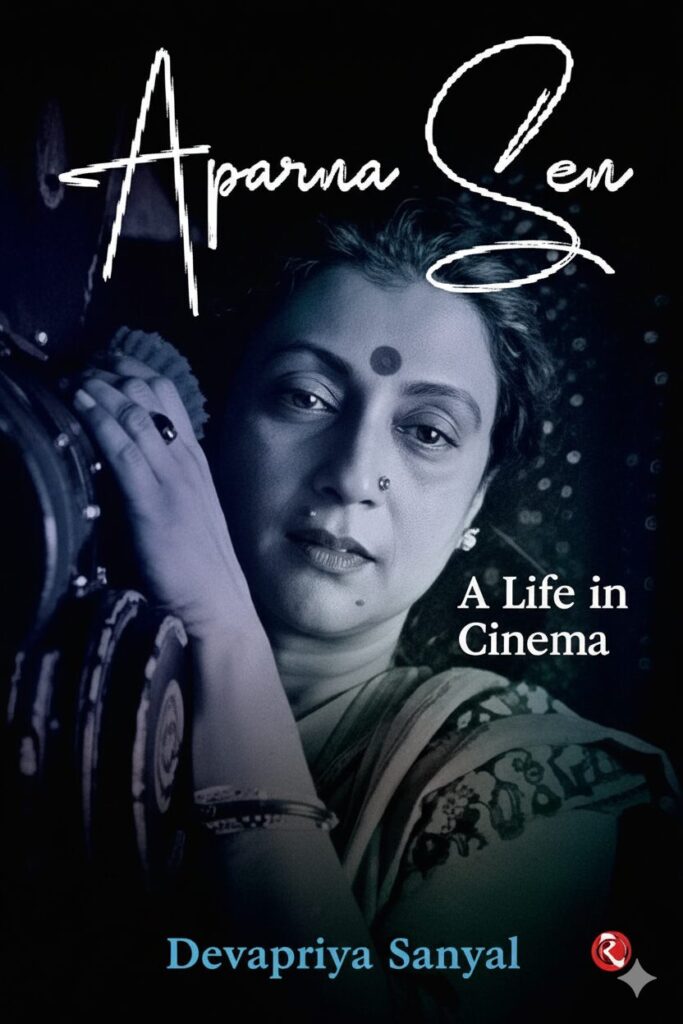
DevapriyaSanyal’s luminous biography “ Aparna Sen- A life in Cinema ‘ is a must read for cinephiles, feminists and any one intrigued by the power of storytelling. The detailed review of her iconic films like 36, Chowrangi Lane, Mr & Mrs Iyer ,Parama, ParomitarEk Din , 15, Park avenue and GhareBaireAaj are particularly fascinating reads. Though brought up under the celluloid subtlety of Ray and her father Chidananda ,Aparna seemed to have freed herself from these aesthetic nicetites to acquire a more direct, outspoken timbre of Mrinal Sen , the celluloid rebel, in her later films. There is also a strong resemblance of her political articulation with Meryl Streep,the renowned Hollywood actress, who criticized Trump for mocking a disabled reporter , stating “ Disrespect invites disrespect . And when the powerful use their position to bully others, we all lose”. Devapriya writes: “Her films are tied together by common themes and threads, but they stand on their own as works of art that attempt to make the world a little saner, a little brighter and a little better.”
(The writer, Satya Narayan Misra, Professor Emeritus at KIIT University, Bhubaneswar, is a cinephile who was closely associated with the NSD in the 1970s and had the opportunity to meet Satyajit Ray briefly at Nandan, Kolkata, in 1986. Views expressed are personal.)