



















India’s freebies debate raises critical questions about welfare, electoral promises and fiscal responsibility, highlighting the need to balance immediate relief with sustainable economic growth and long-term development
Suresh Chandra Sarangi
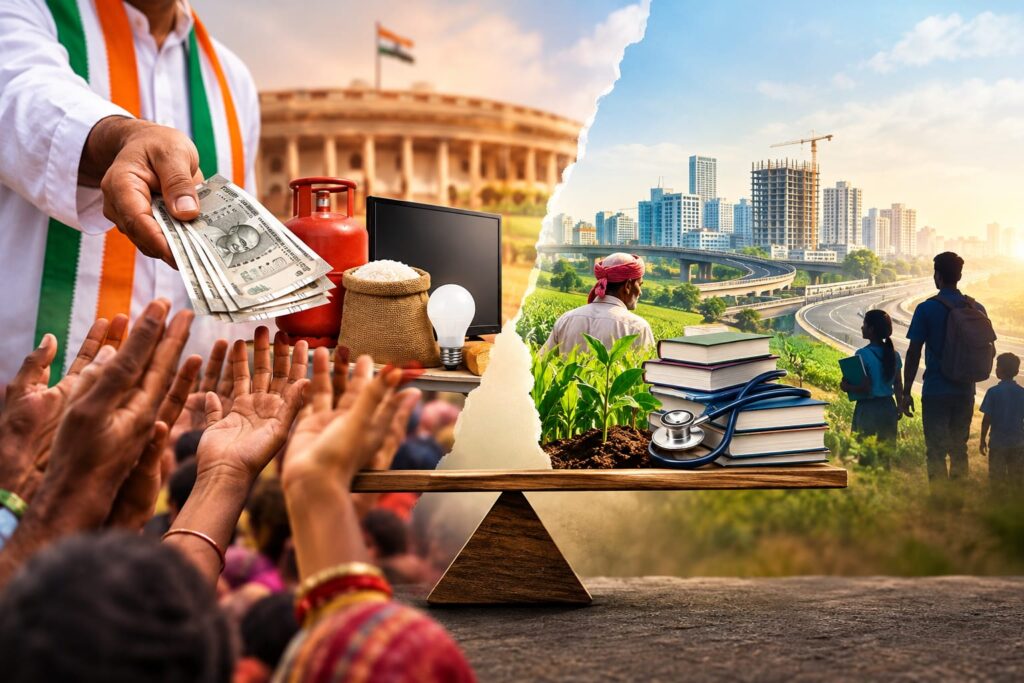
Most politicians today feel that freebies are equivalent to welfare. But some argue that following a policy of freebies leads to economic disaster. Economic development, no doubt, has to be linked with welfare. This is a high-octane debate in India that never dies down. Actually, the idea of welfare and the aim of establishing a welfare state are enshrined in Part IV of the Indian Constitution, the Directive Principles of State Policy (DPSPs), under Articles 38 to 51.
It is another matter that they are not justiciable like the Fundamental Rights, but it was the founding fathers’ intention that the State should endeavour to ensure that a welfare democracy flourishes in India by adopting certain policy measures. It was the vision of the founding fathers to establish socio-economic democracy. Some of the ideas contained in the DPSPs are social, economic and political justice, the minimisation of inequalities, securing adequate means of livelihood for each citizen, preventing the concentration of wealth, and ensuring equal pay for equal work. They direct the State to ensure that everyone is provided with an opportunity and the right to work, a living wage, decent working conditions, and an improved level of nutrition.
But even after 75 years of independence, all these lofty ideals remain to be achieved. However, the underlying spirit of the DPSPs has been partially realised. Election financing, freebies and welfare schemes have dented democratic credentials, and a storm is brewing over freebies that keeps many of us engaged in debates and discourse. The moot question is: when States provide food, healthcare, education, pensions or employment support, are freebies going to bring equity, development and welfare? The DPSPs have been instrumental in strengthening public distribution, maternity benefits, pensions, public healthcare and the MGNREGA, among other initiatives.
In spite of that, States provide doles in cash or kind, creating dependency, killing initiative, and failing to address the deeper questions of inequality in their entirety. Creating opportunities is an excellent social policy, but providing doles strikes at the root of development.
Let us calculate the economics of freebies, their ideological background, benefits and burdens, and consider the way forward. In an era marked by rapid social transformation, the idea of providing goods, services or financial doles at no cost to recipients, without even requiring them to contribute their labour, does not appear conducive to strengthening democracy or promoting welfare. Neither is it a tool for social development, nor is the freebie architecture a sound principle of governance.
Freebies become a double-edged sword, myopic in their conceptualisation and sometimes acerbic in their impact, although in India they are driven by different contexts. Is this short-termism, without either infrastructure creation or genuine welfare? India, a versatile nation and vibrant democracy, is today at the crossroads of development, and it is crucial that we reorient our social policies, as they have long-term implications for improving our Human Development Index.
While navigating India’s development in relation to its economic growth, freebies will never receive critical acclaim when resources are limited and the deficit is ballooning. In bustling villages, receiving ration is a welfare measure. Similarly, providing a minimum support price to farmers as a hedge against crop failure, while supporting them in making farming remunerative, is perceived as being entirely in tune with the objectives of the DPSPs. In a sense, these measures are comparable to those in Scandinavian countries or, for that matter, the United States, where tax breaks and subsidies are provided, or school and college fees are reduced to help students pursue their dreams and thereby create human capital.
Freebies, in the form of subsidies, cash transfers, educational incentives or fertiliser subsidies, have been the cornerstone of our public policies since independence for two reasons: first, they provide support to an individual farmer or student; and second, they support further development and accelerate economic growth. However, providing cash just before elections and announcing projects, freebies and subsidies for electoral gains are antithetical to democratic tenets and an assault on free will. Providing cash cannot be construed as a step towards eradicating socio-economic disparities and stimulating economic growth.
Both in their scope and direction, such measures represent a flawed social policy and fall far short of our vision of a prudent economic infrastructure. In a world beset with problems, including supply chain disruptions, skyrocketing energy prices and climate change-induced natural calamities, when farmers experience the excruciating pain of poverty, freebies may sometimes be necessary to restore faith and hope. They can provide support in times of need, keeping recipients’ morale high so they can work and pursue their dreams. In this context, a question arises: should we provide a fish to eat, or give someone a net to catch fish, eat and sell the surplus in the market? The first approach is ad hoc and transitory, without creating infrastructure, institutions or capital. The second involves long-term planning and economic goals, is perceived as a means to an end, and encourages an entrepreneurial attitude. Its cumulative effect is capital formation and the creation of a solid social infrastructure.
Politicians who advocate freebies without reason or rhyme often have little understanding of their economics or their impact on budget deficits, inflation, borrowing costs and development or economic growth. It is a complex matter, and anyone who believes that providing such assistance is simply an act of generosity is mistaken and has a myopic view of the developmental economy.
The focus is now sharpening on India, where the provision of freebies has become a prominent feature of public policy, governance and electoral politics. From agricultural subsidies and interest subvention to educational loans on easier terms and under a more relaxed interest regime, these are indeed efforts to help people rise above the poverty line. However, the administration of subsidies and the distribution of freebies are too complex to understand at times, with successes and failures, promises and perils, ingrained in the social policy mechanism.
The landscape has turned bizarre, with accusations and counter-accusations between the treasury benches and opposition parties. Even the distribution of cash to beneficiaries and recipients has now been supplemented by direct transfers, which have some semblance of ensuring that money reaches the intended person. Some even go to the extent of saying that freebies enhance the purchasing power of beneficiaries, create market demand, drive economic growth through consumption, and uplift marginalised communities. However, over-reliance on freebies has recently placed a strain on public finances. Direct cash transfers and subsidies help boost consumption, stimulate investment, and build better educational systems and public healthcare. Instead of doling out cash, India can provide better affordable housing, strengthen rural infrastructure and enhance social security, including pensions.
The Supreme Court has criticised the widespread culture of election freebies, distinguishing between genuine public welfare investment and measures intended for private consumption. The Supreme Court has said that genuine welfare measures, such as free medical care and education for the poor under the DPSPs, are a constitutional obligation.
However, the Supreme Court has drawn a hard line against indiscriminate freebies, such as free electricity, cycles, food distribution and cash transfers provided to everyone, irrespective of financial status, describing such practices as an unhealthy development in a democracy. The Court has also said that freebies have strained the finances of many States and that public money needs to be directed towards building infrastructure. The apex court has sought a legal framework from the Union Government and the Chief Election Commissioner for the disclosure of fiscal impacts. This is a cautionary signal, and by reorienting the culture of freebies, governments may recalibrate their policies and reengineer their developmental priorities.
(The writer is a former General Manager of Bank of India. Views expressed are personal.)