
















Odisha BJP faces a golden opportunity to build lasting political support. Explore Dharmendra Pradhan’s role and the party’s vision for Odisha 2036
Dr Vikram Kesari Jena
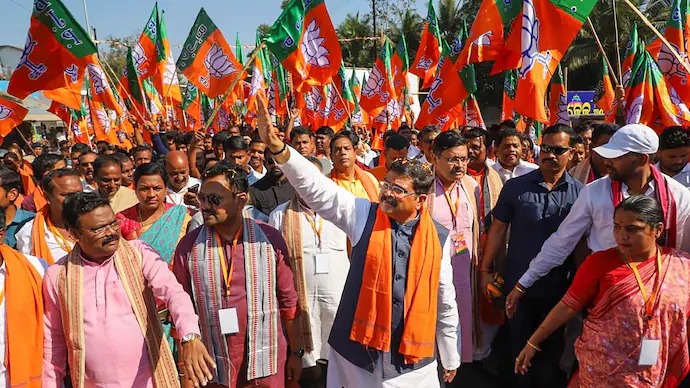
Politics has a strange habit of turning yesterday’s struggle into today’s complacency. The Bharatiya Janata Party (BJP) in Odisha stands today at a historic moment that its leaders should examine with both confidence and caution. After decades of political marginalisation, the BJP has finally crossed the psychological and electoral barrier that separated it from power in Odisha. But winning an election is one thing, and building a durable political organisation is another. The real test begins after victory. If the BJP wants its vision of Odisha in 2036 to become a lasting political project rather than merely an electoral slogan, it must ask a difficult question: Does it fully understand the political opportunity before it?
At the centre of that question stands Dharmendra Pradhan, one of the most recognisable and consequential faces of the BJP in Odisha. For years, Pradhan represented the BJP’s effort to build an organisation in a state where the Biju Janata Dal (BJD) had established an extraordinarily powerful political structure. The BJP’s journey from a relatively marginal force to the principal challenger and eventually the governing party did not happen overnight. It required organisational expansion, cadre building, political communication, sustained mobilisation and a long-term presence beyond election seasons. Pradhan has been an important part of that journey and, for a substantial period, one of the party’s most visible national leaders associated with Odisha.
The numbers themselves tell an important story. In the 2014 Odisha Assembly election, the BJP won 10 seats. In 2019, it increased its tally to 23. In the 2024 Assembly election, the party won 78 seats and formed the government. The parliamentary transformation was equally dramatic. In 2014, the BJP won only one Lok Sabha seat in Odisha; by 2019, it had increased that number to eight, and in 2024, it won 20 of the state’s 21 Lok Sabha constituencies. These results cannot simply be attributed to one individual. Elections are collective political enterprises involving national leadership, state leadership, candidates, workers, social coalitions and changing public expectations. Yet these figures also explain why the political contribution and organisational experience of leaders such as Pradhan deserve serious consideration rather than casual dismissal.
The danger for the BJP now is not necessarily the strength of the opposition alone. The greater danger is misunderstanding the nature of its own mandate. The BJD may no longer possess the electoral dominance it enjoyed for many years, but that does not mean its political and social presence has disappeared. The 2024 Assembly result left the BJD with 51 seats, a substantial legislative presence despite losing power. A political organisation with decades of experience, a large network and an established social base cannot simply be declared irrelevant because it has suffered one major electoral defeat. The BJP would be making a serious strategic mistake if it interpreted the BJD’s setback as permanent political weakness.
The opposition does not need to return to power immediately to become relevant again. It only needs to rebuild its connection with voters, understand the reasons for its defeat and find an alternative political language. This is precisely why the BJP cannot afford complacency. Odisha is not a state where political loyalty can be assumed forever. Its electorate has repeatedly demonstrated that it can sustain remarkable political continuity but can also bring about dramatic political change when public expectations shift. The 2024 verdict should therefore be read not simply as a reward for the BJP but as a responsibility placed upon it.
This is where the question of Pradhan becomes larger than the question of an individual leader. The Odisha BJP needs faces who understand both Delhi and Odisha, both national politics and regional political psychology, and both government and organisation. Pradhan’s long experience in national politics, his familiarity with Odisha’s political landscape and his association with the BJP’s organisational expansion make him an important political resource for the party. To reduce such a resource to factional calculations would be short-sighted. A mature political organisation should utilise every experienced leader capable of strengthening its institutional depth and public credibility.
The BJP’s proposed political journey towards 2036 also requires a broader imagination. The centenary of Odisha’s formation as a separate linguistic state will not merely be another anniversary. It will inevitably invite questions about language, identity, development, migration, employment, tribal rights, industrialisation, cultural confidence and the relationship between Odisha and the Indian Union. A party that wants to shape Odisha’s politics for the next decade must therefore offer more than electoral management. It needs a serious Odisha narrative. It needs to explain what kind of Odisha it wants to build by 2036 and how that vision will improve the everyday lives of ordinary people.
This is also why internal consultation matters. The BJP’s central leadership must listen carefully to its Odisha cadre, elected representatives and experienced leaders. A political party becomes weak when its grassroots workers begin to believe that decisions are being made without an understanding of local political realities. The strength of a national party in a federal democracy depends on its ability to combine national purpose with regional understanding. Odisha cannot be governed politically from Delhi alone. Its political language must emerge from the state’s villages, towns, tribal regions, coastal districts, industrial belts, youth communities and rapidly changing urban society.
Dharmendra Pradhan, therefore, should not merely be viewed through the narrow prism of office or factional politics. The more important question is whether the BJP is prepared to recognise and utilise the political capital accumulated by leaders who have spent years building the organisation before it came to power. The party’s current position was not created in a single election. It is the product of a long political process. Preserving that achievement will require continuity, institutional memory and an ability to learn from the past without becoming imprisoned by it.
The BJP has been given a golden opportunity in Odisha. But history teaches that golden opportunities are rarely permanent. Voters may give a party five years, but they do not give it ownership of the future. The BJP must therefore think beyond the immediate arithmetic of government formation and begin constructing a durable political relationship with Odisha. It must respect the opposition, strengthen its cadre, listen to its experienced leaders, develop a credible vision for 2036 and remain connected to the aspirations of a changing generation. If it mistakes victory for permanence, the same electorate that opened the door can eventually close it.
The question before the BJP is ultimately not whether Dharmendra Pradhan is important to the Odisha BJP. The deeper question is whether the party understands the importance of retaining experienced political capital while building a new generation of leadership. Pradhan’s journey mirrors an important part of the BJP’s journey in Odisha, from 10 Assembly seats in 2014 to 23 in 2019 and finally 78 in 2024. The next chapter will determine whether that journey becomes a durable political transformation or merely another chapter in Odisha’s long history of political change. The BJP has the opportunity. The responsibility now is to understand it before the opportunity begins to disappear.
(The author is the Director of the Center for Adivasi Research and Development (CARD). Views expressed are personal.)