




















Tamilaga Vettri Kazhagam led by Vijay reshapes Tamil Nadu Election 2026, emerging as the largest party and signalling a major political shift
OdishaPlus Bureau
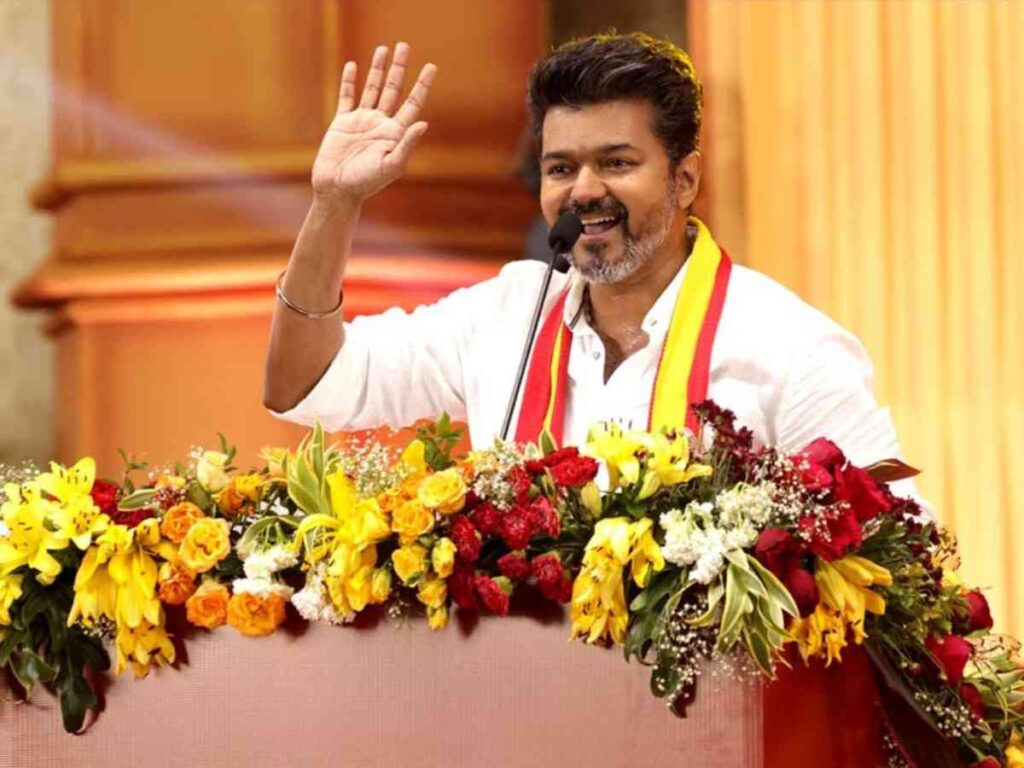
The 2026 Tamil Nadu assembly election did not proceed as a typical contest—it resembled a real-time political realignment. For many years, the state’s electoral narrative had been defined by a well-known rivalry between the Dravidian giants, but this occasion saw the emergence of a new narrative, spearheaded by Vijay and his party, the Tamilaga Vettri Kazhagam.
What began as doubt about a film star’s political aspirations gradually evolved into a well-organized campaign that combined celebrity allure with substantial organizational strength. Vijay did not solely depend on his on-screen charm; over recent years, he had quietly established a network that functioned like a political apparatus—fan clubs transforming into booth-level units, welfare initiatives serving as political communication, and a consistent effort to present himself not merely as a star, but as a viable alternative.
As voting trends began to surface, it became evident that TVK was not merely participating—it was competing, and then, unexpectedly, it was leading. Constituency after constituency revealed a remarkable pattern: the party was transcending traditional allegiances, encroaching upon both the solid vote bases of Dravida Munnetra Kazhagam and the remaining influence of All India Anna Dravida Munnetra Kazhagam. The increase was not uniform, yet it was extensive enough to disrupt the electoral calculus that had governed Tamil Nadu politics for decades.
By the time the results were finalized, the magnitude of the shift was unmistakable. TVK had emerged as the largest party—an outcome that, just months prior, would have appeared unlikely. However, the victory was not complete. The majority threshold remained just beyond reach, resulting in a hung assembly and a new form of uncertainty. Power was within reach, but not firmly established.
In the interval between mandate and majority lies the subsequent chapter of the narrative. Negotiations, alignments, and political recalibration have now taken center stage. Parties that were previously adversaries are now potential allies; ideological boundaries seem more adaptable when faced with a divided verdict.
For Vijay, the task is no longer to establish electoral viability—that has been accomplished—but to exhibit political skill in assembling a governing coalition.
Beyond mere numbers, the profound significance of the TVK surge is structural. It indicates a transformation in how political capital is constructed and utilized in a state historically characterized by legacy parties and ideological consistency. The election implies that a meticulously nurtured persona, when supported by organization and timing, can disrupt even the most stable political environments.
Whether this moment evolves into a lasting change or a dramatic yet fleeting upheaval will hinge on subsequent developments—how alliances are formed, how governance is executed, and whether this new entity can maintain its momentum beyond the excitement of a breakthrough.
For the time being, the message from Tamil Nadu is unmistakable: The old certainties are no longer valid, and a new political chapter has commenced.