
















Ganapati Bappa’s stories, rituals and symbolism bring together devotion, wisdom and tradition, revealing the rich cultural meanings behind one of India’s most beloved festivals
Dr Aditi Panda
India is waiting with bated breath and hearts filled with devotion to welcome Lord Ganesha, who is on his way to our homes. Bappa is the Vighnaharta and harbinger of wisdom. His blessings are sought before any venture or something new or auspicious can begin. Ganesh Chaturthi is typically a 10-day celebration, but this year, it is a 12-day celebration with lots of festivities, a positive vibe, hot and steaming modaks in our kitchens, and heartfelt prayers.
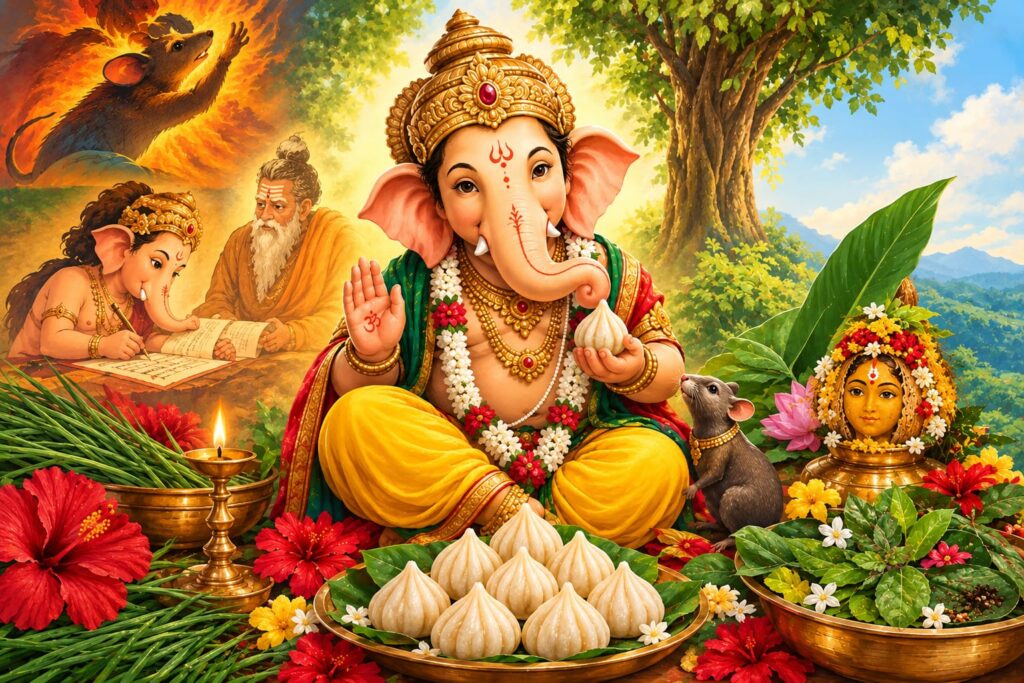
Gowri Puja is usually celebrated the day before, but this year, we happen to celebrate Ganesh Chaturthi and Gowri Puja on the same day, making the celebration even more auspicious because both mother and son will be stepping into our houses together. Gowri Puja is a sacred Hindu ritual celebrated in regions like Karnataka, Maharashtra, Goa, and Kerala, especially by the Gowda Saraswat Brahmin community, to honour Goddess Gowri. The divine face of the Goddess is represented by de-husked coconuts soaked in turmeric water for three to four days, which are then cleaned, scrubbed, and beautified with kajal representing two eyes, sindoor for the mouth, and sandalwood paste for the forehead.
Speaking about Bappa, how can we keep away from mentioning ‘Mushak’, the vahana he travels on? According to our ancient stories, the mouse was once a Gandharva named Krauncha who was cursed for creating a big chaos as a destructive rat by disturbing the hermitage of the sage Parashara. When young Ganesha triumphed over him, the mouse, humbled and pleading for forgiveness, became known as Ganesha’s vahana, transforming a destructive force into docile servitude, another characteristic of the Lord.
Students seek his blessings before taking any exams because Bappa is revered for his knowledge. This story about Bappa will encourage them to imitate him with the same zeal with which they follow social media. When sage Vyasa narrated the Mahabharata, Ganesha agreed to compile it if Vyasa would not stop. Ganesha told the wise Vyasa that he would make sure he understood each verse before writing, and he did it. However, when Ganesha’s pen broke midway, he broke off his own tusk to continue writing, showing his dedication to knowledge and dharma. This is how he earned the title of Ekadanta (one-tusked).
Stories about the gods we worship, including Lord Ganesha, are ubiquitous in our culture’s rich mythology and are passed down from generation to generation as we grow. However, we perform the pooja without fully understanding the deep meaning of each ritual because of stress and hectic schedules, which result in many stories about our cherished gods remaining in the back of our minds.
How many of us, for some reason, wonder why the sacred Durva grass and hibiscus flowers, also known as mandar flowers, are two of the most commonly offered offerings used to worship Bappa? Durva is dedicated to Lord Ganesha because it is closely associated with the mythological tale of the fire-demon Analasura and represents humility, cooling energy, and devotion. Tradition asserts that after Ganpati Bappa swallowed the flaming Asura, he was offered 21 durva blades, which cooled him. The number 21 represents a combination of the five organs of action, five organs of perception, five pranas, five elements, and one consciousness. Every Durva grass blade is offered under a unique Ganesha name.
Offering Durva, a symbol of tenacity and unshakable faith, to Lord Ganesha in sets of three blades has great symbolic significance. Durva sprouts again even after being beaten or cut. The sacrifice is more potent and comprehensive since each set of three blades symbolizes a triad of spiritual concepts. The three blades stand for the three characteristics that regulate human nature: tamas (inertia), rajas (activity), and sattva (purity). The trinity of creation, preservation, and destruction—Brahma, Vishnu, and Shiva—is likewise associated with the tri-blade form. In addition, the blades stand for the past, present, and future, recognizing Ganesha as the ruler of time and the conqueror of all barriers.
Another well-known custom, particularly in Andhra Pradesh and Telangana, is the offering of 21 sacred leaves during Vinayaka Chavithi, a unique ritual in which each leaf represents a name or attribute of Lord Ganesha. As his names are chanted, these leaves are offered one by one, having been gathered with devotion. In addition to Durva grass, which is most essential, lotus leaves are offered, representing purity and spiritual awakening, while tulsi leaves are offered as symbols of devotion and sanctity. Sesame leaves represent longevity and vitality, while neem leaves stand for protection and cleansing. Bilva, mango, Jammi, peepal, banana, lotus, jasmine, coriander, curry, banyan, Ashoka, tamarind, guava, coconut, pomegranate, sandalwood, and arka are among the other leaves offered.
As the whole world knows, ‘modak’ is Ganapati Bappa’s everlasting preferred prasad or naivedyam, and it has a delightful divine tale. Once, Goddess Parvati made a single, unique modak that contained the essence of extreme wisdom. Ganesha and Kartikeya, her sons, were informed that it would be given to the most intelligent among them. Believing that understanding all its regions and secrets was the key to intellectual awakening, Kartikeya set off on a global journey. Rather, Ganesha said that his parents, Shiva and Parvati, were his entire world as he circled them. This act of devotion and wisdom established that real wisdom comes from recognizing one’s parents’ divine essence. The mouthwatering modak that Parvati presented to Ganesha after being deeply touched thus became his most loved food.
We all enjoy the delicious modak, but apart from the delectable combination of coconut, jaggery, and dry fruits flavoured with cardamom powder, it contains a lot of science. Offering 24 modaks to Lord Ganesha has scriptural and metaphorical origins because the number 24 stands for the 24 elements (tattvas), which include the mind, senses, and material principles. Offering 24 modaks is seen as full and auspicious, signifying completeness in ritual practice and the giving up of all facets of existence to Ganesha. Additionally, it is believed that when devotees donate this sacred offering, Ganesha, also known as Modakapriya (lover of modaks), is most delighted.
Another well-known tale about Bappa is that, inside the renowned Jagannath Temple complex in Puri, the Kalpabata Ganesha, also known as Bata Ganesha, is worshipped before any daily temple rituals start. It is located next to the wish-granting banyan tree. Seeing Lord Jagannath adorned in Gajanan apparel (Gajanan Besha) on Deva Snana Purnima is a delight.
Ganapati Bappa has small eyes that see the essence of things rather than their outward appearances, big ears that represent the capacity to listen widely and distinguish truth from noise, and focused attention that needs to be cultivated in a world full of distractions. Bappa’s big belly represents the capacity to calmly process everyday joys and sorrows. Another legend related to Ganapati Bappa’s big belly is that Ganesha swallowed the Trinity (Brahma, Vishnu, and Shiva) and wrapped a snake around his tummy to contain that huge power.
As Bappa enters our homes to bless us, let’s take a closer look at our beloved God and try to absorb the virtues from his divine presence that will keep us afloat in this hectic and stressful world.
Ganapati Bappa Morya!
(The author is a development sector professional. Views expressed are personal.)