













As Nuakhai travels from paddy fields to distant cities, it continues to preserve memories, relationships and cultural identity, even as its connection with agrarian life gradually changes
Lipsa Sahoo
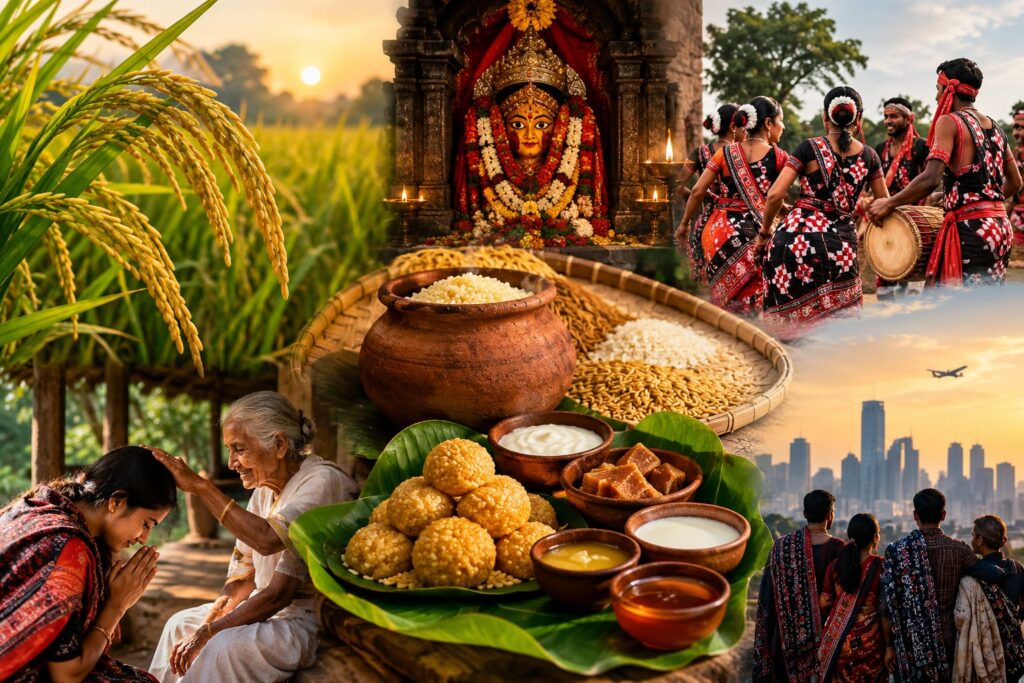
Rising from the soil, the paddy stands straight until the ears bend, heavy and ready to be gathered as the first harvest of the season. The paddy then finds its way home, where it is roasted in a maati handi (earthen pot) and separated from its husk. The rice is ground into powder, mixed with the five offerings of Panchamrit – gud (jaggery), dahi (curd), ghee (clarified butter), milk and honey – before it is shaped into laddus. But the harvest has not reached the plates yet. It must pass beneath the gaze of deities like Maa Samaleswari in Sambalpur or Pataneswari in Balangir, where the laddus become ‘prasad’. Only then does the first taste of the new harvest arrive on the leaf-plate, before the rest of the Nuakhai meal begins.
The journey of that first morsel is, however, far longer than one can imagine. The physically closer it is to our plates, the further removed we may be from its source. That distance sits at the heart of Nuakhai, a harvest festival deeply woven into the cultural life of Western Odisha. The relentless pull of city life is drifting us away from our agricultural roots. We have essentially inherited the ritual without inheriting the agricultural life that gave birth to it. What has changed is the way we have stopped seeing everything behind the celebration.
Some see Nuakhai as a way of preserving the relationship that modern life is slowly weakening. But is it? At its core, Nuakhai acts as a force to pause the urban hustle, compelling us to acknowledge the land that feeds us. Yet the connection it preserves is not only with the land. It is also with the people and memories that surround it.
This is where the Nuakhai rituals come in. Through the Nuakhai Juhar, younger family members seek the blessings of their elders, actively bridging generational gaps. Culturally, it is a time of forgiveness and a fresh start. Even partitioned brothers or estranged family members are expected to gather under one roof to partake in the Nabanna (new rice) together.
However, to say that the contemporary way of living isn’t changing the festival would be an illusion. Nuakhai is fundamentally a harvest festival rooted in an agrarian lifestyle. But as younger generations migrate to cities for education and jobs, the festival has transitioned from being about the land to being about cultural identity. For many, it is more of a heritage appreciation than a relationship with the soil.
In earlier times, different regions had their own dates and auspicious times for Nuakhai based on tithi and lagna. It was only in 1991 that the Odisha Government established a common observance of Nuakhai on Bhadrava Shukla Panchami, the day after Ganesh Puja, making it a state holiday. While this brought the region together, it also marked a shift towards a more standardised regional identity.
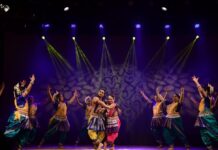
This standardisation paved the way for how the festival travels. The Nuakhai Bhetghat, which used to be a simple village gathering, has evolved into a powerful social glue. Today, Nuakhai Bhetghats are massive events held by the Western Odisha community residing in major cities including Delhi, Bangalore and Mumbai, and even internationally. It reinforces a shared identity, reminding people of their roots through Sambalpuri music, dance and traditional attire. The further the festival travels from the field, the more deliberately people try to recreate the things that connect them to it. A Bhetghat in these places cannot possibly recreate a paddy field, but it can recreate the memory, the ambience and the connection. Distance from the land doesn’t necessarily destroy cultural memory. Sometimes, it makes people more conscious of the need to preserve it.
Perhaps Nuakhai isn’t failing to preserve the connection. The very fact that people who no longer farm still gather to receive the nua as prasad means the connection has changed rather than disappeared. The festival may not keep families living in the same courtyard, but it ensures that once a year, no matter where they are in the world, they remember who they are and where they come from. It preserves the idea of community, preventing those bonds from snapping entirely.
(The writer is currently pursuing a Master’s in English Literature at Ramadevi University. Views expressed are personal.)