


























Explore the historical migration of the Odia diaspora, from ancient maritime routes across Kalinga to colonial movements in Southeast Asia
Bhaskar Parichha
Migration is as old as civilisation itself. People have always moved in search of food, security, trade, work, knowledge, and opportunity. Some journeys have been forced by war, famine, or political upheaval; others have been driven by curiosity, enterprise, or the desire for a better life.
The history of Odisha, too, is inseparable from movement. Long before the modern idea of a diaspora emerged, the people of ancient Kalinga were travelling across the seas, establishing commercial contacts and exchanging ideas with distant lands.
The Odia diaspora today is smaller in numerical terms than some of India’s larger overseas communities, but its story is distinctive. It is a story of sailors and traders, labourers and clerks, teachers and doctors, engineers and scientists, entrepreneurs and artists. It is also a story of families that carried their language, food, festivals, and memories across borders. The journey has been from temporary migration to permanent settlement, from anonymity to greater visibility, and from isolated individuals to organised global communities.
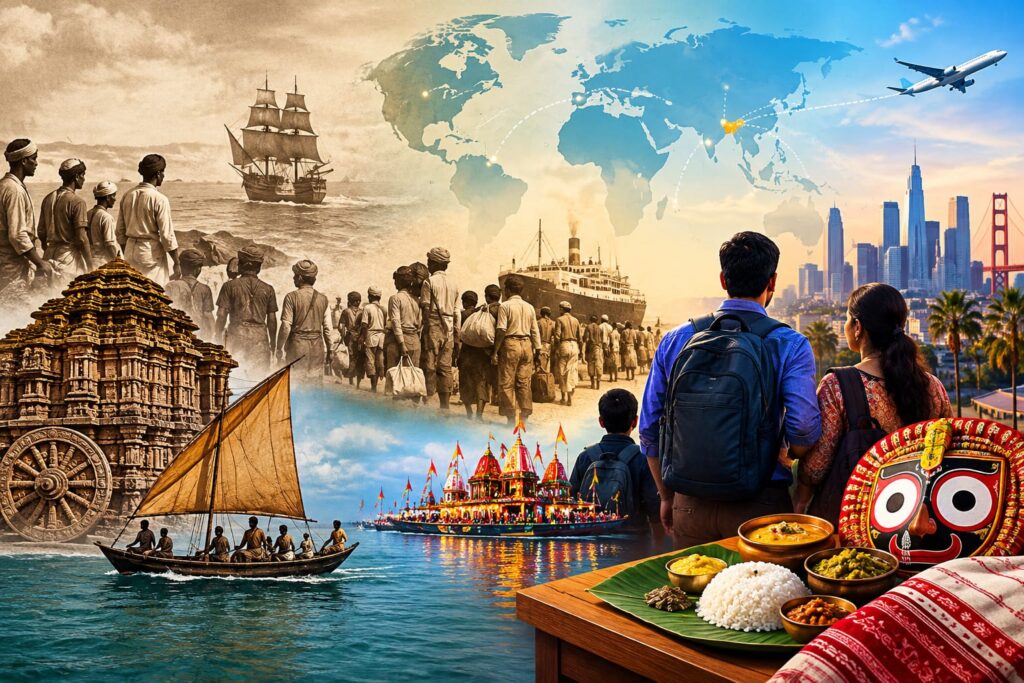
The geographical location of Odisha played an important part in this history. Its long coastline, navigable rivers, fertile plains, and proximity to the Bay of Bengal created conditions for contact with other regions of India and with Southeast Asia. Odisha’s maritime past is remembered most vividly through the annual celebration of Boita Bandana, when people float miniature boats on Kartika Purnima. The ritual is symbolic today, but it preserves the memory of an era when boats carried merchants and sailors from the ports of Kalinga towards distant shores.
The Maritime Beginnings
Ancient Kalinga was part of a wider maritime world. Archaeological evidence, literary references, and historical traditions point to commercial links between the eastern coast of India and Southeast Asia. Ports and coastal settlements associated with ancient Odisha participated in networks connecting the subcontinent with Sri Lanka and regions of present-day Myanmar, Thailand, Malaysia, and Indonesia.
The famous Kalingan voyages were primarily commercial rather than migrations in the modern sense. Merchants and sailors travelled for trade and often returned. Yet commerce inevitably carried culture with it. Along with goods travelled stories, religious practices, artistic forms, languages, and social customs. Maritime contact, therefore, created relationships that extended beyond the immediate exchange of commodities.
The traditional association of Kalinga with Bali is particularly strong in Odisha’s cultural memory. The Bali Jatra festival in Cuttack commemorates the maritime heritage of the state and has become one of the most visible reminders of Odisha’s seafaring past.
Whether every popular legend associated with these voyages can be historically verified is another matter. What is beyond doubt is that Odisha’s coastal communities participated in the maritime networks of the Bay of Bengal and that these contacts formed an important part of the region’s historical identity.
The significance of this early maritime tradition lies not simply in the fact that Odias travelled abroad. It lies in the confidence with which coastal communities looked beyond the horizon. The sea was not merely a physical boundary. It was a route to another world.
Migration Under Colonial Rule
The character of migration changed dramatically during British rule. The nineteenth century brought economic dislocation, recurring food shortages, and changes in traditional livelihoods. The devastating famine of 1866, remembered as the Na’Anka famine, had a profound impact on Odisha. Later periods of scarcity and economic distress also encouraged people to move in search of work.
Colonial migration, however, cannot be understood simply as a continuation of the earlier maritime tradition. The movement of labour under the British Empire operated within an entirely different economic and political system. Indentured labour took large numbers of Indians to plantations and other colonial enterprises in places such as Mauritius, Fiji, the Caribbean, and parts of Southeast Asia. People from Odisha were among those who participated in these movements, although their numbers were considerably smaller than those from some other parts of India.
Others moved to Burma, Ceylon, and different parts of the British Indian Empire for employment. Rangoon, in particular, became an important destination for Indians from eastern India. Odias found work in rice mills, transport, construction, government establishments, and small businesses. Some established families and community networks, while others remained part of a larger Indian migrant population.
Burma occupied a special place in the history of migration from eastern India. Rangoon was a major commercial centre, and the movement of people between Odisha, Bengal, and Burma became part of a wider Bay of Bengal network. During the Second World War, however, the Japanese invasion and the collapse of British authority transformed the lives of thousands of Indians. Many were forced to undertake difficult journeys back to India.
These early migrants often left little written record. Their lives rarely entered official histories. Yet they were important in shaping the social history of Odisha. Migration became a means of survival and advancement, and the experience of living away from home strengthened the importance of community.
Festivals, temples, family gatherings, and associations became ways of maintaining identity. Food became another form of memory. So did language. Even where the younger generation gradually adopted the language of the country of residence, older members often retained a strong emotional attachment to Odia.
(First of a three-part series on the Odia diaspora.)
(The author is a senior journalist and columnist. Views expressed are personal.)