























From AI-generated obscene images to online grooming, rising digital threats highlight the need for awareness, stronger safeguards and accountability without compromising women’s freedom and right to self-expression
Monalisa Dash Dwibedy
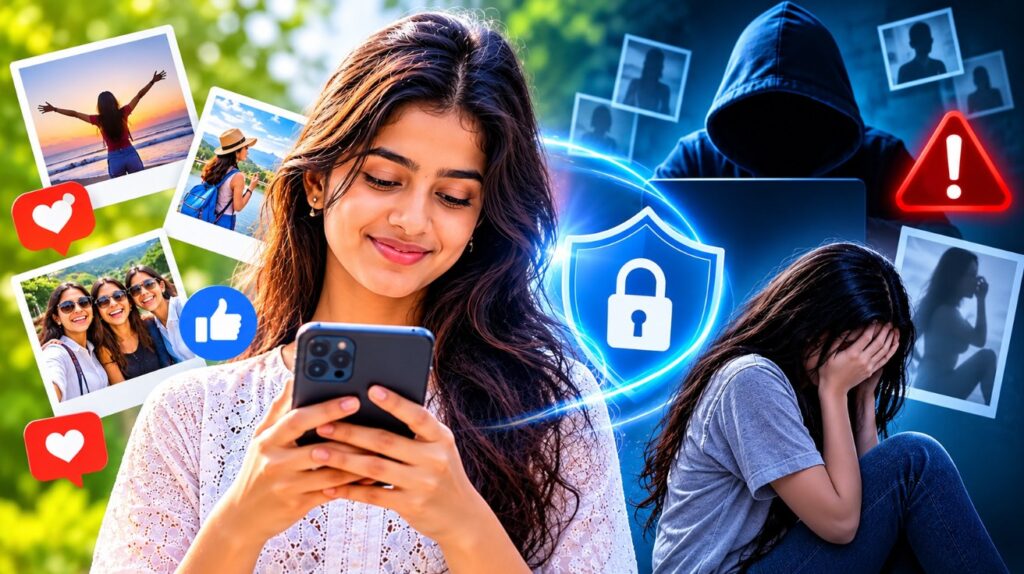
In today’s world, social media is no longer merely a medium of communication; it has gradually transformed into an open diary of our lives. Our happiness, celebrations, holidays, relationships, likes and dislikes—all find their way onto Facebook, Instagram and other social networking platforms. We take pleasure in sharing beautiful photographs, reels, travel videos and fleeting moments that touch our hearts. The appreciation that follows, in the form of likes, comments and shares, often adds to our happiness.
But have we ever paused to consider that the very moments we share with joy could one day become weapons in the hands of a criminal? A photograph that we post confidently or a video that we share in the hope of receiving thousands of likes and compliments can be misused by someone with malicious intentions. What begins as an innocent expression of happiness can turn into a source of humiliation, harassment and psychological trauma. This has become a particularly serious concern for women and young girls.
Several disturbing incidents reported by Indian newspapers in 2026 have exposed the alarming dimensions of this growing threat.
According to a report published in The New Indian Express in February 2026, a student of a private college in Coimbatore allegedly collected photographs of 24 female students from social media and WhatsApp. Using Artificial Intelligence (AI), he manipulated these photographs into obscene images and uploaded them to a fake Instagram account. Photographs that the young women had shared as part of their ordinary social lives were transformed into instruments of abuse.
An equally disturbing incident was reported by DT Next in July 2026. A 36-year-old man in Chennai allegedly downloaded photographs posted by women and minor girls through fake Instagram accounts. He then used AI applications to create obscene images and threatened to circulate them on social media unless the women engaged in sexually explicit conversations with him. The police subsequently arrested him.
Another such case emerged from Ahmedabad. According to The New Indian Express in May 2026, a 27-year-old man allegedly downloaded a woman’s social media photographs and used AI to create more than a hundred fabricated obscene photographs and videos. He reportedly created several fake accounts in her name to circulate the manipulated content. He even distorted and shared photographs of the woman’s mother.
Perhaps even more heartbreaking was an investigative report published by Deccan Chronicle in August 2026. A 12-year-old girl, aspiring to become an Instagram influencer, regularly posted reels and videos. An unidentified individual began praising her content and promised to help her gain more followers. Gradually, the interaction moved from public comments to private messages, phone calls and other forms of communication. By winning her trust, the individual allegedly lured the young girl into a situation that ultimately led to human trafficking.
These are not merely crime reports. They are warning signals for every family and every member of society.
The criminal of today’s world does not necessarily hide in a dark alley. He could be an unknown person liking our photographs, an unfamiliar individual leaving flattering comments on our posts or someone pretending to be a well-wisher while promising greater popularity and thousands of followers.
The digital world has changed the face of exploitation. Artificial Intelligence has made it easier to manipulate photographs, manufacture false identities and create convincing fabricated content. A person’s digital identity can be misused even without physical access to their photographs or personal information.
The question, therefore, is not whether we should use social media, but whether we understand the consequences of using it without awareness.
One particularly worrying trend is emerging among teenage girls.
When young girls see their friends posting beautiful photographs, fashionable reels, videos and glimpses of their everyday lives, they naturally develop a desire to do the same. When their friends receive more likes, comments and followers, a subtle fear begins to take hold.
What if I do not post photographs? What if I do not make reels? Will I fall behind my friends? Will people stop noticing me? Will I fail to keep up with the trends of this generation?
This invisible competition for digital attention can become surprisingly powerful. In their eagerness to remain relevant, some teenagers begin posting without thinking carefully about what they are sharing, who might be watching or how the content could be misused in the future. They may imitate what their friends are doing without stopping to consider whether it is appropriate or safe for them.
The fear of missing out gradually overshadows independent judgment. The desire to belong becomes stronger than the ability to question.
Remember one thing: just because your friend posts a photograph does not mean you must post one too. Hundreds of likes do not determine your worth. Compliments from strangers are not proof of your beauty, and thousands of followers are certainly no guarantee of your safety.
Your real identity lies in your character, personality, talents, intelligence and self-respect—not in the number of people looking at your photographs. You do not have to participate in every digital trend to prove that you belong to this generation. Your individuality is far more valuable than your popularity.
First, before posting a photograph or video, pause and ask yourself a simple question: If this content reaches people beyond my intended audience, could it create a problem for me?
It is important to remember that once something is uploaded online, we may lose control over where it travels and who saves it. Even content shared with a limited audience can be copied, captured through screenshots or circulated without permission.
Second, avoid sharing sensitive personal information such as your home address, daily travel routines, school or college details, live locations and information about travelling alone. Keep your social media accounts private where appropriate, be selective about accepting friend requests and think carefully before sharing personal photographs or videos, even through private messages.
Third, never compromise your safety in pursuit of likes, followers or online popularity. Compliments from strangers do not always come from innocent intentions. Be cautious if someone begins asking excessively personal questions, insists on meeting privately, requests intimate photographs or attempts to move conversations to private communication channels. Trust should be earned, not granted simply because someone appears friendly online.
Fourth, if anyone manipulates your photographs, threatens you, blackmails you or circulates obscene content using your identity, do not remain silent out of fear or embarrassment.
Never pay an extortionist or surrender to unreasonable demands. Preserve screenshots, messages, account details, links and other evidence. Inform a trusted family member and approach the police or appropriate cybercrime authorities immediately.
In India, cybercrime complaints can be registered through the National Cyber Crime Reporting Portal at www.cybercrime.gov.in. Cases involving the sexual exploitation of minors can also be reported under the Protection of Children from Sexual Offences (POCSO) Act.
Most importantly, remember that the shame belongs to the perpetrator, never the victim. While discussing digital safety, we must never overlook one fundamental principle: no woman’s photograph, clothing, lifestyle or social media activity gives anyone the right to exploit, harass or abuse her.
A woman has every right to wear what she likes, share photographs, express herself and showcase her talents. Her freedom deserves respect. Posting a photograph is not an invitation to harassment, and being active on social media is not consent to the misuse of one’s identity. Blaming a victim for an offender’s actions is an injustice that society must stop perpetuating.
Digital safety must never become another excuse to restrict women’s freedom. We should not create a society where women are expected to hide themselves because some individuals choose to misuse technology. Instead, we must create an environment where women can express themselves freely without living in constant fear.
The role of families in addressing this problem is equally significant. Imposing unnecessary restrictions on girls or confiscating their phones is not the solution. Such measures may only discourage them from sharing their problems with their parents. What they need is guidance, understanding and an atmosphere of trust.
Parents must have open conversations with their children about online behaviour, privacy, digital footprints, cyberbullying, online grooming and the dangers of interacting with strangers. Children should know that they can approach their parents without fear of punishment or judgment if something uncomfortable happens online.
Schools and colleges must also introduce meaningful digital safety education. Young people need to understand not only how to use technology but also how to recognise manipulation, protect their identities and respond to online threats.
The police and law enforcement agencies must strengthen awareness programmes and ensure that complaints involving women and children receive prompt and sensitive attention. The responsibility does not rest solely with users and their families. Social media companies must recognise that they have a significant role in protecting the people who use their platforms.
Companies operating digital platforms must develop stronger mechanisms to prevent the misuse of photographs and videos. Fake accounts, sexually abusive comments, unauthorised use of personal photographs, AI-generated obscene images and sexually exploitative content must be identified and removed promptly.
Accounts involved in such activities must face meaningful consequences. Reporting mechanisms should be simple, accessible and responsive, particularly when the victims are women and minors. Platforms must also strengthen safeguards for underage users by introducing appropriate restrictions on unsolicited contact from strangers, improving age-appropriate privacy settings and making emergency reporting and support mechanisms readily available. AI-generated manipulation presents an additional challenge. Technology companies must invest in effective detection systems and safeguards to prevent the creation and circulation of non-consensual intimate imagery.
A platform cannot celebrate its millions of users and its growing popularity while ignoring the harm that takes place within its digital boundaries. Digital platforms must understand that protecting users is not an optional service; it is an essential responsibility.
Always remember this: your photograph represents you, your freedom is your right, and your self-respect is your strength. But navigating the digital world with awareness is equally important for your safety.
Share your happiness, celebrate your achievements and let your talents reach the world. But understand the consequences of what you post and whom you trust.
You do not have to display every beautiful moment of your life to prove that you are happy. You do not have to reveal every chapter of your personal life to establish that you are modern.
Allow some pages of your life to remain yours alone. Being modern does not mean making everything public. True modernity lies in having the wisdom to decide what should be shared and what should remain private.
Awareness is not weakness; it is a form of self-protection. Caution is not the enemy of freedom; it is one of the ways to preserve your dignity while exercising that freedom. Give wings to your dreams and enjoy the happiness life offers you. But do not leave every door of your personal world open to everyone.
We live in an age where technology has opened doors to extraordinary possibilities. It has brought the world closer, created opportunities and given individuals a powerful platform to express themselves. Yet the misuse of the same technology can destroy a person’s dignity, confidence and peace of mind.
We must not teach our daughters to live in fear. We must teach them to live with awareness, confidence and courage. Let us also remember that a photograph shared in a moment of happiness can become an instrument of exploitation in the hands of someone with malicious intentions. One photograph, one video or one careless disclosure of personal information may unknowingly open the door to risks that can have lasting consequences.
The answer is not to silence women or restrict their freedom. The answer lies in empowering them with knowledge, strengthening digital safeguards and holding perpetrators accountable.
Dear young girls, never measure your value through the screen of a mobile phone. Your beauty does not need validation from strangers. Your talent does not depend on the number of followers you have, and your identity is much bigger than your social media profile.
You deserve to be seen, heard, appreciated and respected. You also deserve to be safe.
In today’s digital world, looking beautiful is not enough; learning to stay safe is equally important.
Let us learn not only the art of presenting the beautiful moments of our lives to the world but also the wisdom of protecting our privacy, dignity and self-respect.
Because true confidence is not about how many people can see you. It is about knowing your worth, protecting your identity and having the courage to live freely without surrendering your dignity.
(The author is an IT Consultant living in Toronto. Views expressed are personal.)