












For migrant families in Western Odisha, Nuakhai is a cherished homecoming—but also a brief pause in a cycle of debt, seasonal work, separation and return
Lipsa Sahoo
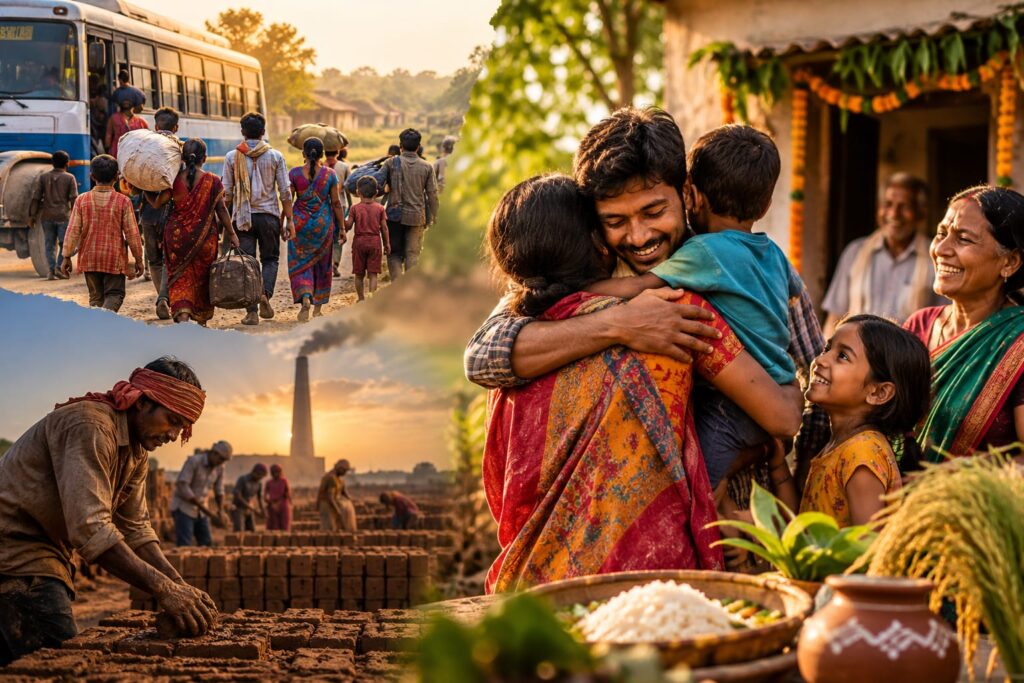
The roads begin to fill again. Buses and shared jeeps arrive from distant brick kilns, carrying men and women with tanned faces, holding small children and bundles of clothes that smell of dust and smoke. They step down into villages that have been half-empty for months. As the courtyards come alive with the fragrance of freshly cooked rice and the sound of laughter echoes through the home, families finally gather around the same hearth after months of waiting.
It is Nuakhai — the day the harvest is welcomed, families reunite, and the community briefly becomes whole again. For a brief moment, the distances that separate families seem to disappear.
But the homecoming doesn’t last long. Many of them will leave once again.
For many families, Nuakhai is not only a festival of harvest and togetherness; it is also a pause between two departures. The returnees will depart again, trading familiar courtyards and harvested fields for brick kilns, construction sites, and other workplaces far from home. Their return is festive, but temporary; their departure? Almost inevitable.
Hundreds of thousands of people leave Western Odisha every year in search of work. Conservative estimates suggest that around 5 lakh seasonal migrants from the wider KBK region, including Kalahandi, Balangir, Koraput, and adjoining districts, leave for brick kilns alone. A 2014 Aajeevika study estimated about 0.58 million seasonal migrants just from the Western Odisha districts it covered. Most of these migrants come from Balangir, Kalahandi, Nuapada, and Bargarh — the very districts that form the heart of the Nuakhai-celebrating region. Many travel to brick kilns in Andhra Pradesh, Telangana, Tamil Nadu, and Karnataka, while others find work in construction and other informal sectors across the country. The migration is largely seasonal and circular. Families leave for six to eight months and return the following year.
Migration is driven by hardship at home, not just the attraction of work elsewhere. It is not a free choice for most people. It is a distress strategy — a way to survive when local options fail. Farmers in these districts generally cultivate one crop a year. Once that agricultural work ends, local employment opportunities become scarce. Western Odisha has a long history of drought vulnerability. Environmental degradation, drought, and food insecurity are among the factors contributing to distress migration. Even the availability of work under MGNREGA often proves insufficient to meet livelihood requirements. When the income falls short, workers take an advance from a labour contractor. That advance quickly turns into an obligation to migrate. A 2024 study found that seasonal migrants were more likely to come from households that were poor, indebted, landless, socially disadvantaged, and less educated.
The arrival of labour contractors (locally called Sardar or Seth) in villages is seen mostly around Nuakhai. They come with cash advances. Needy families, without anywhere else to turn, take a lump-sum advance to cover festival expenses, repay old debts, buy food, or meet urgent needs. Once the advance is taken, the worker and often the whole family are bound to go to the brick kiln for the season. Not honouring the contract can lead to pressure or even violence. But this is where the cycle of bondage takes shape: wages are frequently adjusted against the advance, and the workers have little to no control over the final amount they receive. The advance itself is kept at a level that prevents most workers from generating a surplus. Many of them return still in debt or with very little savings, forcing them to take another advance the next year. The cycle continues. This system is commonly called Dadan labour. Studies show that village institutions and local networks themselves actively help sustain the contractor system.
For brick-kiln migrants from Western Odisha, the destination is often not a conventional workplace with a separate home. Work and living happen in the same space. Families stay in temporary shelters at or near the kiln and work collectively for long hours and low payment. The physical environment itself can be punishing: prolonged manual labour, heat, dust, inadequate shelter, and poor access to healthcare. Studies describe these sites as lacking in nutrition, health, and security. Some families take their children with them because there is nobody at home to look after them. An NCERT study on Balangir notes that migrant families may take school-age children to brick kilns for precisely this reason, affecting their education and contributing to low achievement and dropout. This is where the cost of migration extends beyond the migrant worker.
And yet, for a few days, those burdens fade into the background. The same hands that spent months moulding bricks far from home now gather around the familiar hearth. New clothes are worn, food is prepared, and laughter fills the home again. After months of separation, the family is whole. But for many, even this homecoming comes at a cost. The money that helps make this celebration possible may come from an advance that eventually takes them back to the very worksites they have returned from.
That is the quiet poignancy of Nuakhai for families caught in the cycle of seasonal migration. It brings them home at the end of one journey, even as the next departure is already beginning to take shape. For a few days, the hearth gathers everyone back together. Then the roads begin to fill again. The same buses and shared jeeps begin to take workers away from the villages that had just welcomed them home. The distance that disappeared for a few days returns once more.
And so the cycle begins again.
(The author is pursuing a Master’s in English Literature at Rama Devi Women’s University. Views expressed are personal.)
Such a clear vision of nuakhai has been portrayed here! The writer has done a wonderful job by sharing with us the culture and tradition of Western Odisha…