

















Sajid Mohamed’s The Chromatic World Order examines how race, colonialism and ideas of white superiority shaped the modern world and continue to influence global power and geopolitics
Kabir Sharma
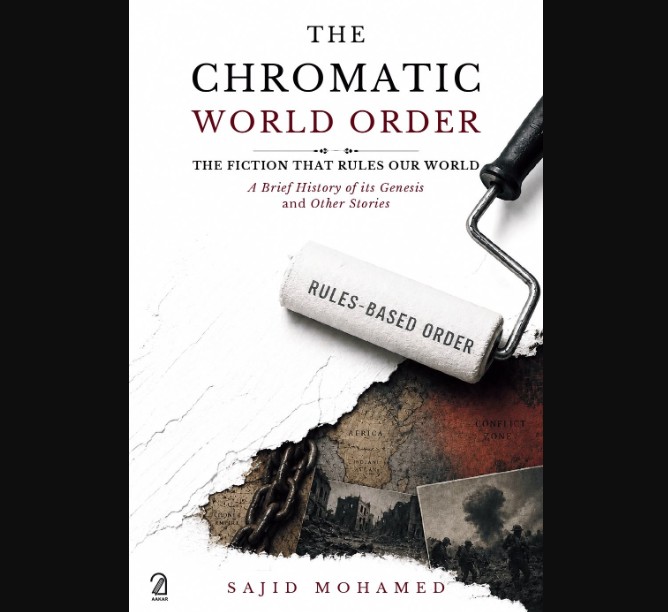
The Chromatic World Order
Sajid Mohamed
Aakar Books
Race is often discussed as a problem of the past, closely linked to slavery and colonialism. But what if its influence has continued long after the end of colonial rule? This is the central question explored by Sajid Mohamed in The Chromatic World Order: The Fiction That Rules Our World, published by Aakar Books.
The book examines how ideas of race and white superiority influenced European imperialism, colonialism and the systems that developed after them. Mohamed argues that racial hierarchies did not simply disappear when former colonies became independent. Instead, their influence can still be seen in global politics, institutions and ideas about power, development and civilisation.
The author takes readers across five centuries of history. He begins with European expansion and Columbus’s voyage aboard the Santa Maria, and goes on to examine the transatlantic slave trade, imperialism and the development of racial thinking. Historical events are presented not as isolated incidents but as part of a larger story about how the modern global order was created.
One of the book’s key arguments is that race cannot always be understood through class alone. While economic inequality is important, Mohamed argues that racial hierarchies have another dimension: they can determine how people and communities are viewed and treated. In this sense, racism is not only about exploitation but also about dehumanisation.
The book then connects this history with the present. Mohamed discusses events such as the 2023 Adriana migrant tragedy, the War on Terror and conflicts involving Gaza and Iran. These examples are used to question whether racial ideas continue to influence the way different communities are represented and treated in international affairs.
What makes the book particularly relevant is its attempt to connect history with contemporary geopolitics. Instead of looking at colonialism as something that ended with independence, Mohamed asks readers to consider the structures and ideas that may have continued beyond it.
The author’s background as a practising lawyer also shapes the book. His approach looks closely at how ideas become part of institutions and systems, and how those systems affect people in everyday life. Writing from the perspective of a formerly colonised society, Mohamed also questions whether Western interpretations of world history should always be treated as universal.
Written in an accessible style and supported by historical examples, The Chromatic World Order invites readers to look again at familiar stories of colonialism, race and global power.
Ultimately, the book raises a larger question: has the world truly moved beyond the racial hierarchies created during the colonial era, or do they continue to influence the way power operates today?
For readers interested in history, international relations, geopolitics and questions of inequality, the book offers a thought-provoking perspective on how the past continues to shape the present.
(The author is an independent reviewer. Views expressed are personal.)