





















Explore the forthcoming book “Icons of Odisha” by Bhaskar Parichha. Discover how 35 influential figures shaped the moral, cultural, and political landscape of modern Odisha
Bhaskar Parichha
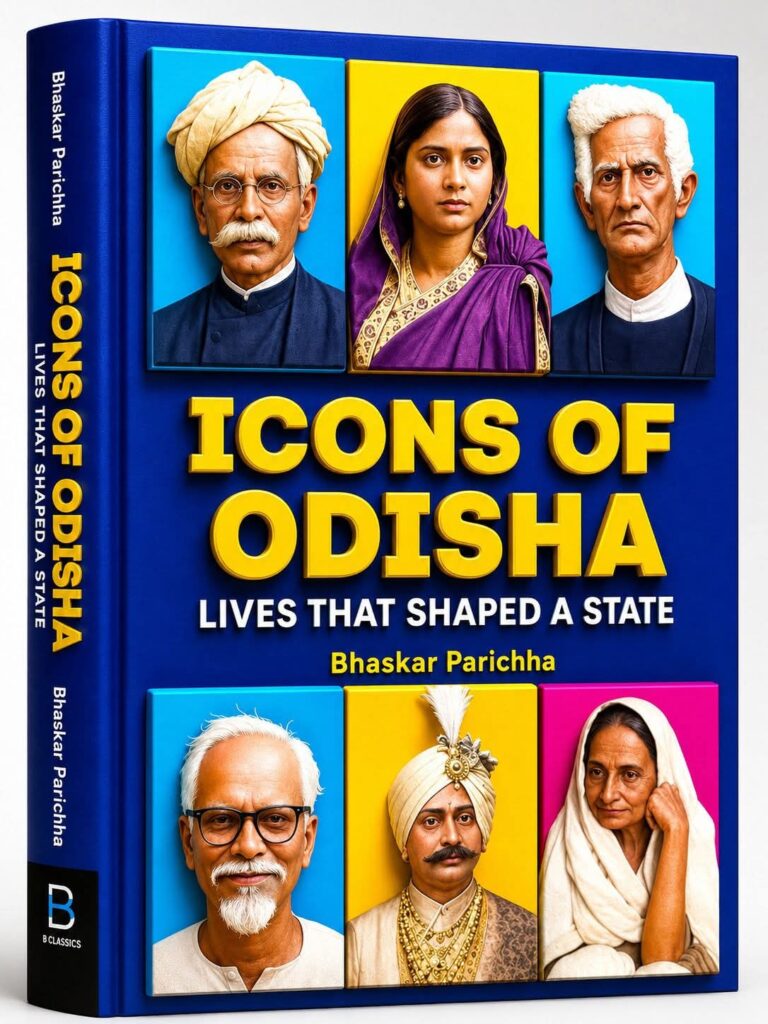
The history of Odisha is often approached through the visible markers of civilization—its ancient kingdoms, magnificent temples, maritime trade, freedom struggles, and political milestones. While these frameworks are indispensable, they do not fully explain how Odisha came to possess its distinctive moral and cultural character.
Beneath these historical structures lies another, equally powerful narrative: the story of individuals whose ideas, actions, and creative energies shaped the consciousness of the land. This book begins from that premise—that civilizations are not sustained by monuments and institutions alone, but by people who articulate values, challenge inertia, and imagine new possibilities for society.
The book is an attempt to trace the making of modern Odisha through thirty five such lives. These men and women belonged to different generations, professions, and ideological persuasions, yet each responded to the demands of his or her time with uncommon clarity of purpose. Their contributions—whether through literature, politics, education, social reform, music, dance, or visual art—collectively chart Odisha’s transition from a region struggling for linguistic and cultural recognition under colonial rule to a self-aware society negotiating the complexities of modern democracy and globalization.
The temporal arc of this book broadly spans the late nineteenth century to the present. This was a period of profound transformation, marked by colonial intervention, the rise of nationalism, social reform movements, and the challenges of post-independence governance. For Odisha, these changes were especially significant.
At the turn of the twentieth century, Odia language and identity faced marginalization; administrative divisions ignored linguistic realities, and cultural confidence was under strain. The response to these challenges did not emerge solely from mass movements or political negotiations. It was shaped decisively by individuals who understood that language, culture, and ethics are the foundations of collective self-respect.
Language emerges as a central thread running through this volume. The struggle to establish Odia as a language of administration, education, and literature was inseparable from the struggle to assert dignity and belonging. Fakir Mohan Senapati’s pioneering realism transformed Odia prose into a vehicle for social critique. Gangadhar Meher demonstrated that poetic excellence could arise from lived experience rather than elite privilege.
Sachi Routray, Gopinath Mohanty, Surendra Mohanty, Ramakanta Rath, and Manoj Das expanded the thematic and aesthetic boundaries of Odia writing, ensuring that the language could address modern anxieties without losing its rootedness. Through their works, literature became a site of resistance, reflection, and renewal.
Parallel to this literary awakening was the emergence of a political consciousness grounded in ethical responsibility. Figures such as Madhusudan Das and Gopabandhu Das understood that political rights without cultural self-respect were fragile. Their efforts to unite Odia-speaking regions, build educational institutions, and mobilize public opinion laid the groundwork for statehood and democratic participation.
In the post-independence era, leaders like Nabakrushna Choudhury, Harekrushna Mahtab, Biju Patnaik, Nandini Satpathy, Rabi Ray, and J. B. Patnaik represented diverse approaches to governance—Gandhian idealism, mass politics, charismatic leadership, administrative firmness, and parliamentary propriety. Their careers reveal the tensions between ideals and power, and the enduring challenge of translating moral vision into public policy.
The book also foregrounds the role of culture and aesthetics in sustaining civilizational continuity. Odisha’s artistic traditions, particularly in dance and music, were once confined to ritual spaces and threatened by neglect. The revival and global recognition of Odissi were made possible by individuals such as Kelucharan Mohapatra, Sanjukta Panigrahi, Raghunath Panigrahi, and Balakrushna Dash, who combined rigorous training with creative reinterpretation.
In the realm of visual art and cultural scholarship, figures like Dinanath Pathy demonstrated that tradition could be preserved without fossilization, and modernity embraced without rupture. Popular music and cinema, shaped by artists like Akshaya Mohanty, Sarat Pujari, and Jharana Das, carried cultural values into everyday life, reaching audiences beyond elite circles.
A defining feature of this volume is its attention to voices that expanded the boundaries of participation. Women such as Rama Devi, Kuntala Kumari Sabat, Bidyut Prabha Devi, and Sarala Devi entered public and creative spaces at a time when such participation was constrained by social norms. Their lives represent different modes of resistance—quiet reform, lyrical assertion, intellectual challenge, and administrative authority.
Similarly, the inclusion of Raghunath Murmu underscores the importance of indigenous cultural assertion. By creating the Ol Chiki script, he transformed linguistic empowerment into a tool of cultural survival, reminding us that Odisha’s identity is plural and layered.
This book does not present these figures as flawless icons or distant heroes. Instead, it offers interpretive portraits that seek to understand what each life represents within a broader historical and cultural context. The essays focus on ideas, values, and influence rather than exhaustive chronology. In doing so, they invite readers to engage critically with legacy—to see these lives as conversations across time rather than closed chapters of history.
The organization of the volume reflects a distinctive approach. Literary figures appear alongside political leaders; artists are placed next to reformers; revolutionaries share space with philosophers and administrators. This deliberate juxtaposition underscores a central argument of the book: that the making of a civilization is a collective, multidimensional process. Progress in one domain is sustained by developments in others, and cultural vitality depends as much on ethical leadership as on creative expression.
In an era where public conversations are frequently influenced by quick reactions and disjointed thoughts, looking back at these lives has a more profound significance. It shows us that cultural confidence is developed slowly, through consistent effort and moral vision. The people honored here didn’t just react to their situations; they transformed what could be achieved within those situations. Their legacies push today’s readers to confront tough questions about accountability, creativity, and a sense of belonging.
Icons of Odisha: Lives That Shaped a State is not only a book about the past. It is an invitation to reflect on the present and the future. To remember these lives is to recognize that heritage is not inherited passively but renewed through conscious engagement. The values embodied by these figures—integrity, courage, empathy, intellectual rigor, and cultural pride—remain as relevant today as they were in their own time.
Through their stories, this book seeks to affirm that the making of Odisha, like the making of any living civilization, is an ongoing moral and cultural endeavor.
(Excerpted from the forthcoming book ‘Icons of Odisha: Lives That Shaped a State’ by Bhaskar Parichha; published by BK Classics. The author is a senior journalist and columnist. Views expressed are personal.)