




















Is political symbolism overshadowing development? Explore why true good governance is measured by public welfare, not cosmetic changes to public assets
Rabindra Kumar Nayak
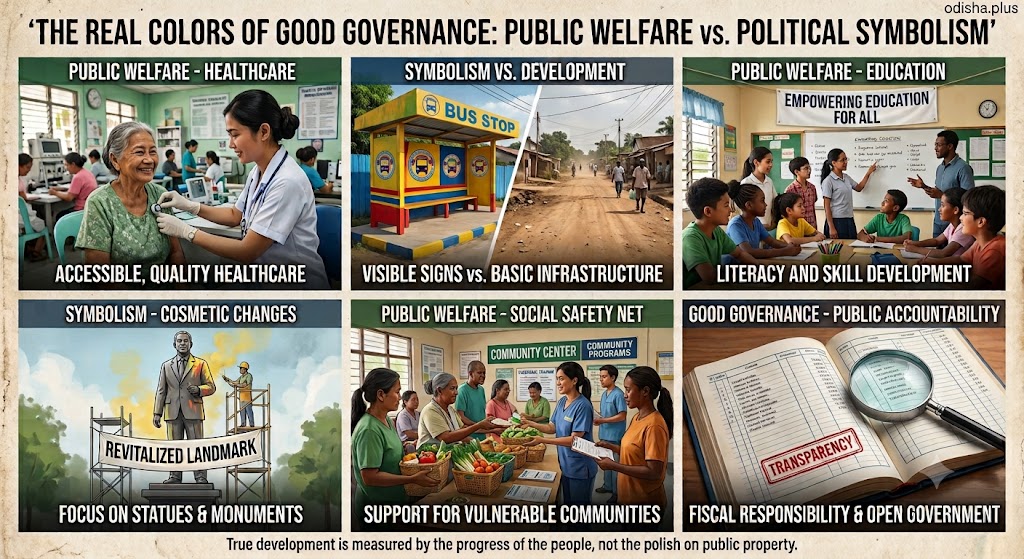
In every democracy, governments are elected not merely to rule but to improve the quality of people’s lives. Citizens vote with the hope that their children will receive better education, that hospitals will become more accessible, that jobs will be created, and that poverty will gradually disappear. When these expectations are overshadowed by an excessive focus on changing the colours of public buildings, institutions, or symbols, an important question arises: Does changing colours change the lives of people?
Colours have cultural, historical, and political significance. Every government has the right to express its identity through legitimate administrative decisions. However, when symbolic changes begin to dominate public discourse while fundamental concerns remain unresolved, priorities appear misplaced. Democracy is ultimately judged not by the colours painted on walls but by the conditions in which people live.
A nation cannot paint away unemployment. A young graduate searching for work does not become employed because a government office has acquired a new colour scheme. Employment requires industrial growth, investment, skill development, transparent recruitment, and a vibrant economy. These are the colours that truly brighten the future of a nation.
The same holds true for healthcare. Patients waiting outside overcrowded hospitals seek doctors, medicines, and functioning equipment—not freshly painted buildings alone. The real measure of a welfare-oriented government lies in reducing infant mortality, expanding rural healthcare, strengthening emergency services, and making quality treatment affordable. These achievements save lives; cosmetic changes do not.
Education presents another challenge. Millions of children still require better classrooms, qualified teachers, modern laboratories, digital facilities, and equal opportunities. A nation secures its future by investing in minds rather than appearances. Great civilizations have been remembered not for the colours of their institutions but for the knowledge they produced and the values they nurtured.
Poverty remains perhaps the greatest moral challenge before any democratic state. Economic inequality continues to affect access to nutrition, healthcare, education, and dignity. Governments earn public trust when they create opportunities for sustainable livelihoods rather than temporary spectacles. A poor family values secure income far more than symbolic gestures that have little bearing on daily survival.
This does not mean that public spaces should never be renovated or beautified. Maintenance of government infrastructure is necessary, and aesthetics contribute to civic pride. But beautification should complement development, not replace it. A school requires competent teachers before decorative paint. A hospital requires medicines before ornamental walls. A village needs drinking water before impressive gateways.
History repeatedly teaches that societies flourish when governments concentrate on substance rather than symbolism. Roads, irrigation, scientific research, education, agriculture, public health, and social justice have always determined the strength of nations. Symbolic politics may capture headlines for a few days, but genuine development transforms generations.
There is another aspect that deserves serious public attention. Whenever crores of rupees are spent on repainting government buses, public buildings, offices, or other state-owned assets merely to reflect the preferences of a new administration, the financial burden is not borne by political parties, whether in government or in opposition. It is borne by the taxpayers—the ordinary citizens whose hard-earned money constitutes the public exchequer. Every unnecessary expenditure on cosmetic changes is money that could otherwise strengthen schools, equip hospitals, improve public transport, generate employment, or provide relief to the poor. In a welfare state, every rupee of public money carries a moral responsibility. Governments are temporary custodians of public resources, not their owners. Therefore, expenditure should always be guided by public necessity rather than political symbolism.
Democracy rests upon accountability. Citizens have every right to ask whether public money and administrative energy are being directed towards the most urgent needs. Such questions should not be viewed as criticism for its own sake but as an essential part of democratic participation. A healthy democracy welcomes scrutiny because it ultimately strengthens governance.
Public representatives are custodians of the people’s trust. Their greatest legacy will never be remembered in terms of colour combinations or altered appearances. They will instead be remembered for reducing poverty, expanding opportunities, protecting the vulnerable, improving schools, strengthening hospitals, creating employment, and preserving social harmony.
Ultimately, governments come and go, political colours change, and slogans evolve with time. But the aspirations of ordinary citizens remain remarkably constant. Parents still dream of good schools for their children. Young people still seek meaningful employment. Farmers still hope for fair returns. Patients still pray for timely treatment. Elderly citizens still long for security and dignity.
The true colour of democracy is neither saffron, green, blue, nor any other political shade. Its enduring colour is the well-being of its people. When governance places human welfare above symbolism, democracy acquires its brightest and most meaningful hue. Any government that keeps this principle at the centre of its policies will earn not merely electoral victories but a lasting place in the hearts of the people.
(The author is a former Reader in English. Views expressed are personal.)