


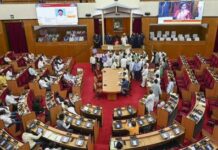


















Explore Kolkata’s shifting political identity and its timeless cultural fabric, from the Left’s legacy to the TMC era and modern governance challenges
Satya Narayan Misra
As I waded through the hills of North Bengal and the salubrious city of Sikkim, into my favourite city, Kolkata, last week, I was overly curious to know from ordinary Bengalis how the whole state has been swept through by saffron, trumping the prediction that it would be a close race. I have lived in the city when Jyoti Babu was the presiding deity. I have also seen Mamta Banerjee as LOP lathi charged in 2003, with blood splattered all over the saree, refusing to get into the ambulance till she was photographed and interviewed. No wonder, the colour of affiliation of the State changed from fiery red under the vice-like grip of the Left party for 34 years to a sea of green, with the icon of a woman in a white saree ruling Bengal with firmness for 15 years. She was a symbol of defiance against a Central regime wedded to authoritarianism, cultural homogenisation, and Hindu consolidation. While people of North Bengal were overly critical of Didi, Calcutta offered a more confused picture, with a sense of loss by a few, while most seemed to want a change. As I serenaded the city in the evening and crossed through the Maa Setu, I was a bit relieved that the flotilla of flaming green had still not been swept by the sea of saffron.
The Many Hues of Calcutta
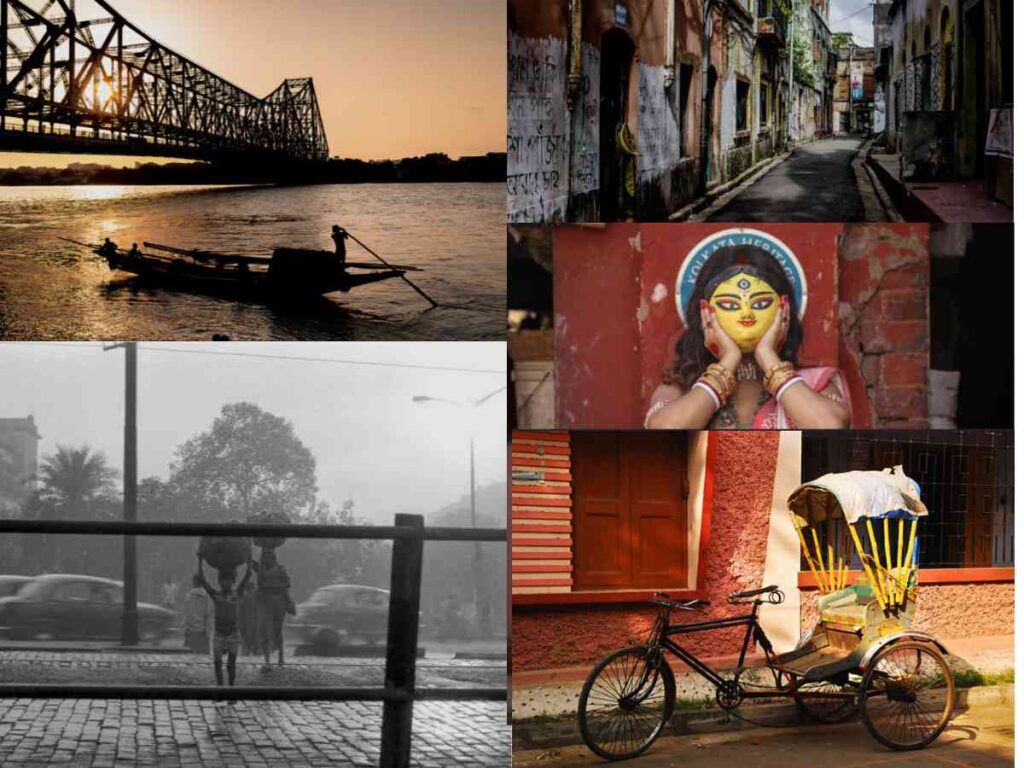
One of the best reads on Calcutta is Rajiv De’s pictorial history book “ My Endless City” (2023). Shorn of overt ideological predilection, the black & white pictures capture the innards of the city beautifully. The Cycle is the most visible symbol of movement in the city. Dreams ride it as did Violet Stoneham in the cult movie 36, Chowrangi Lane, on a cycle rickshaw. Trams still run from Esplanade to Kiddipore, as it started its first foray in 1902, straddling the lazy Hoogly on one side and the verdant green Calcutta maidan on the other side. Except for Vienna, Toronto, Melbourne, Amterdam & Prague, you do not find such jalopies trundling so elegantly in our busy streets.r
If you judge a city by the books it reads, Kolkata takes the cake. From pamphlets, to newspapers to the most treasured domes, the city devours everything. I have seen rag pickers reading newspapers astride their rickety wheelbarrow and conservancy workers wiping dirt in their hands to pick up daily newspapers. I will never forget the experience when a rare book, ‘ Body Line’ written by Harold Larwood requisitioned by me in the National Library came through a lift from the basement in a few minutes! Barring Kerala, which houses a public library in every remote corner, books and Bengalis are best buddies.
Theatres and Cinema run through the veins of Bengal. Be it Utpaul Dutt’s Yatra, Sambhu Mitra’s Theatre, Satyajit Ray’s cinema, or the larger-than-life presence of Rabindranath Tagore and Rabindra Sangeet, it’s an all-consuming DNA of the city. Nandan, a cultural centre whose foundation was laid by Jyoti Babu in 1980 and inaugurated by an ailing Ray in 1985, remains the new epicentre and heartthrob of cinema aficionados. The ordinary Calcuttans rub shoulders with fiery Mrinal, or classically correct Satyajit as they watch the best of cinema of Bergman, Fellini, Goddard, Kurusewa, Wajda, and Polanski.
The city also reveres Maa Durga as much as it adores football. Football is as entrapment as much as its deliverance, despite the looming presence of Saurabh Ganguly as an icon of cricket. The frenzy the city witnesses during Durga Puja, UNESCO calls it “ Intangible Cultural Heritage of Humanity”. Starting from 1610 with the core idea of Good triumphing over Evil, the Puja in Calcutta is sui generis, with theme Pujas, Sabeki Puja, and fostering inclusivity as Muslims and Christians join, and millions walk all night free from fear.
From Suhrawardy to Mamta
The city witnessed the shameful 1946 Calcutta Killings, when around 10000 were killed in cold blood, mostly Hindus. This was engineered by Jinnah to get Pakistan as a separate nation and executed in cold blood by the Bengal CM Suhrawardy, called the Butcher of Bengal. This triggered Noakhali. This communal outrage was upended by its first CM, the legendary BC Roy, who was not only the founder of modern industry, new towns, hospitals, and educational institutions, but also played a pioneering role in the rehabilitation of refugees, who came from erstwhile East Bengal after the partition. Mr Jyoti Basu would be remembered for his stellar role in ushering agrarian reforms, as did Namboodirpad in Kerala. Rural Bengal strongly batted for Jyoti Babu. Didi dismantled 34 year left rule, with a promise of “ Poribartan,” “Governance with a human face, “a plethora of welfare and social schemes, rural connectivity, Jaganath temple in Digha, and a Calcutta city which looked cleaner and brighter during the TMC rule.
But Nandigram was her nemesis. She stopped the Tata Nano Project and upended the Left government. It became her Waterloo as Suvendu Adhikari, an old ally, was dumped by Mamta. He defeated her in 2021 and again in the recent election. Quite clearly, industrialisation has taken a huge beating under her watch. The record of Bengal in terms of housing deprivation ( 47% ), Cooking fuel deprivation (61%), and population % with multidimensional poverty (12% ) is not edifying. Besides, Bengal, which was connected to global routes of capital flow, primarily through the British companies, got delinked from the late 60s, as the British sold off their companies mostly to the Marwaris. Very little FDI has come into Bengal.
Hindu Consolidation
There is an overwhelming apprehension that Bengal has succumbed to an all-encompassing wave of Hindu consolidation. Prof Ghosh of Xavier’s College believes that such a perspective is analytically lazy. Religion in the city, post 1946 communal killings, has transcended barriers. Be it Christians in the Church, or the Muslims praying in the open, the State shows remarkable secular sinews. However, when you talk to the common men, they feel that Mamta was manifestly pro-Muslim, did not deliver on her employment/development promises, and promoted her nephew Abhishek Banerjee, who is allegedly involved in a slew of scams. Her defiance against many central schemes smacked of foolhardiness. Disillusionment against the Did has certainly deepened. Prof Indraneel, from ISI Calcutta, a hardcore leftist, believes that Bengal will see a major shift towards physical infrastructure and capital accumulation. Mamta shifted her administrative podium from Britisher’s Lal Bari (Writer’s Building) to Neel Bari ( Blue & White Secretariat) . It remains to be seen whether the colour of administration under Subhendu will change and bring a new wisp of hope. Tagore’s hope that ‘the clear stream of reason must not lose its way in the dreary desert of dead habit’ should become the beacon light for Suvendu.
(Satya Misra teaches Constitutional Law & is deeply involved in Development Studies. Views Expressed are Personal.)