














A decade-long digital archive initiative, Odia Bibhaba preserves over 19,000 books, rare newspapers, and the Purnachandra Bhashakosha for future generations
Bhaskar Parichha
Language is not merely a medium of communication; it carries a people’s history, culture, memory, experience and identity. To preserve a language’s past is to secure its future. Seen in this light, the nine-year journey of “Odia Bibhaba” is not just the story of a digital collection. It is also an important effort to safeguard the historical and literary wealth of the Odia language for future generations.
It is human nature to preserve what we love. From childhood toys to old letters, photographs, books and family memories, we hold on to a great deal. But when this act of preservation goes beyond the personal and becomes a means of protecting the collective wealth of a society, its importance multiplies.
The present digital age has made this work easier and more far-reaching. Old books, journals, newspapers, documents, photographs and handwritten manuscripts can be digitized and preserved for a long time. The greatest benefit is that geographical distance no longer prevents access to knowledge. Whether a researcher in Odisha or an Odia living abroad, both can access the same historical resources through the internet.
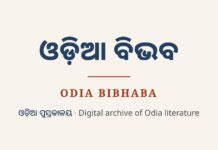
The brainchild of Nikhil Mohan Patnaik and Pushpasri Patnaik, Odia Bibhaba’s achievements in this field are notable. So far, its collection includes about 19,100 books, 157 journals and 22 rare newspapers, such as ‘Utkal Dipika’ and ‘Balasore Sambadbahika’. In addition, it holds 28 dictionaries published between 1811 and 1942. Works by eminent writers such as Gokulananda Mohapatra, Gopinath Mohanty, Jagannath Prasad Das, Chittaranjan Das and Chandrasekhar Rath have also been gathered. Historic works such as the first Odia short story, novel and play, Pathani Samanta’s ‘Siddhanta Darpana’ and the ‘Gita Govinda’ are likewise part of the collection.
These figures do not merely show the scale of a digital project; they are also a mirror of Odisha’s intellectual history. Preserving old newspapers and journals is especially important because they are not just records of news. They bear witness to the social consciousness, political movements, language movements and cultural changes of their time.
Yet this success should not become a cause for complacency. Measured against the literary and historical wealth of a language that is more than two thousand years old, this collection is small and incomplete. Even now, in corners across the state, many rare books lie neglected in private collections, old libraries, educational institutions and family cupboards. Some rare books are on the verge of destruction. Finding them, verifying their authenticity and digitizing them are urgent tasks.
One of Odia Bibhaba’s biggest achievements is the digital conversion of the Purnachandra Bhashakosha. The ability to download all seven volumes, view an exact copy of the original page for any word, and look up its meaning and explanation has made it an invaluable digital resource. The efforts of computer expert Dr. Ajit Kumar Nayak made this possible. Later, with the collaboration of Dr. Sanujit Puhan, the creation of a mobile app further extended its digital reach.
Still, much remains to be done in the days ahead. The main current needs include the re-preparation of word meanings covering about 90,000 words, re-proofreading of the Purnachandra Bhashakosha, preparation of an evidence-based bibliography of published books, and compilation of data for the Charitakosha (biographical dictionary). Many details in the Charitakosha, which contains biographies of about 11,000 people, remain incomplete. If new information, photographs and revised biographies can be added, it could become far more useful to researchers.
Preparing a comprehensive bibliography of about 22,000 books is also a fundamental need. Odia research suffers from a major gap: there is no authoritative list indicating which book was published when, where and by whom. Collecting this data requires the cooperation of authors, publishers, libraries and general readers.
It would not be right to see this work as the responsibility of a single institution. The state government, universities, research institutions, publishers and cultural organizations should all cooperate. Digital preservation requires continuous funding, technical support, checks on data quality and accuracy, and long-term maintenance. Digitization is not just about scanning and uploading; it is equally essential to index the material properly and make it searchable and easily accessible to the general public.
The identity of the Odia language will not be protected by emotional slogans alone. It requires the preservation of knowledge, research, the use of new technology, and easy access to it for the new generation. Odia Bibhaba is certainly a meaningful step in this direction. But its future success will depend on how eagerly we take up this responsibility.
To love a language does not mean only singing its glory; it also means preserving its wealth, linking it with new knowledge and making it available to future generations. This remarkable journey of Odia Bibhaba reminds us that preserving the past for the future is the first and strongest step towards enriching that future.
(The author is a senior journalist and columnist. Views expressed are personal.)