






















Analysis of Prashant Kishor’s transition from election strategist to political leader through his Bankipur victory and Jan Suraaj movement
Bhaskar Parichha
For over a decade, Prashant Kishor occupied a unique position in Indian politics. He was the man behind the curtain—the strategist who helped leaders script victories but never sought the spotlight himself.
Politicians depended on his data-driven insights, campaign narratives and organisational acumen, while the public knew him largely as the architect of winning elections rather than as a political leader.
That distinction has now changed.
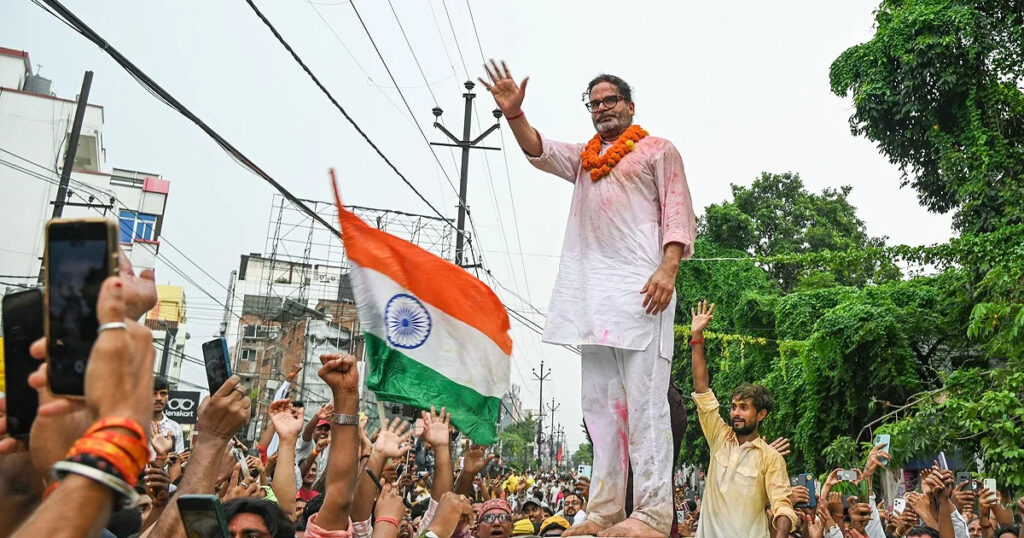
With his electoral victory from Bankipur, Kishor has completed one of the most fascinating transitions in contemporary Indian politics: from being an adviser to power to becoming a claimant to power himself. The victory is not simply an addition to his résumé. It represents a transformation in identity.
For the first time, Prashant Kishor’s political legitimacy stems not from clients or campaigns but from the mandate of voters.His journey into politics has been anything but conventional.
Unlike most politicians, Kishor did not rise through student unions, party organisations or family dynasties. Trained in public health, he worked with international organisations before entering Indian politics during Narendra Modi’s campaign for the 2014 general election. That campaign revolutionised political communication in India through the extensive use of technology, voter profiling, targeted messaging and professional campaign management. Kishor emerged as the face of a new generation of political consultants who treated elections with the precision of corporate strategy.
Success followed success.
His imprint was visible in Nitish Kumar’s emphatic return to power in Bihar in 2015, Mamata Banerjee’s decisive victory against the BJP in West Bengal in 2021, M.K. Stalin’s triumph in Tamil Nadu and electoral successes in Punjab, Andhra Pradesh and elsewhere. Few political strategists anywhere in the world have worked successfully across such diverse ideological and regional landscapes.
Yet therein lay a paradox.
Kishor could help others become chief ministers but could not test whether his own political ideas resonated with voters. His reputation rested on understanding public opinion, not necessarily representing it. Critics often argued that he was a skilled consultant rather than a mass leader. Campaign management, they insisted, was no substitute for grassroots politics.
Perhaps Kishor recognised this limitation himself.
His decision to leave political consultancy and launch the Jan Suraaj movement marked a conscious departure from election management. Rather than immediately floating a political party, he embarked on an extensive padayatra across Bihar, walking through thousands of villages, listening to citizens and attempting to build an organisation from the ground up. It was a slow and demanding exercise in political mobilisation, quite unlike the high-tech campaigns that had made him famous.
The choice reflected an understanding that sustainable politics cannot be outsourced. Electoral strategies may influence voters for a few weeks, but political movements are built over years through trust, organisation and continuous engagement.
The early electoral returns, however, were disappointing. Jan Suraaj’s first major electoral tests failed to produce significant victories. Critics were quick to pronounce the experiment a failure. Many concluded that Bihar’s deeply entrenched caste equations and established party structures left little room for a newcomer, regardless of his national profile.
Bankipur has forced a reassessment of that conclusion.
The victory does not automatically make Prashant Kishor Bihar’s next dominant leader, nor does it guarantee that Jan Suraaj will emerge as the state’s principal political force. But it demonstrates that Kishor can convert organisational effort into electoral success. That distinction matters because Indian politics has witnessed numerous celebrated activists and public intellectuals who struggled to translate popularity into votes.
Kishor has crossed that threshold.
His challenge now is qualitatively different. As a strategist, his responsibility ended on counting day. As an elected leader, accountability begins after the results are declared. Voters will judge him not by campaign slogans but by legislative performance, policy positions and organisational leadership.
That transition may prove more demanding than any election campaign.
The Jan Suraaj movement itself faces critical questions. Can it expand beyond the personality of its founder? Can it nurture a second line of leadership? Can it maintain its emphasis on governance and institutional reform while navigating the realities of coalition politics, caste alliances and electoral compulsions? Every successful political movement eventually outgrows its founder’s charisma; whether Jan Suraaj can do so remains uncertain.
For Bihar, Kishor’s emergence introduces an intriguing possibility. The state’s politics has long oscillated between identity and governance, between social justice and development. Kishor seeks to position himself as a leader who acknowledges Bihar’s social realities while insisting that governance, education, employment and administrative efficiency should define the next phase of politics. Whether that message can consistently transcend caste loyalties will determine his long-term relevance.
Nationally, his journey also carries a broader lesson. Indian democracy is witnessing the gradual professionalisation of political campaigns, but Kishor’s own evolution suggests that professional expertise alone cannot replace democratic legitimacy. Strategy may win elections for others, but only voters can confer political authority.
The election strategist has finally entered the arena.
Whether Prashant Kishor ultimately joins the ranks of transformative regional leaders or remains an influential but limited political experiment is a question only time can answer. What is beyond dispute is that he has taken a path few political consultants have dared to tread.
(The author is a senior journalist and columnist. Views expressed are personal.)