



















Examination of the planetary emergency, resource depletion, and climate crisis as Earth approaches a population of 10 billion
Suresh Chandra Sarangi

The dusty planet is hungry, too. Brooding over its sustainability, oil again reached US dollar 109, with panic all over the world. The stock markets are bleeding. People are worried, and their scary faces say it all. The revenge of geography in the Iran-Israel war, with American support for Israel, is getting terrible. Elsewhere, Russia and Ukraine are prisoners of geography, which has become consequential. The climate crisis has already played spoiler. The resources crunch mocks humanity. They say a fatigued planet would house approximately 10 billion by 2100. A worried farmer looks at the sky.
There is no rain. Bees are dying or in the process of extinction. There will be no pollination, and the ten billion will possibly starve. Environmental degradation is a fire that never wants to be subsumed. Natural resources are being consumed faster than they can be replenished. Wetland depletion, soil erosion, ecosystem degradation, the depletion of wildlife populations. Ecological diversity is in perilous condition, and we are at the threshold of the sixth extinction.
It is all about a planetary emergency: the future of we the people, our posterity and future generations. It appears we have failed the planet. The Earth is home to millions of species. They have a far cry. We are the most intelligent species, but our activities do not prove that. The planet is profoundly impacted because of us, and the monstrosity of our actions cannot be comprehended, yet it is a scathing attack against that pale blue dot we say is our home.
We will be ten billion by 2100 or before that. Both terrestrial and marine ecosystems are under duress. The microbial community, as well as the Earth’s forests, are to cope with the changes seems impossible unless we change our activities and stop exploiting the resources at this speed, because of our consumerist society. The Industrial Revolution has fundamentally altered the state of nature, in which we lived a life of idyllic felicity. If the exploitation continues, the legacy will be unbearable. But they are shaping our present on planet Earth and shall reshape our gruesome future. By 1890, the global population crossed one billion. The agricultural revolution broke the cycles of famine.
The Green Revolution provided us with an abundance of food, but the fertilisers, pesticides, and insecticides spoiled the very creatures who are responsible for good crops. The impact of the next revolution, the Industrial Revolution, upset the Apple cart. But our lethal addiction to exploit natural resources like coal, oil, etc as the principal sources of energy. We grew in numbers , needed more food, still more food. Food was our necessity for sustainability. Food was industrialised; raising animals and birds for our food became imminent. All these revolutions flourished at a huge cost: the loss of habitat, pollution, and overfishing. Then started a domino effect of degradation of forests and ecosystems.
We started manufacturing modern gadgets. The television, video recorder, Walkmans, clothes, beauty products, our cars- all these accelerated the woes of planet Earth. We needed more roads, more airports, more carving and digging, more bridges and shipping. More disturbance to the other species. All these were extracted from nature, and the resources gradually declined. The water demand increased, not only for agriculture, but for our food production and fodder for our increasing number of animals. Ethiopia faced famine. It is said by critics that there will be more parched lands, thereby forcing farmers out of cultivation, and in the future there may be a water war, as there is a serious shortage of potable water. The globe is facing unusual drought, unusual flooding, and water, which is an elixir of life and a vital resource, is in shortage.
Accumulation of carbon dioxide, methane, and other greenhouse gases suffocates the atmosphere; as a result of increased area coverage under agriculture, land use and production, processing, and transportation, our climate is changing beyond comprehension and repair. It is estimated that demand for food and encroaching forests to retrieve agricultural land will double by 2050. Organizations are engaged in grabbing land and forests for timber, extracting minerals, rare earths, or land required for livestock and crops. Loss of tropical rainforest and woodland is a threat to our climate.
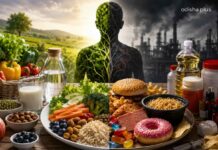
Constantly, we are eroding the natural systems. Loss of biodiversity at the current rate shall lead to the loss of the ecosystem, and that would be a real threat to our survival. GDP and per-capita income are increasing, and our food production is increasing, as we are obsessed with calorie consumption. There is pressure on land, pressure on water. Food production roughly accounts for around 30% of greenhouse gases.
We need 3000 litres of water to prepare a burger, 9000 litres of water to produce a chicken, 27000litres for production of one kg of meat. Running out of fossil fuels. War has already brought an energy crisis. Now we are interested in adding ethanol for less consumption of oil, as we feel the pinch. Emerging economies are feeling the pressure, and as oil prices sky rockets, business came to a standstill and transportation to a grinding halt. Now the effort is for new and renewable energy to replenish. Coal and charcoal use is having a devastating effect on the climate, and there is no chance of replenishing it anymore.
As the human population increases, the pressure on everything increases. We need more green energy, nuclear power, desalination, geo engineering, and a second green revolution. The next war, or for that matter two continuing wars at present, is for the world’s resources. As it appears, world peace is in danger as the struggle for critical water resources, mineral resources, resources of nature’s flora and fauna, and energy resources and are not finite resources, are not finite and they will come to an end. The more rapacious use, because of increased population, makes pressure on land, earth, water, and sky unbearable.
A judicious use of nature’s resources is the need of the hour. A balance between human population at one end and the planet’s natural resources would be the most commendable job that mankind can lay its hand on. The future of growth of economies will come primarily from the developing countries. That means more industrialisation, more pressure on natural resources. Economic use of consumer products and a shift in food habits, with more stress on vegetarian food, can ease the process of degradation.
Earth Overshoot Day is a date when humanity’s demand for ecological resources exceeds Earth’s ability to regenerate these resources in a given year. We have to make it habitable, as it is already an uninhabitable Earth. The Earth counts for the continuation of human and other species. Sustainable Development Goals, for 2030 with goals to be achieved by 2030, are far from the target.
The planet is our common heritage. We must be very careful about our common future. Environmental degradation, unchecked climate change, and unintended consequences of advanced technology could create serious, even catastrophic setbacks to society,” says Martin Rees, a world-famous scientist. Governments must act locally and think globally, as the problem is interrelated. There is no scope for short-termism. It has to be on a long-term basis. Now is the time to think optimistically, in the age of Artificial Intelligence. Peter Medwar’s days,” The bells which toll for mankind are, most of them anyway, like the bells on Alpine cattle; they are attached to our own necks, and it must be our fault, if they do not make a cheerful and harmonious sound.”
(The writer is a former General Manager of Bank of India. Views expressed are personal.)