
























Explore a reflective essay on social media validation, the illusion of digital likes, and the importance of genuine human connection and presence
Monalisa Dash Dwibedy
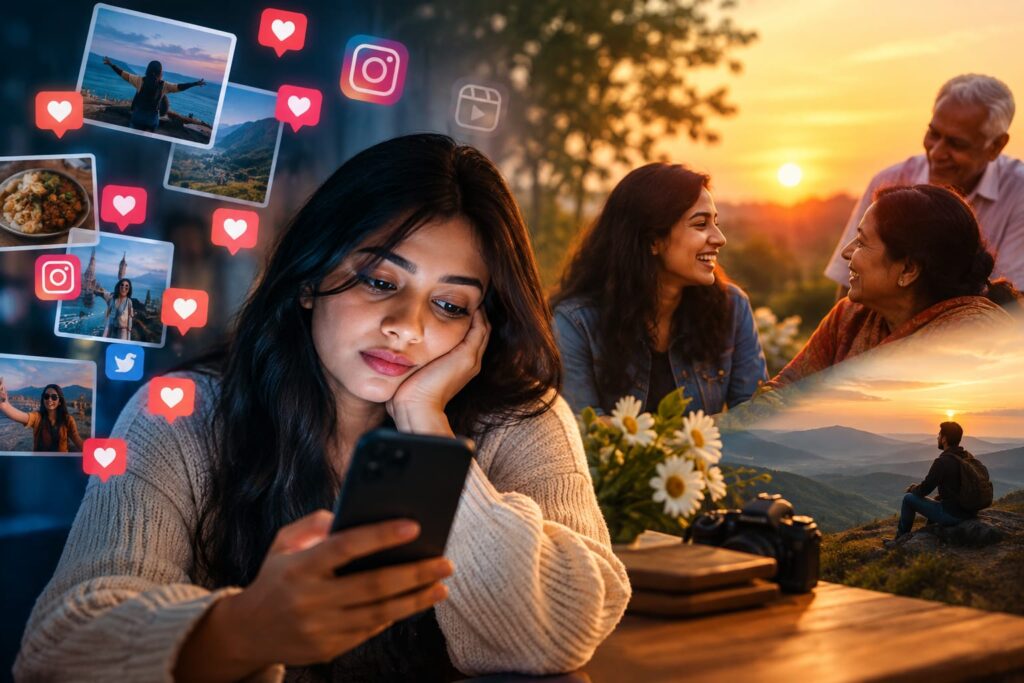
Perhaps I shouldn’t say this. Perhaps I have no business saying it at all.
But after nearly two decades of living through the evolution of social media—from Orkut to Instagram—I think I have earned the right to say what I have observed. And what I have observed is both amusing and unsettling.
We have somehow managed to outsource our happiness. To a notification. To a number. To a tiny red heart.
We post a reel or photograph and wait. One like. Two likes. Twenty. A hundred. And then somehow, the day feels a little better.
Think about how strange that is. A little digital symbol, pressed by someone sitting somewhere else, has acquired the power to tell us whether we should feel good about ourselves.
We dress up, travel, celebrate, buy something expensive, accomplish something meaningful—and before we have even finished experiencing the moment, we are already thinking about how it will look on Instagram.
We don’t just live our lives anymore. We live, then wait to see whether other people approve of how we lived.
Everyone looks happy on Instagram. Everyone looks beautiful. Everyone is travelling somewhere extraordinary, eating something delicious, attending something glamorous, or standing beneath a perfect sunset.
Of course, there are Instagram filters. But perhaps the bigger filter is the one we have placed over our own minds—the belief that what receives attention must be valuable.
It is not.
A like is not admiration. A heart is not affection. And the absence of either is certainly not rejection.
Sometimes, a person simply has a difficult day. Sometimes, they are busy. Sometimes, they are hurting. And sometimes, they have something far more important occupying their mind.
Imagine posting photographs from an exotic vacation while a friend of yours is desperately trying to locate a missing relative after the recent devastating flash floods in Nepal.
Will that friend look at your beautiful photographs? Perhaps not.
Will they press the heart? Probably not.
Not because your photographs aren’t beautiful. But because their world, at that moment, is collapsing around them.
And suddenly, we understand something important: Other people’s reactions to our lives are rarely about us. They are about where they are in their own lives.
The same is true of comparison.
You buy a beautiful new luxury car. You are delighted. You hold the keys, take a photograph, and share your happiness.
Someone who owns a Porsche comments: “Congratulations. But does it give mileage like a Porsche?”
There it is.
Your happiness, measured against someone else’s possession. You thought you were sharing joy. Someone else turned it into a competition.
And perhaps that is another disease social media has quietly normalized—the constant comparison of our ordinary lives with someone else’s carefully edited highlights.
But something even more revealing than Instagram and WhatsApp exists.
Our little digital village.
How many groups are you in? Family. Friends. Work. Community. School. College. Neighbourhood. Sports. Alumni.
We are connected to everyone. And yet, are we really?
During the COVID pandemic, someone from my village died. He was not an ordinary person. He was someone our village had every reason to be proud of.
For years, he had delivered Prabachan and running commentary during the live telecast of the world-famous Rath Jatra of Puri, Odisha. His voice had reached thousands of people, and his association with that sacred occasion had given our village a quiet sense of pride.
When he died suddenly of COVID, messages appeared in the village WhatsApp group: “Om Shanti.” “RIP.” A few people who knew him personally wrote beautiful words about him. And then the conversation moved on.
But something about it stayed with me.
Not the RIP. The silence that came before it.
Why hadn’t we celebrated him when he was alive? Why hadn’t we felicitated him? Why hadn’t someone presented him with a bouquet and simply said: “You make us proud”?
Why do we find it so easy to write beautiful words about people after they are gone, but so difficult to say those same words when they are standing right in front of us?
Life gives us the opportunity to say it. And perhaps we should.
Tell your friend you are proud of them. Tell your parents you appreciate them. Tell your colleague that their work matters. Tell your teacher what they changed in you. Tell the person who helped you years ago that you still remember.
Give people flowers while they are alive so that they can feel the warmth of your appreciation. Don’t wait until the photograph has a garland around it. Don’t wait until all you have left is a WhatsApp message saying, “Om Shanti.”
Because a society that only remembers people after they are gone has forgotten something fundamental about being human.
Appreciation is most meaningful when the person is still here to receive it.
So perhaps these are my parting words to my social media friends.
Don’t stop using social media. Just stop allowing it to use you.
Post if you want to. Share your photographs. Celebrate your milestones. Show the world the places you have seen and the things that make you happy.
But don’t confuse visibility with value. Don’t confuse followers with friends. Don’t confuse likes with love. And never confuse silence with indifference.
Most importantly, don’t live your life for an audience.
Travel because the journey calls you. Eat the food you love. Buy the car you can afford. Celebrate your success. Laugh loudly. Love deeply. Make memories for yourself, not for others’ approval.
There is a strange freedom in knowing that a beautiful moment can exist without being photographed.
A sunset does not become more beautiful because it receives a thousand likes. A holiday does not become more meaningful because someone comments, “Goals!” A successful life does not require an audience. And happiness certainly does not require a notification.
Maybe, once in a while, put the phone away.
Don’t take the photograph. Don’t post the dinner. Don’t check who viewed your story. Don’t count the hearts.
Just sit there.
Be present.
Look into someone’s eyes. Have a conversation that never gets recorded. Tell someone you love them. Tell someone they matter. Tell someone, while they are still here, that they made a difference.
Because one day, all of us will leave this digital world behind.
And when that day comes, nobody will remember how many hearts your photograph received. Nobody will remember your follower count. Nobody will care how perfectly filtered your life looked.
What will remain is much simpler.
Who did you love? Whom did you make feel loved? Whom did you appreciate while they were still alive?
And perhaps the most important question of all:
Did you actually live—or were you too busy proving to everyone else that you did?
(The writer is an IT Consultant living in Toronto. Views expressed are personal.)