
















Explore the significance of Indian Sign Language (ISL), its role in empowering the deaf community, and Odisha’s progressive inclusion initiatives
Dr Aditi Panda
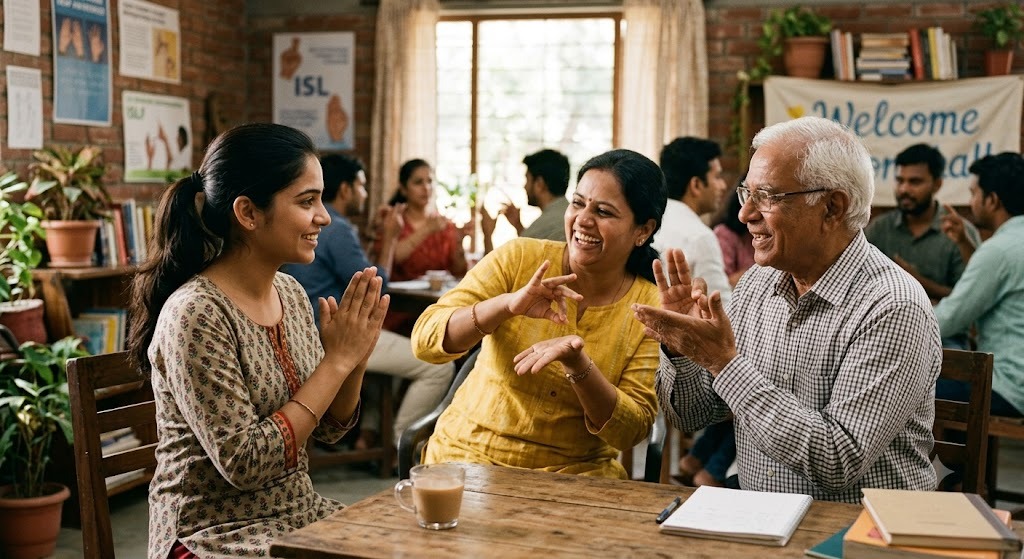
Successful communication is a cornerstone of human relations, as it allows people to articulate their perspectives, sentiments, and thoughts in a manner that promotes reciprocal understanding and respect. Sharing one’s opinions and emotions helps facilitate productive conversation and improves interpersonal ties. In simple words, communication is an essential tool for fostering empathy, establishing trust, and making sure that different views are heard and respected. Having said that, think about how people who are deaf must be communicating. Given that they are unable to hear the sound necessary to start a discussion, how many difficulties must they be enduring in their effort to converse?
Acknowledging the significance of language is recognising each person’s right to be acknowledged, heard, and understood in their natural communication style. Words are the basis of human interaction, as communication is more than just language. That’s how Indian Sign Language (ISL) becomes more than just a tool for deaf people, since it is a lifeline that allows them to express their identities, feelings, and thoughts with dignity and clarity. Without language, communication is separated and alienating, and with ISL, it is equitable, inclusive, and empowering.
Millions of deaf people in India and South Asia use Indian Sign Language (ISL), a fully developed natural language that has its origins in residential schools from the late 19th century and is becoming more widely recognised thanks to contemporary laws like the National Education Policy (2020) and the Rights of Persons with Disabilities Act (2016). Although it still lacks constitutional legitimacy, it has developed from casual gestures into an organised linguistic system with grammatical rules, syntax, and dialects.
ISL not only provides deaf people with a comprehensive and natural linguistic system for communication, but it is also essential in helping them exercise their sense of autonomy. Beyond simple gestures, it facilitates clear and expressive communication using hand forms, movements, facial expressions, and body language. Deaf people can communicate complicated concepts, feelings, and narratives thanks to its structured grammar and vocabulary, which makes it an effective tool for social engagement, education, and the workplace.
In furtherance of bridging communication gaps, ISL facilitates accessibility in public services, workplaces, and educational institutions, fosters inclusivity, and strengthens cultural identity within the deaf community. Children with hearing loss or deafness will find it simpler to adapt to ISL in their growing years and advance academically faster when they are introduced to it early. In families, the ability of deaf children to interact with the outside world is greatly influenced by their parents, and learning Indian Sign Language (ISL) is a significant part of this process. By learning the correct language, parents may interact with their child directly and successfully, making sure that everyday instructions, emotional needs, and personal expressions are all understood. This promotes the child’s self-assurance, social inclusion, and cognitive growth, in addition to strengthening the parent-child bond. Additionally, when parents adopt ISL, they provide an example of inclusivity and acceptance, which makes the child feel supported and appreciated at home and in society.
However, this is only feasible for children who belong to comfortable socioeconomic classes and whose parents are willing to invest in them. Many of our children live in rural areas, where parents don’t know ISL or have not even heard of it, and even if they do want to learn, they are not able to due to a lack of services. Following that, children are sent to special schools, where they spend their academic lives socialising only with other deaf students. When the appropriate time comes for them to enter mainstream higher education and eventually the workforce, they are unable to deal with the stress of communication because of limited awareness and access to inclusive communication systems, which causes them to lose out on competitive and long-term employment.
The Rights of Persons with Disabilities Act (2016) officially recognised ISL as an element of accessibility measures, even though it does not currently have the same constitutional standing as Hindi, Odia, or other listed languages. With the conversion of NCERT textbooks into ISL and the introduction of ISL as a subject in certain institutions, the National Education Policy (2020) placed a strong emphasis on ISL inclusion in schools. The Indian Sign Language Research and Training Centre (ISLRTC), founded in 2015, creates digital resources, training courses, and ISL dictionaries to encourage more people to use it, including inclusive school teachers and other service providers.
In the context of our state, Odisha has become a leading state in the advancement of Indian Sign Language (ISL) through organised policy interventions and community-focused activities. Launched in 2024, the flagship programme Sanketa-Mo Bhasha is a significant step towards helping deaf people overcome communication hurdles. The project, which is being carried out in partnership with the Odisha Rising Foundation (ORF) and the Ali Yavar Jung National Institute of Speech & Hearing Disabilities (AYJNISHD), intends to educate parents and teachers in schools and train at least 100 sign language interpreters, whose numbers have to be increased to make a significant impact.
The International Day of the Deaf is observed on the final Sunday of September, which happens to be the 27th of this year. The International Week of the Deaf is held yearly during the last full week of September. Ideally, as we understand the value of inclusion, each one of us would consider learning Indian Sign Language as a means of promoting inclusion on the ground.
(The author is a development sector professional. Views expressed are personal.)