
























Explore humanity’s future as AI, climate change and global risks reshape society. Suresh Chandra Sarangi examines technology, resilience and hope.
Suresh Chandra Sarangi
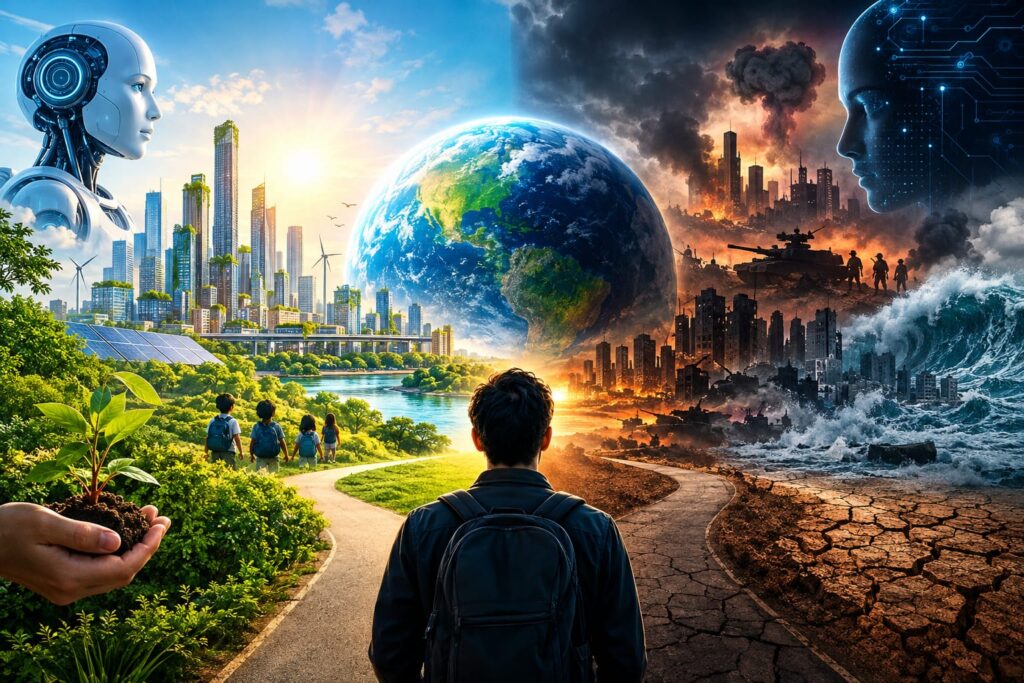
What are the prospects for humanity in the future? Is it a benign world or a dystopian one? Politically, it is uncertain and chaotic, with geopolitics taking centre stage and the revenge of geography shattering the myth of one world. It is unsettled, rapidly changing, and faces an existential threat. Short-termism, ad hocism, and greed are taking over. Debates are polarising on almost everything, the latest being the transformational power and potential of artificial intelligence.
The future of humanity hinges on the future of technology and how we harness its power by accepting it in society so that it can produce public good as well as growth. Here comes the mantra for human beings to think rationally, globally, and collectively while avoiding dystopian risks. Cautious optimism will take us into exploring the frontiers of science and technology for a common future full of hope and optimism. Massive advances in robotics, biotechnology, cyber technology, and artificial intelligence, if applied properly, could boost our economic growth, ensure progress, solve our climate crisis, and help avoid a nuclear war. Scientists have already issued a stern warning that if we do not shed consumerism and throw off our complacency, we may be losing control.
Perils and Prospects
The perils and prospects are huge, and how we use our tools is important. First is a growing population, along with a scarcity of food, housing, healthcare, wages and income, and increasing inequality amid limited resources. In spite of powerful technologies such as biotechnology, cyber technology, and AI helping us find a benign future without the threat of catastrophic downsides, everything depends on how we use them so that they do not become rogue tools. The stakes are high, and the prudent management of available resources and information, along with the formulation of appropriate, balanced policy guidelines best suited to growth and development, will remain key to achieving crucial developmental goals.
Change is constant; it is happening with accelerating force. In a world of endless outrage, the planet’s problems are multiplying day by day. There is mounting public dismay, and the leaders’ total indifference to addressing these problems is making the situation murkier. There is still some light, it appears, at the end of the tunnel. That light is the determined optimism of Homo sapiens. Policy initiatives in the areas of education, poverty reduction, and inequality are steps towards progress, while climate change and environmental challenges remain monstrous villains. Amid the pall of gloom, people are clamouring for infectious optimism, with unshakable faith and hope, by designing and pursuing a policy of strategic optimism. There is a call for the protection of nature and its biodiversity, as well as concern about global warming, with the developing El Niño pointing to impending doom.
Technology Is a Good Servant
So, can we say that the problems humanity faces today can be erased in a “Gone with the Wind”-type situation? Public discourse is increasing as our survival is at stake. Thus, it is an intermixture of hope, despair, and conjecture. Actually, the challenges are daunting, but by introducing a policy of sustainability and long-term planning, and by bringing in people-centred technologies and planet-centred ecological stability, we can withstand this vulnerability. Gone are the days when humans were bewildered and felt helpless in the face of floods, droughts, diseases, pestilence, etc. Human beings have been able to address these problems, though not fully, but significantly.
In the book Technofeudalism, the author lays out how, within a decade, technology will disrupt working patterns, national economies, and international understanding. But technology is a good servant and a bad master. Governments are improving governance worldwide, but the gap between the rich and the poor is increasing. War is destroying the world’s cultures and the concept of peaceful coexistence, without reason or rhyme, while welfare becomes a dirty word, much used but gradually losing its relevance. The rising inequality, which continues to widen and affects equity and justice, is particularly disquieting.
As Steven Pinker says, there is less violence today than in the Middle Ages, and there is an abundance of everything as a result of industrialisation, with technology acting as an enabler. There has been a welcome improvement in people’s lives through medicine, with the prospects of better health, longer lifespans, improved education, and better telecommunications and management through electronic media. The bottom billions now decide who will rule through universal suffrage. Political equality is awesome, while the redistribution of wealth through welfare economics, financial inclusion, inclusive growth, and governance is working wonders.
Any humanitarian imperative, such as justice and equity, represents a major shift in our ideology and is a welcome departure from the past. The remedial measures have, in fact, improved the lot of the poor, who now have the means to earn and opportunities to improve their lives. The future is better than we think. Change, both social and technological, is happening so fast that humanity must believe in the immense power of technology and move forward.
There is no doubt that these are turbulent times. One tiny virus brought the whole world to a standstill when the world seemed to be on the edge. But humanity could control it. There have been big bumps on the road to economic progress, such as the 2008 global financial crisis, which shattered global economic systems, but the world of finance emerged victorious from it. The hard fact is that science and technology, along with socioeconomic trends, are rapidly changing the world for the better.
Recovering from the financial shock so quickly, with a massive stimulus package and huge outlays, enabled humanity to absorb the shock with tremendous resilience and proved that the inexorable laws of the universe, nature, and social systems cannot take humanity for a ride forever, despite the traumatic, gut-wrenching experience. Today, natural disasters can be predicted in advance, and terrorist attacks can be countered through scientific monitoring and signals.
The Climate Crisis
No doubt, we have withstood unspeakable disasters, but incredible advances have brought dividends as well. The world wars, the influenza pandemic of 1918, tsunamis, hurricanes, earthquakes, fires, floods, plague, locusts, smallpox, and, last but not least, the COVID-19 pandemic were turning points, but they were controlled with efficiency and human resilience, helping lift humanity from the scourges of these disasters. Infant mortality has gone down by 90%; overall life expectancy has increased by 100% in some countries. The cost of food has dropped, while the cost of energy has skyrocketed after the US-Israel-Iran war. Prices have soared, and a shattering energy crisis haunts the world, prompting us to develop new and renewable energy sources and abandon fossil fuels, the main cause of the climate crisis.
The real issue is, as Peter Diamandis would remark, that as a result of globalisation, Diamandis and Steven Kotler write in their book Abundance, “what happened here, also happens there.” Now, pandemics do not respect borders, terrorist organisations operate at scale, and overpopulation is everybody’s problem. The future lies in the next convergence, and future economic growth in a multipolar, multispeed world is a new panacea for humankind.
Applying science and technology to production, logistics, communication, and management, along with changes in technology, institutions, and global governance, has brought and will continue to bring a dramatic shift in patterns of growth and development in the future. The landscape is changing because of all these cumulative effects. In the future, leadership, politics, governance, and effective administration will play a major role in shaping not an egalitarian social order, but at least an equitable one that promises hope, equity, and justice.
Notwithstanding the looming dangers of climate change, another issue gripping humankind is the emergence of artificial intelligence and the rise and rule of robots. With biotechnology, cyber technology, robotics, AI, and human-level intelligence, the current debate centres on emerging existential risks. When Geoffrey Hinton and Anthropic scientist Saxon raised the alarm, they highlighted the existential threat. AI becoming autonomous, using its power to hack the internet, and the self-propagation and mutation of agents, combined with reduced human control, have posed a genuine existential threat.
That is where regulation is mandatory for our survival. Three issues confronting Homo sapiens today, with the potential to fundamentally alter the human race in the future, are the impending climate crisis threatening the planet and our ecosystem, the prospect of nuclear war, and autonomous artificial intelligence systems.
Society, it appears, will be transformed by autonomous robots, even though the jury is still out on whether they will possess what we would call real understanding or whether they will be “idiot servants” with competence but without comprehension, as the noted astrophysicist Martin Rees says. Let us hope there is always a silver lining in every dark cloud.
(The writer is a former General Manager of Bank of India. Views expressed are personal.)