
























Satya Brata Das’s The Manifesto of Hope reimagines Gandhi’s philosophy to address climate change, sustainability, citizen leadership and the need for a new social contract
Sourav Prakash Das
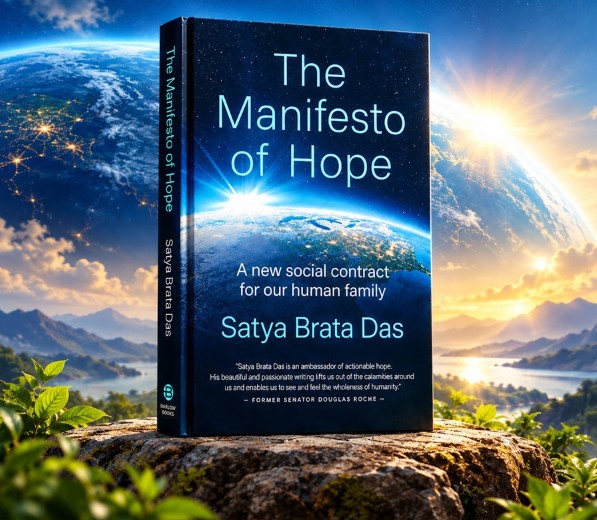
The Manifesto of Hope
Satya Brata Das
Barlow Books
Price (Kindle-edition): Rs 834
What can Gandhi’s philosophy tell us about a world facing climate change, ecological degradation, growing inequality and deepening social divisions? ‘The Manifesto of Hope’ by acclaimed journalist, author and global sustainability expert Satya Brata Das explores this question, taking the Mahatma’s ideas beyond their historical context to examine their relevance to today’s planetary challenges.
The book’s engagement with Gandhian philosophy is one of its most distinctive features. Ahimsa, Sarvodaya, Swaraj and Satyagraha are presented not simply as principles of India’s freedom struggle, but as a contemporary framework for responsible citizenship and sustainable living. Ahimsa becomes an ethic of reducing harm to people and the planet; Sarvodaya speaks to equity and inclusive progress; Swaraj becomes an argument for self-governance and citizen leadership; and Satyagraha is connected with truth, evidence and accountability.
This philosophical foundation becomes particularly relevant as Das examines the scale of the problems confronting humanity. Climate change is no longer a distant threat. Extreme weather, ecological degradation, biodiversity loss, resource pressures and inequality are already affecting communities across the world. Yet governments, businesses and international institutions often struggle to translate ambitious commitments into meaningful action.
Das argues that the challenge is therefore not simply a lack of technology or knowledge. It is also a crisis of political will, institutional capacity, financial architecture and collective responsibility. Crucially, it is a crisis of citizenship. Citizens are too often positioned as spectators of decisions made by governments and institutions rather than as active participants in shaping the future. For Das, this disconnect is significant because no policy, agreement or institutional reform can deliver lasting change without public participation and ownership. Citizen leadership, therefore, becomes an essential part of the response – empowering individuals and communities to move beyond awareness and consumption towards self-governance, accountability and everyday action.
The book consequently looks beyond conventional approaches to climate action. At its heart is the ARM doctrine — Adaptation, Resilience and Mitigation. Rather than treating climate policy as a choice between reducing future emissions and responding to present impacts, ARM brings these priorities together. Mitigation remains essential, but societies must also prepare for unavoidable climate impacts and strengthen the resilience of vulnerable communities.
Das also examines the financial foundations of the green transition. Climate action requires substantial capital, yet existing financial systems often struggle to direct investment towards long-term sustainability. The book explores green finance, blended finance and the idea of a World Climate Bank to mobilise and de-risk capital for climate resilience and the green transition. It challenges the world to rethink finance not merely as a mechanism for growth, but as an instrument for planetary wellbeing.
These ideas lead to the book’s central proposition: the need for a new social contract. Das argues that the planetary age demands a social contract extending beyond the traditional relationship between citizens and the state. It must recognise our shared responsibilities towards one another, nature and future generations. Governments, businesses, institutions, communities and citizens must all become partners in building a sustainable and equitable future.
Ultimately, The Manifesto of Hope does not present hope as passive optimism. It presents hope as responsibility and action. Its message that “despair is not a strategy” gives the book its urgency, while its Gandhian foundation gives that urgency a moral direction.
Satya Brata Das brings considerable experience to this conversation. An Odisha-born Canadian author, sustainability expert, strategist and barrier-breaking journalist, he has more than five decades of experience spanning journalism, public policy, international affairs and leadership. This diverse background is reflected in the book’s wide canvas, connecting philosophy with climate action, economics with geopolitics, and global institutions with everyday citizenship.
At its core, ‘The Manifesto of Hope’ invites readers to rethink climate action not merely as an environmental imperative, but as a collective project to rebuild our relationship with society, nature and one another.
(The writer is a communications professional specializing in content writing, digital journalism, and public relations. Views expressed are personal.)