























Children’s Day highlights the fight against child labour, trafficking and child marriage in Odisha. Discover why protecting childhood needs year-round action
Dr Aditi Panda
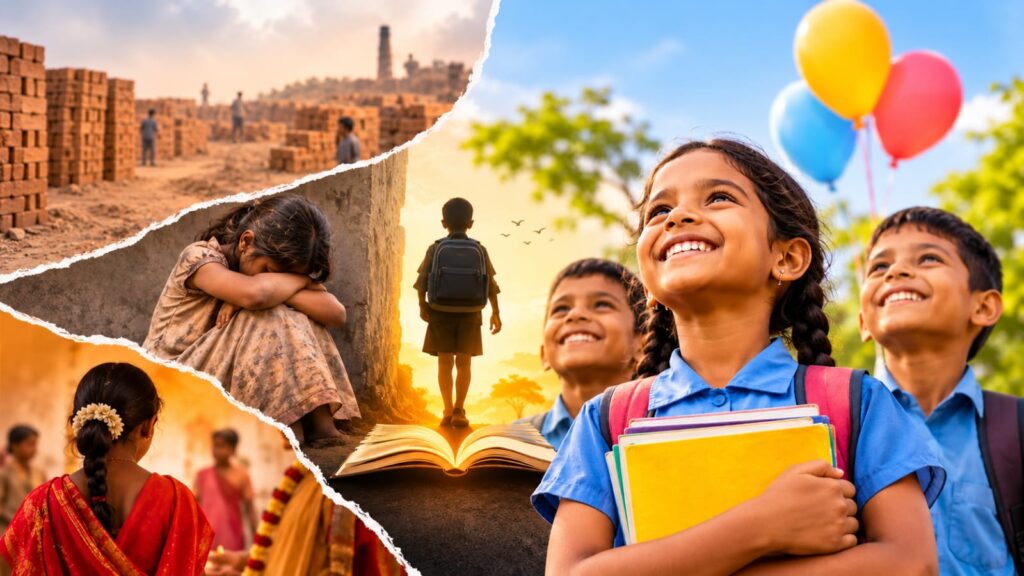
Every year on November 14, schools and slums throughout India come alive with speeches, chocolates, and laughter, professing love for children and emphasising our moral responsibility to protect them. But, on the other hand, we find several children in Odisha and the rest of the country spending their days away from classroom desks in brick kilns, roadside restaurants and shops, as well as distant agricultural fields, far from the schools where they should belong.
In India, along with child labour, child marriage and child trafficking are two major issues that exacerbate one another and, at the same time, rob children of their childhood. Poverty and school dropout rates force young boys into dangerous situations and adolescent girls into early marriages in rural pockets of our vast country, which has diverse living conditions, including in Odisha. We need to keep in mind that if a child is deprived of education during their growing years, not only is their health harmed, but their childhood is also lost, whether they are trapped in a brick kiln or burdened with domestic duties as a child bride.
According to the National Crime Records Bureau’s Crime in India report, it is discouraging to learn that only six cases under the Child and Adolescent Labour (Prohibition and Regulation) Act, 1986, were reported between 2018 and 2022, placing Odisha among the states with the fewest reported cases. These six cases were all filed in 2021. However, 1,992 children were rescued, removed from employment, and mainstreamed under the Ministry of Labour and Employment’s NCLP programme during that period, which is indicative of the minimal reporting.
The National Family Health Survey (NFHS-5) data reveals that 20.5% of women aged 20–24 in Odisha were married before turning 18 (down from 37.2% in NFHS-3 and lower than the national average of 23.3%). At the same time, 13.3% of men in the age group of 25–29 years were married before attaining the legal age of 21, which is a matter of concern.
In the context of human trafficking in India, Odisha has recorded the highest number of victims for four consecutive reporting years, with 1,475 victims in 2021, 1,120 in 2022, 1,305 in 2023, and 1,039 in 2024, as per data from the National Crime Records Bureau (NCRB). Children make up a disproportionately large share of these figures, as Odisha ranks second in the nation for minor girl trafficking and first for registered incidents of minor boy trafficking (mostly for hazardous labour and begging). This risk is intensified by the state’s sharp increase in missing children, with the number rising from 2,899 in 2020 to 6,223 in 2024. Nearly 87% of these children were girls, making thousands of minors extremely vulnerable to forced marriage, domestic servitude, and interstate exploitation.
Handing out chocolates and delivering stage speeches once a year will never rescue a child from a brick kiln, prevent an underage marriage, or dismantle a trafficking network. The legal system and government bodies alone cannot combat these matters of utmost concern and protect every child. However, the burden can be reduced if we, as a vigilant and engaged civil society, join hands with the government and share the responsibility equally.
Meaningful change starts with small, doable choices in our own homes and localities. Every resident can take a stand by refusing to hire minors as domestic help, verifying age proofs before employing workers, and boycotting or reporting shops or restaurants that employ children. We can check whether the children of our domestic staff and local construction workers are enrolled in school, help struggling families access government welfare schemes, and donate school supplies to verified shelters instead of handing cash to children begging at traffic signals. Most importantly, saving 1098 on our phones and reporting suspected child labour, trafficking, or underage marriages without hesitation can turn passive sympathy into life-saving action.
It is discouraging, but a sad reality, that despite increased awareness, girls remain more vulnerable to abuse and early marriage. This makes it even more necessary to break the silence and prioritise their safety. In addition to losing her education and independence, a girl who is taken out of school and pushed into marriage before turning eighteen is also more vulnerable to exploitation, domestic abuse, and potentially fatal health issues. Maternal and infant mortality rates will drop significantly when we ensure that a girl enters motherhood only after her body and mind are fully mature. Keeping girls in school, enabling them to speak out against abuse through peer support networks, and holding families, local service providers, and community elders responsible for preventing underage marriages are all part of safeguarding girls.
Our children will be happy and safe if we stop brushing pertinent issues under the carpet once the decorations are taken down after a Children’s Day celebration. Stronger village-level migration tracking, stringent enforcement against employers and traffickers, accessible schools, and proactive community reporting through helplines like 1098 are all necessary for real change. November 14 should not be our only day of concern, but rather our annual checkpoint. We will not be able to genuinely celebrate Children’s Day until every child in Odisha and throughout India is safe in a classroom instead of being exploited through labour or coerced into marriage.
True celebration cannot be limited to twenty-four hours, even though a designated day on the calendar serves as a reminder of our responsibility towards children. An unwavering, year-round commitment is necessary to safeguard childhood, put a stop to atrocities against children, and ensure that every child has the chance to learn and dream.
Together, let us strive to create a safer and happier place for our children, ensuring that we celebrate Children’s Day every day.
(The author is a development sector professional. Views expressed are personal.)