






















Pandit Gopabandhu Das, revered as Utkalamani—the Jewel of Odisha, devoted his life to selfless service, education, journalism, and India’s freedom struggle. His unparalleled sacrifices, boundless compassion, and enduring ideals continue to inspire generations, making him an immortal symbol of patriotism, humanity, and service to the nation
Sourav Prakash Das
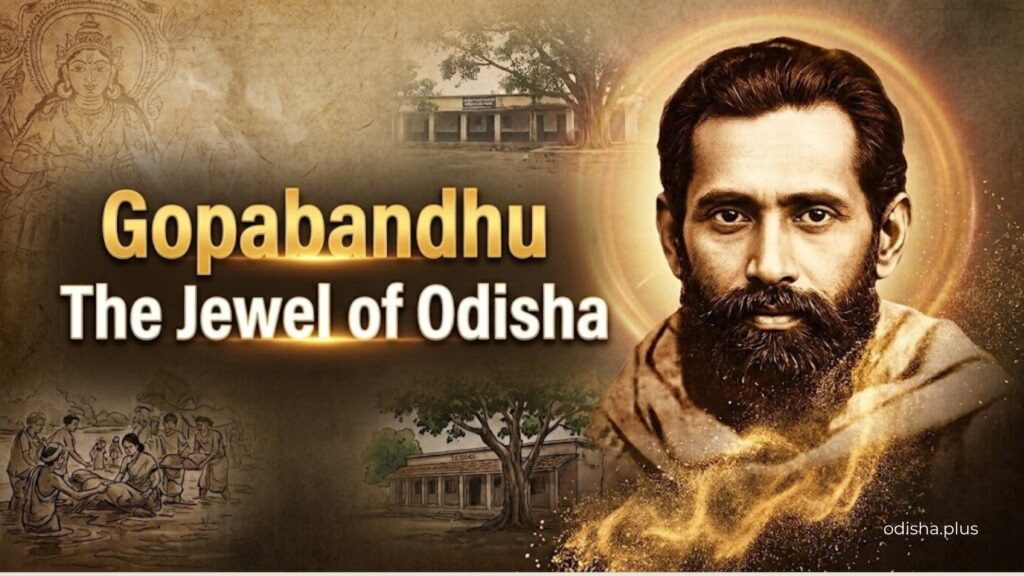
“Misu mora deha e desha matire, Desabasi chali jaantu pethire. Desara swarajya pathe jete gada, Puru tahin padi mora mansa hada.” (Let my body merge with the soil of this land; Let my countrymen walk upon my back. Wherever there are trenches on the path to the nation’s freedom, May my flesh and bones lie there to fill them.)
These are not merely poetic lines – they are the heartbeat of a man who offered every breath, every tear, and every drop of his blood to his motherland. They are the eternal prayer of a patriot who never desired wealth, comfort, or recognition, but wished only to become a part of the very soil of Odisha and India.
Few leaders have lived their ideals as completely as Pandit Gopabandhu Das, lovingly remembered as Utkalamani – the Jewel of Odisha. His life was not a tale of personal success but a magnificent saga of sacrifice, compassion, courage, and unwavering service to humanity.
Even today, when Odisha remembers its greatest sons, the name of Gopabandhu shines with unmatched brilliance. His story is not simply history – it is an enduring inspiration that teaches every generation that the highest purpose of life is to live for others.
The Making of Utkalamani: A Title Earned Through Service
Across Odisha, Pandit Gopabandhu Das is remembered with deep affection and reverence as Utkalamani, the Jewel of Odisha. While the title “Pandit” was traditionally used as a mark of learning and scholarship, the honour of “Utkalamani” was bestowed upon him by the great scientist and thinker Acharya Prafulla Chandra Ray in 1924. The title was not given merely for his intellectual brilliance, but as a tribute to his extraordinary dedication, selflessness, and lifelong service to the people of Odisha.
A Childhood Shaped by Loss, Strength, and Compassion
Born on 9th October 1877 to Daitari Das and Swarnamayee Devi in the tranquil village of Suando, near Sakhigopal in Puri district, Gopabandhu Das entered the world amid sorrow. His mother passed away during his infancy, and he was lovingly raised by his widowed aunt. Bereft of a mother’s affection from the very beginning, he perhaps developed the boundless compassion that later defined his life.
Following the custom of child marriage prevalent in those days, Gopabandhu was married at the tender age of twelve. Yet neither early responsibilities nor personal hardships diminished his thirst for knowledge. He continued his education with unwavering determination and joined Puri Zilla School in 1893, where his literary talent and fearless devotion to truth began to flourish. While pursuing higher studies, he endured another painful loss with the death of his father, a tragedy that further strengthened his resilience and sense of duty.
A devoted reader of the Srimad Bhagavata and a passionate lover of Odia literature, Gopabandhu fearlessly defended the dignity and independence of the Odia language. Through an article published in Indradhanu, he expressed his views boldly and refused to compromise even when he was fined by the respected poet and School Inspector Radhanath Ray.
For Gopabandhu, truth was never something to be surrendered before authority.That fearless devotion to truth became the foundation upon which his extraordinary life was built.
A Heart That Belonged to the People
Education carried him to Ravenshaw College in 1899, where he earned his Bachelor’s degree in 1904 before studying Law. Yet his greatest classroom was society itself.
Even as a student, he could never ignore human suffering. Whether floods devastated villages or disease spread among the poor, Gopabandhu was always among the first to serve. Compassion was not an occasional virtue for him – it was his very identity.
Nothing illustrates this more powerfully than the most heart-rending episode of his life.
His only son lay critically ill at home. At that very moment, catastrophic floods swept across Odisha, leaving thousands homeless and helpless. Faced with an impossible choice between his dying child and countless suffering strangers, Gopabandhu made the ultimate sacrifice. Believing that his son still had loving family members beside him while the flood victims had no one, he left home to organize relief work.
When he returned, his beloved son was no more.
The grief of a father became the strength of a servant of humanity. Such sacrifice is beyond ordinary imagination. It transformed Gopabandhu from a great man into a timeless legend.
When Mukhtar Ramachandra Das once asked him about the purpose of his life, his answer came without hesitation: “Service to society and a life of freedom.”
Every action that followed became a living interpretation of these simple yet profound words.
Life continued to test his resilience. In 1906, while only twenty-eight years old, he lost his beloved wife, leaving him with two young daughters, Sarangini and Ketaki.
Friends repeatedly urged him to remarry, but Gopabandhu quietly refused.
His family had grown larger than his own household. Every orphan became his child. Every grieving mother became his own. Every suffering citizen became a member of his extended family. His heart no longer belonged to himself—it belonged to the people of Odisha.
The Architect of Character-Building Education
Gopabandhu believed that true education must produce good human beings before producing successful professionals. Guided by this conviction, he founded the Satyabadi Bana Vidyalaya on 12 August 1909 with only nineteen students beneath the shade of trees.
The school became a revolutionary experiment where students learned not only literature and science but also honesty, discipline, patriotism, equality, and service. Nature became the classroom, and character became the curriculum.
Orthodox sections of society strongly opposed these progressive ideals. In an act of hatred, the school was even set on fire.
But flames could burn walls – not ideals.
With unshakable determination, Gopabandhu rebuilt the institution, proving that truth always rises from ashes.
Together with Nilakantha Das, Acharya Harihar, Godabarish Mishra, and Krupasindhu Mishra – the celebrated Panchasakha of modern Odisha – he pledged to dedicate his entire life to the service of the motherland without seeking government employment for personal gain.
The Voice of Freedom and the Soul of Odisha
The Partition of Bengal in 1905 awakened Gopabandhu Das’ patriotic spirit while he was studying law in Calcutta. A firm believer in self-reliance, he embraced khadi throughout his life, promoted indigenous industries, and worked tirelessly for the welfare of the people.
When the Province of Bihar and Odisha was formed in 1912, Madhusudan Das repeatedly urged Gopabandhu Das to enter the Legislative Council. Deeply attached to his beloved Satyabadi Bana Vidyalaya, Gopabandhu was initially reluctant to leave his educational mission. However, recognising that he could serve the people on a larger platform, he eventually agreed and was elected to the Legislative Council in 1917.
His deep commitment to Odisha found expression through both the Utkal Sammilani during his Ravenshaw days and the Legislative Council, where he worked tirelessly for the unification of the scattered Odia-speaking regions. During his tenure, he championed permanent flood-control measures, the expansion of education, the restoration of the people’s traditional right to manufacture salt without oppressive taxation, and, above all, the dream of a united Odisha.
Though he did not live to witness the creation of Odisha as a separate province in 1936, his vision and relentless efforts laid a strong foundation for that historic achievement.
After joining the Indian National Congress in 1916, Gopabandhu embraced Mahatma Gandhi’s ideals and played a key role in merging the Utkal Sammilani with the Congress in 1920. Gandhi’s visit to Odisha in 1921, at Gopabandhu’s invitation, further strengthened the freedom movement. Revered as the “Gandhi of Odisha”, he later became the first President of the Odisha Pradesh Congress Committee, and one of the foremost leaders of the state’s freedom movement.
The Patriot Who Gave Odisha a Voice
Gopabandhu believed that the freedom of a nation depended not only on courageous leaders but also on an informed and awakened society. Recognising the power of journalism, he first supported the publication of the daily Asha in Berhampur in 1913. Later, using his entire earnings as a member of the Legislative Council, he founded the monthly magazine ‘Satyabadi’ and the weekly newspaper ‘The Samaja’ in 1919.
What began as a humble newspaper gradually became the conscience of Odisha. ‘The Samaja’ emerged as the fearless voice of the voiceless, speaking for farmers, labourers, flood victims, and every ordinary Odia whose sufferings often remained unheard. Through his writings, Gopabandhu transformed journalism into a powerful instrument of public service and national awakening.
A Prison That Could Not Imprison His Spirit
Gopabandhu’s fearless journalism and unwavering commitment to India’s freedom inevitably attracted colonial repression. Arrested for defying British authority during the Non-Cooperation Movement, he endured imprisonment in Cuttack Jail and later Hazaribagh Central Jail.
Yet prison walls could imprison only his body—not his spirit. Within those lonely cells flowed a stream of immortal literature. He authored enduring classics such as Bandira Atmakatha, Dharmapada, Go-Mahatmya, Nachiketa Upakhyana, and Karakavita. Earlier, during his student days, he had written Abakasha Chinta.
In the captivity, his pen remained free, inspiring generations with ideals of truth, sacrifice, patriotism, and selfless service.
Serving Until His Final Breath
After his release in 1924, Gopabandhu plunged once again into relief work during the devastating floods of 1925 and 1927. Ignoring his deteriorating health, he travelled tirelessly to rescue the suffering and rebuild shattered lives.
His unmatched dedication deeply moved Lala Lajpat Rai, who appointed him Vice-President of the Lok Sevak Mandal.
Yet even failing health could not persuade him to rest. Travels to Lahore and Calcutta for public causes further weakened him.
Finally, on 17 June 1928, at 7:25 pm, the compassionate heart that had lived entirely for others ceased to beat.
But only his mortal body perished.
His ideals became immortal.
A Light That Will Never Fade
Gopabandhu Das never measured life by possessions or achievements. He measured it by the number of lives touched, the tears wiped away, the children educated, the oppressed defended, and the nation uplifted.
His dream was simple—to see an educated, united, compassionate, and self-reliant Odisha within a free India.
His own immortal words continue to guide humanity: “Human life is not merely a count of years, months, and days. The true measure of a person’s life is the work he does for others.”
That is why Odisha reveres him not merely as a freedom fighter, teacher, lawyer, journalist, or poet. He lives forever as Utkalamani, the Jewel of Odisha.
His body indeed merged with the soil of his beloved land. But his ideals became the soul of Odisha itself.
(The writer is a communications professional specializing in content writing, digital journalism, and public relations. Views expressed are personal.)