
























Explore the debate between linguistic prescriptivism and natural language evolution in India. How do institutions balance standard grammar with linguistic diversity?
Bhaskar Parichha
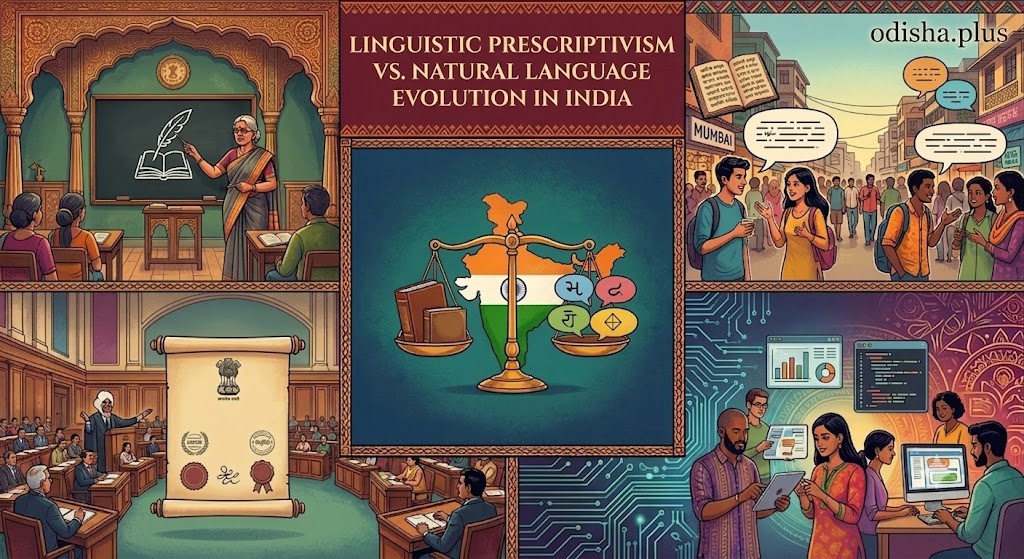
Linguistic prescriptivism refers to enforcing “correct” language rules, grammar, and usage standards over natural evolution. This was seen in the 18th-19th centuries with the rise of the French Academy (1635), Johnson’s Dictionary (1755), Lowth’s grammar (1762), and Murray’s rules. It standardized “correct” usage via education and elites.
Indian Situation
Linguistic prescriptivism is the belief that there is a “correct” or “standard” form of a language and that other forms should be discouraged or corrected. In India, where hundreds of languages and thousands of dialects coexist, prescriptivism has played a significant role in language policy, education, literature, and identity.
Prescriptivism emerged strongly during the colonial period, when grammars and dictionaries were prepared for major Indian languages. Scholars and administrators codified languages such as Hindi, Bengali, Odia, Tamil, Telugu, Kannada, and Marathi, often elevating one dialect as the standard. These standardized forms became the languages of education, administration, and literature.
After Independence, language standardization became closely linked to state formation and cultural identity. The creation of linguistic states reinforced the need for standardized languages. Institutions such as the Sahitya Akademi, state language academies, and universities promoted standard spelling, grammar, and vocabulary.
This happened in several ways – the preference for highly Sanskritized Hindi over colloquial Hindustani. Then, the standardization of Odia spelling and grammar followed the recognition of its classical language status. Similar Efforts were made in Tamil Nadu to promote “pure Tamil” by reducing the use of Sanskrit. Also, the promotion of standard Bengali is based on the Kolkata dialect despite regional variations.
Pros and Cons
Prescriptivism has both advantages and disadvantages. It facilitates education, administration, publishing, and official communication by creating a common standard. However, it can marginalize regional dialects, tribal languages, and everyday speech. Speakers of non-standard varieties may face social stigma, and linguistic diversity may be undervalued.
In recent years, linguists have increasingly advocated a descriptive approach, recognizing that all dialects are systematic and linguistically valid. Digital media and social networking have further blurred the distinction between standard and non-standard language by encouraging people to write in their own regional styles.
So, India’s linguistic landscape continues to balance the need for standardization with the preservation of its extraordinary diversity. The challenge here is to maintain a common standard for public communication while respecting the richness of regional languages, dialects, and speech communities.
How Practical?
The practicability of linguistic prescriptivism in India, as said above, is limited by the country’s extraordinary linguistic diversity.
A fully prescriptive approach—enforcing a single “correct” form of a language—is difficult to sustain because India has over a thousand speech varieties, numerous regional dialects, and multilingual speakers who constantly mix languages in everyday communication.
Standard languages are undoubtedly necessary for education, administration, law, publishing, and the media, but excessive prescriptivism can alienate speakers of non-standard dialects and undermine linguistic diversity.
Limited Role
In practice, India follows a mixed model. Prescriptivism is used in formal domains such as school textbooks, government documents, competitive examinations, and official broadcasting, where uniformity is essential.
Descriptivism increasingly dominates everyday communication, literature, cinema, television, and especially social media, where regional dialects, code-switching, and hybrid forms (such as Hinglish, Tanglish, and Odia-English mixes) are widely accepted.
Therefore, linguistic prescriptivism is practicable only to a limited extent. It is effective when applied to formal and institutional contexts but becomes impractical if imposed rigidly on everyday speech. India’s multilingual reality demands a flexible approach that balances standardization with respect for linguistic variation.
Who Dominates?
Truly speaking, the common people ultimately dominate the evolution of language, not specialists. Scholars, grammarians, and language academies can prescribe rules for formal writing, education, dictionaries, and official communication. They help standardize spelling, grammar, and usage. However, they cannot permanently control how people actually speak.
Languages change because of everyday use. New words, pronunciations, and grammatical patterns spread through ordinary speakers, popular culture, migration, technology, and social media. If enough people adopt a form, it often becomes accepted over time—even if scholars initially reject it.
In India, this is evident in many examples. Everyday Hinglish has become common despite traditional prescriptions favoring “pure” Hindi or English. Regional dialects continue to influence standard languages. Common usage often determines which words enter dictionaries and school grammars. The relationship is therefore not one of absolute dominance. While scholars shape the standard language used in formal settings, the common people shape the living language used in everyday life.
As the linguist William Labov demonstrated through sociolinguistic research, language change originates within speech communities and is later documented—not created—by scholars.
(The author is a senior journalist and columnist. Views expressed are personal.)