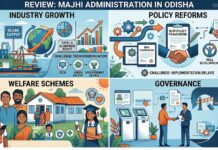



















Two years into the Majhi administration, how is Odisha performing? Get a balanced review of policy, industrial growth, welfare schemes, and governance challenges
Bhaskar Parichha
The conclusion of two years under the leadership of Mohan Charan Majhi signifies a pivotal chapter in Odisha’s political narrative. The 2024 elections ended the uninterrupted 24-year dominance of the Biju Janata Dal, ushering the Bharatiya Janata Party to power independently for the first time in the state. This transition was not solely electoral; it marked a fundamental change in governance approach, political focus, and administrative ethos. Two years on, the performance of the Majhi government presents a complex yet critical overview.
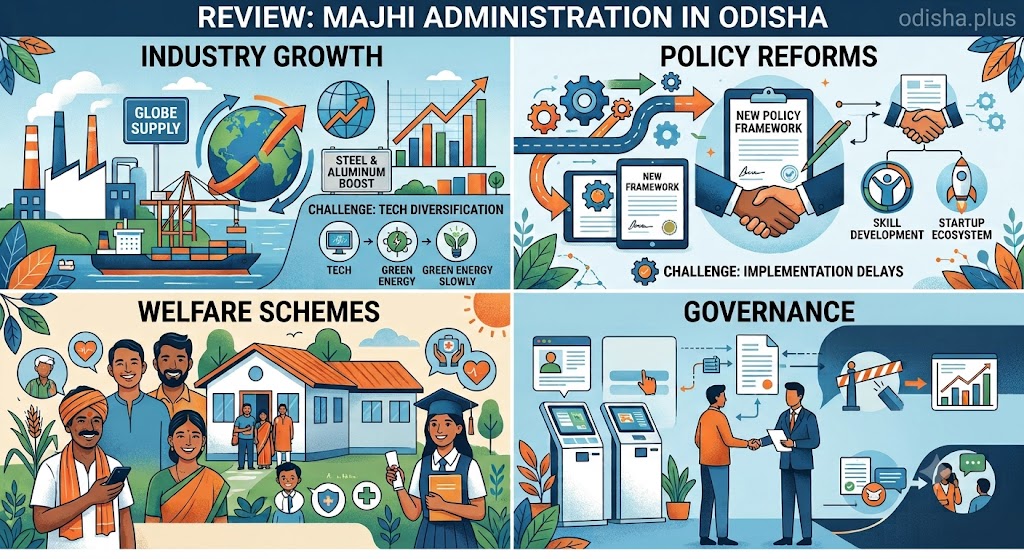
The government’s most notable success has been its capacity to fulfill numerous major electoral commitments with remarkable promptness. The execution of the Subhadra Yojana, the expansion of Ayushman Bharat health coverage, increased support for farmers, and the reopening and cataloging of the Ratna Bhandar of the Jagannath Temple reflect a readiness to decisively address issues of both political and symbolic importance. The administration asserts that over one crore women have benefited from the Subhadra scheme, and that healthcare coverage has significantly broadened throughout the state.
Another prominent aspect of the last two years has been the government’s focus on growth driven by investment. Odisha has garnered investment proposals amounting to several lakh crores of rupees, while striving to diversify its economy beyond its historical reliance on mining and heavy industry.
Sectors such as electronics manufacturing, textiles, renewable energy, semiconductor-related initiatives, defense production, and information technology have garnered policy focus. If even a small portion of these proposals comes to fruition, they could transform Odisha’s economic landscape in the next decade.
The government has aimed to set itself apart through a more visible and accessible administrative approach. Public grievance hearings, extensive outreach initiatives, and the promotion of a “people’s government” have emerged as consistent themes. The political leadership has effectively solidified its position within the state and enhanced its status within the national party framework.
However, these accomplishments are accompanied by considerable challenges. Investment announcements do not necessarily lead to job creation. Although industrial commitments have risen, the generation of employment has not aligned with public expectations.
Issues such as infrastructure bottlenecks, urban management difficulties, and concerns regarding implementation capacity remain prevalent. The government is now entering a stage where citizens will evaluate outcomes rather than mere announcements.
The administration also confronts the challenge of governing beyond mere symbolism. Cultural and religious initiatives have resonated with various segments of society, yet voters increasingly demand advancements in education, healthcare, employment, agriculture, and urban services. The success of the government’s long-term vision for a developed Odisha will hinge on whether welfare schemes and investment pledges yield tangible improvements in daily life.
Two years is an insufficient timeframe for a conclusive assessment. The Majhi government has exhibited vigor, political confidence, and the ability for swift decision-making. Nonetheless, it must translate promises into lasting results.
The initial two years focused on establishing a new political order; the subsequent three will determine if that order can effectuate enduring transformation. Odisha’s electorate, having embraced change in 2024, will ultimately evaluate the government based on its results rather than its intentions.
(The author is a senior journalist and columnist. Views expressed are personal.)