























Based on the talk presented at the National Seminar-cum-Workshop on ‘Grassroots Journalism’ hosted by the Central University of Odisha during 3-5 August 2026
Nilambar Rath
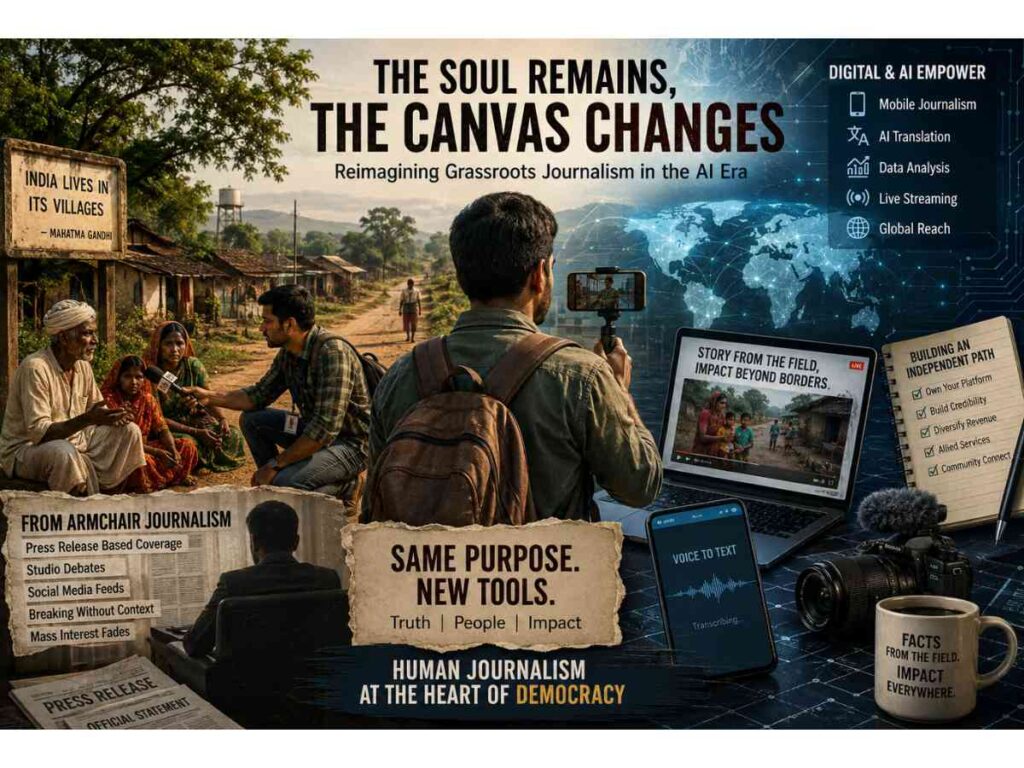
When we discuss “Grassroots Journalism”, we are discussing the very pulse of our democracy. Over my three decades navigating print, television, and the digital convergence, I have witnessed the media landscape shift violently beneath our feet. Yet, amidst the swirl of algorithms, artificial intelligence, and mobile technology, the fundamental truth articulated by Mahatma Gandhi remains absolute: “India lives in its villages.”
Today, we stand at a critical intersection. Legacy media is sunsetting, traditional revenue models for field reporters are collapsing, and digital convergence is rewriting the rules. To navigate this, we must ask ourselves not just how journalism is surviving, but how it can thrive and empower communities in this dynamic era.
Redefining the ‘Grassroots’
Historically, rural journalism was often treated as an afterthought—a small column in a broadsheet dedicated to a remote dispatch. Today, we must urgently redefine our terms. Journalism from the grassroots should no longer be limited merely to journalism from rural areas.
Instead, we must view it as journalism from the field level, irrespective of geography and subjects. Whether the beat is a tribal hamlet in Koraput, a bustling semi-urban block, or a forgotten municipal ward, grassroots journalism is the act of covering the uncovered, discovering the undiscovered, and reaching the unreachable.
So, it is not about reporting on people for the consumption of city dwellers; it is the democratization of information where human-centric reporting takes center stage.
The Engine of Holistic Development and Governance
How does this field-level journalism impact policy and governance?
Simply put, it provides the “last-mile connectivity” for democratic governance. A welfare scheme drafted in New Delhi or Bhubaneswar only succeeds if its implementation at the block or panchayat level is flawless.
When a grassroots journalist highlights a defunct primary health center, a broken supply chain in the PDS (Public Distribution System), or a successful micro-entrepreneurship model, they are providing a real-time audit of governance.
This bottom-up feedback loop forces bureaucratic accountability, corrects policy delivery mechanisms, and ultimately drives the holistic, inclusive development of the state. Without the eyes and ears of the grassroots journalist, the dashboard of governance is flying blind.
The Crisis: Armchair Journalism and Fading Legacy Media
We must acknowledge a harsh reality: since the 1990s, technology has brought unprecedented scale and speed, breaking down all geographical barriers, but it has also triggered a crisis of substance.
Legacy media—print, radio, and television—which were once at their peak, have grossly adopted what can only be described as “armchair journalism.”
There is a growing, uncritical trend of press-release-based coverage. Similarly, today, newsrooms increasingly rely on picking up breaking news, statements, and visuals directly from the social media channels of government departments, corporate PR machineries, and influential individuals. Consequently, mass interest journalism, public interest journalism, and deep investigative reporting have almost faded out from the legacy platforms.
When human-reporting-based journalism takes a back seat, the role of the field journalist is severely curtailed.
For four to five decades, people associated with the press in rural areas (at the district or block levels) managed a living through honorariums tied to the growth of Print and TV. Now, as those mediums lose their luster and shift toward cost-effective studio debates and official feeds, these grassroots communicators face a massive financial and professional shock.
Furthermore, while social media has created a new era of independent outreach, it has not automatically ushered in a new era of robust social and public interest journalism. The rural voices risk being lost in the digital noise.
Shining in the Digital and AI Era: A Global Reach
However, the same technology that disrupted the delivery mechanisms is also the ultimate enabler for the independent field reporter. Journalism itself has practically not changed; the pursuit of truth remains intact. What has changed is our toolkit. Digital, mobile, and AI technologies have fundamentally empowered grassroots media persons to spread their good work across the globe.
Here is how a rural or semi-urban journalist can shine when traditional doors close:
Embrace Mobile Journalism (MoJo):
The smartphone is a full production studio. A field journalist no longer needs an OB van. High-definition video, live streaming, and instant digital publishing allow raw, unvarnished truths from the most remote corners to be shared instantly with a global audience.
Leverage AI as a Co-Pilot:
AI is not here to replace the grassroots reporter; it is here to empower them. Use AI tools to instantly translate regional dialects into multiple global languages, breaking the barrier that kept local stories confined to local audiences. Use voice-to-text for rapid transcription of interviews, and employ AI data analysis to sift through complex panchayat budgets to uncover stories.
Hyper-Local Niche with Global Resonance:
Because of digital convergence, a well-reported, hyper-local story about agricultural distress or indigenous climate resilience in Odisha can instantly find an audience in New York or London. Authenticity and deep community knowledge are assets no corporate press release can replicate.
Building an Independent, Respectable Livelihood
How does a journalist operating in a semi-urban or rural place pursue independent journalism today and lead a respectable life with a decent, clean earning? The answer lies in transitioning from a dependent stringer to a digital entrepreneur.
Establish a Digital Platform: Own your distribution.
Transition from being a contributor to an owner. Launch a hyper-local news platform, a dedicated YouTube channel, or a community social media page. Establish your own direct connection with the audience.
Build Uncompromising Credibility:
In an era of armchair journalism, trust is your only true currency. Practice rigorous, human-centric, evidence-based reporting. When the public knows your platform cannot be bought and your facts are verified from the ground, your brand value skyrockets.
Diversify Revenue Streams:
Move beyond legacy honorariums. Monetize through programmatic digital advertising, secure local business sponsorships, and explore reader-supported models (subscription) or community crowdfunding.
Expand into Allied Communication Services:
Use your digital storytelling skills to offer clean, professional services. Help local businesses, educational institutions, or NGOs with their digital presence and content creation. This subsidizes your independent journalism without compromising editorial integrity.
The future of media is not exclusively written in the boardrooms of global tech giants; it is being written on the smartphones of dedicated field communicators. The challenges are undeniably steep. If we cling to the past and rely on the legacy models, grassroots voices will indeed be lost.
But if we adapt the timeless ethics of investigative, human-centric journalism with the boundless potential of digital convergence and AI, we will not just save grassroots journalism. We will elevate it, ensuring that stories from the deepest corners of India continue to shape policy, demand accountability, and reach the furthest corners of the globe.
The Canvas Has Changed, But the Soul Remains. Let’s Bring Human Journalism Back to the Center Stage. Let’s Celebrate Grassroots Journalism.
(The Author is a senior journalist, communication specialist, and media educator with over 3 decades experience in the sector serving at the highest levels in the national and regional newsrooms and media operations. Views Expressed are Personal)