

























Why India must reimagine the IAS by decolonising administration, reforming civil service training and placing citizens at the centre of governance
Dr. Vikram Kesari Jena
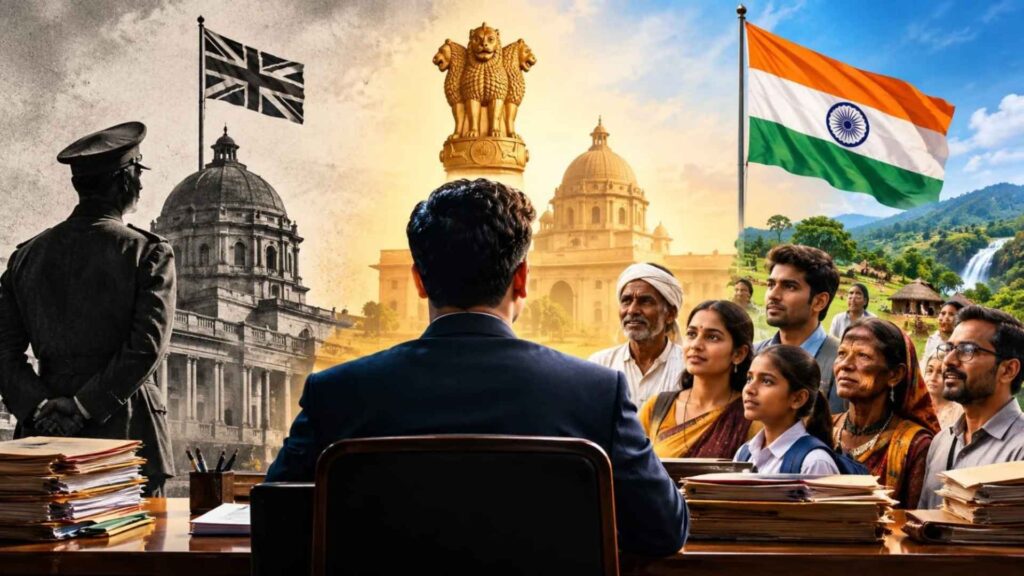
India became politically free in 1947, but freedom did not automatically rewrite the architecture of administration. The Union Jack disappeared from the flagstaff, the Constitution replaced imperial authority, elections created democratic legitimacy, and citizens became sovereign. Yet beneath this magnificent transformation survived an administrative culture whose deeper grammar had been shaped in another age. The colonial state needed officials who could collect revenue, preserve order, enforce law, monitor political activity, and maintain the authority of the imperial government across a vast and diverse territory. The district Collector became the face of that system, combining extraordinary fiscal, executive and magisterial powers.
Colonial Civil Service
The question for the twenty-first century is therefore not whether India needs an efficient civil service. It unquestionably does. The question is more profound: can a democratic civilisation continue to operate through an administrative imagination substantially inherited from a colonial state?
The colonial civil service was not created primarily to cultivate citizenship. It was created to govern subjects. The distinction is fundamental. The East India Company developed increasingly systematic mechanisms of revenue extraction, record-keeping and bureaucratic control. Historians have shown how revenue administration became central to the formation of the colonial state and how documentary systems enabled the extraction of agrarian wealth.
The District Collector consequently became an institutional embodiment of fiscal authority, law enforcement and executive power. This arrangement gave the state enormous capacity, but it also produced a political psychology in which administration could be understood as command rather than conversation, inspection rather than participation, and compliance rather than citizenship.
This is where the historical criticism must become intellectually precise. It would be simplistic to claim that every element of the colonial civil service existed only to suppress revolution or loot India. Colonial administrators performed many functions, created institutional records, administered law and sometimes acted with considerable personal integrity. Nor were all Indian members of the ICS identical to their British counterparts. By Independence, Indians constituted a substantial part of the service, and individual officers could interpret their responsibilities differently. Yet the institutional purpose remained embedded within the larger colonial state. The ICS was closely identified with imperial rule, and scholarship has documented the remarkable continuity of its structure into the postcolonial period.
Post-partition Time
Independent India faced an extraordinary dilemma. It had won political freedom but inherited a country requiring immediate administrative stability. Partition, refugee movements, princely state integration, food insecurity, institutional reconstruction and economic uncertainty made administrative collapse an unacceptable risk.
The Constituent Assembly therefore chose continuity alongside transformation. Sardar Patel famously defended the necessity of an all-India administrative service, arguing that India needed capable officials who could provide continuity and integrity. But his defence contained an equally important democratic principle: administrators had to give honest advice, speak freely to ministers and ultimately serve the new nation.
The creation of the IAS was therefore not supposed to preserve the colonial relationship between ruler and ruled. It was supposed to convert administrative capacity into an instrument of democratic nation-building.
Nearly eight decades later, India should ask whether that transformation has gone far enough. The problem is not the IAS as a professional institution. The problem is an inherited administrative culture that can still place the citizen psychologically below the office. A citizen enters an office carrying a grievance, while the official sits behind a desk surrounded by files, procedures and layers of institutional authority. The elected representative seeks implementation, the voter seeks recognition, the farmer seeks justice, the entrepreneur seeks permission, the tribal community seeks protection of its rights, and the ordinary family seeks dignity. Too often, the language of administration becomes a language of distance. A republic cannot permanently remain comfortable with that distance.
India now requires a different philosophy of public administration. The future administrator should not merely know the law, the rules and the file. The administrator should understand the civilisation in which those rules operate. India is not culturally homogeneous. Its languages, tribal traditions, local histories, religious traditions, ecological knowledge, customary institutions and regional political memories are not administrative obstacles. They are sources of public intelligence. An administrator posted in Odisha should understand Odisha through Odia, its history, its tribal societies and its social imagination. An administrator in Tamil Nadu should understand Tamil society through its language and historical experience. Language cannot remain merely a subject of translation. It must become an instrument of governance.
Training Structure
This means transforming training itself. The present IAS training structure has evolved considerably since Independence, and the Lal Bahadur Shastri National Academy of Administration has periodically revised its programmes. Yet an official review has acknowledged that social, political and economic developments have moved faster than incremental changes in induction training.
The next transformation should be deeper. Training must include Indian civilisational studies, constitutional morality, regional languages, anthropology, public communication, indigenous knowledge, environmental history, conflict resolution, behavioural economics, digital governance and democratic sociology. Every future administrator should spend substantial time living with communities rather than merely visiting them. A village should not be a field visit. It should be a classroom.
The relationship between administrator and citizen must also be philosophically reconstructed. The voter is not a petitioner before the state. The citizen is the constitutional source of democratic legitimacy. The elected government is not an interruption to administration. It is the democratic authority through which public policy receives political direction, while the civil service provides professional advice and lawful implementation. Administrative neutrality should therefore never mean social indifference. It should mean constitutional fidelity, professional integrity and impartial implementation. An officer can be firm without being arrogant, disciplined without being inaccessible, and powerful without behaving like a ruler.
Practical Reforms
The deeper reform is therefore cultural rather than merely procedural. India does not need simply faster files, more digital dashboards or additional training modules. It needs a new administrative imagination. The colonial state asked: how can territory be controlled? The developmental state asked: how can resources be administered? The democratic republic must ask: how can citizens flourish? That change in the question changes the meaning of the office.
The Collector should increasingly become a coordinator of public aspirations rather than an embodiment of governmental authority. The Secretariat should become a place where knowledge meets policy rather than where files disappear. Administration must move from hierarchy towards partnership without sacrificing accountability.
After nearly eighty years of Independence, India is entitled to undertake such a civilisational review. This does not require destroying the IAS or weakening the state. It requires democratising its culture, modernising its training and reconnecting administrative authority with the lived realities of citizens. The reform can be debated, legislated and institutionalised by the Union government, Parliament and the states.
Prime Minister Narendra Modi, as the present Prime Minister, has the political position to place such a question on the national reform agenda, but the transformation should be understood as a constitutional and institutional project belonging to the Republic rather than to one individual leader. Its legitimacy must come from public reasoning and democratic institutions.
India has changed enormously since 1947. Its economy, technology, demography, aspirations and global position have transformed. Yet the deepest test of a republic is not the sophistication of its technology. It is the character of its relationship with its people. The twenty-first-century Indian administrator should not inherit the psychological distance of the colonial Collector. He or she should inherit the constitutional humility of a public servant. The administrative state must learn to speak the citizen’s language, understand the community’s memory, respect the voter’s dignity and recognise that governance is ultimately a conversation between the state and society.
The unfinished task of Independence is therefore not merely administrative reform. It is the decolonisation of the relationship between power and people. India has changed the sovereign. Now it must change the spirit of sovereignty itself.
The question is no longer whether the state can command the citizen. The question is whether the state can earn the citizen’s trust. That is the administrative revolution India should begin after eighty years of freedom.
(The author is the Director of the Center for Adivasi Research and Development (CARD). Views expressed are personal.)