



















Explore an immersive OdishaLIVE documentary review capturing the vibrant world and rich cultural heritage of Baragada Dhanujatra
Lipsa Sahoo
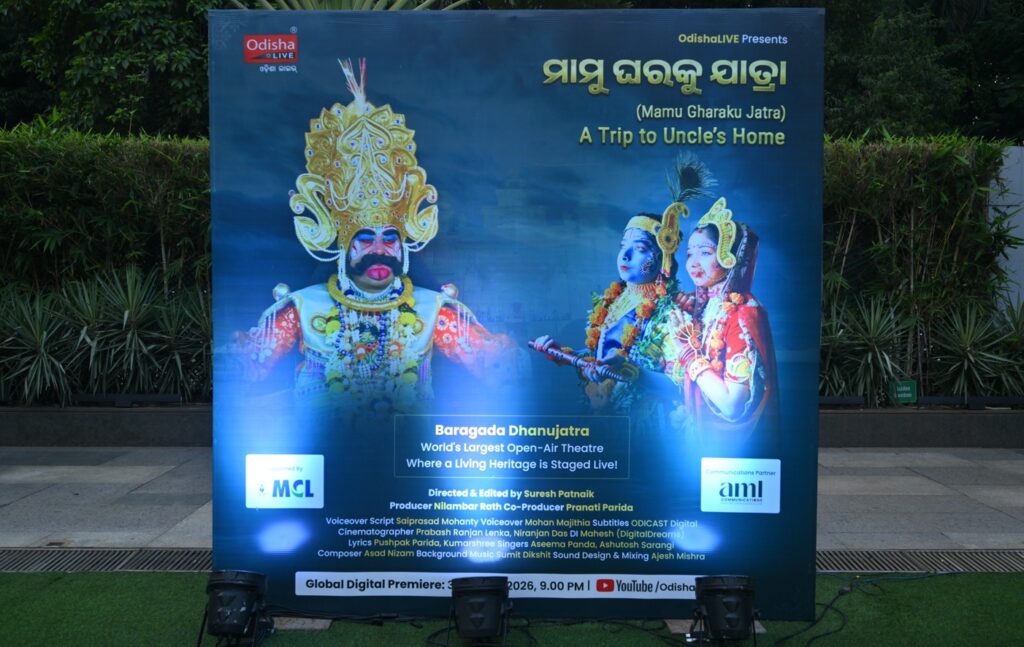
What if an entire town turned into a stage and mythology walked its streets? What if the familiar streets of Baragada suddenly transported you to the realm of the Dwapara Yuga? This is exactly what happens every winter in the world’s largest open-air theatre—the famous Dhanujatra of Baragada. A space where the boundaries between the real and the mythical begin to disappear. Streets become stages, ordinary people become characters, and the town itself becomes a living theatre. It is where devotion, performance and tradition come together.
For eleven days, Baragada ceases to be merely Baragada. The town transforms into Mathura, the Jira River becomes the Yamuna, and Ambapali takes on the identity of Gopapur. The spectator is no longer merely watching the story; they become part of it.
At the heart of this living theatre lies the timeless story of Krishna and Kansa—the rise of a tyrant, the prophecy that foretells his downfall, and the divine child destined to end his reign. From Kansa’s growing tyranny and his fear of the prophecy to the playful leelas of Krishna and Balaram in Gopapur, and finally their journey towards Mathura, the story unfolds not on a conventional stage, but through the streets of an entire town.
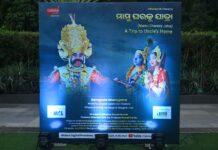
It is this magnificent world that OdishaLIVE attempts to bring to life through its latest documentary film—Mamu Gharaku Jatra (A Trip to Uncle’s Home). Produced by Nilambar Rath and co-produced by Pranati Parida, the film captures the grandeur and the quiet devotion that sustain this extraordinary tradition.
Even the title carries a quiet warmth. Mamu Gharaku Jatra suggests something familiar—a journey to one’s uncle’s home. Yet within that simple phrase lies the journey of Krishna and Balaram to Mathura, the journey that would eventually bring Kansa’s reign to an end. Perhaps it is this sense of familiarity that makes the title so fitting: an ancient myth, brought close to home.
One of the most fascinating aspects of the Jatra is the way Baragada accepts Kansa as its king for those eleven days. The actor playing the tyrant is addressed as Maharaj, and people follow his commands as though he truly were the ruler of Mathura. Even those in positions of power are not exempt. Former Chief Minister Biju Patnaik was once “fined” by Kansa for arriving late to the royal court. He accepted the fine, playing along with the rules of a realm where, for eleven days, Kansa really is the king.
“For those eleven days, I have no family, I am no human, I am the asura Kansa of Dwapara Yuga himself,” says Bhubaneswar Pradhan, a former Kansa Maharaj of Baragada’s Dhanujatra. For him, the role does not end when he steps off the stage. For those eleven days, it becomes a way of life.
And the transformation does not end with Kansa. Even the young actors who step into the roles of Krishna, Balaram and Radha speak of how the experience has changed the way they live their own lives. By portraying these divine characters, they say, they have learnt to look at life through the values they embody, to choose truth, remain steadfast in it, and carry those lessons beyond the streets of Gopapur. It is not simply about becoming someone else for a few days. In some ways, it has taught them something about who they want to be when they return to being themselves.
Something similar seems to have happened to the filmmaker himself.
“I couldn’t recollect myself being Suresh. That day, in front of that 12-year-old kid, I was but a mere devotee yearning for the touch of Lord Krishna’s feet,” says Suresh Patnaik, the director and editor of the film.
For Mr Suresh, the documentary is not merely a record of the Jatra, but an attempt to experience it through the eyes of a devotee—to be so immersed that, for a moment, the filmmaker disappears and only the devotee remains. This is what gives Mamu Gharaku Jatra its distinct perspective.
The film does not pause to explain the Jatra or dissect its traditions. Instead, it lets the experience unfold. Guided by a quiet, reflective narration, the film moves through the streets of Baragada, from the royal court of Kansa to the playful world of Gopapur, allowing the images, the music, the faces and the moments of devotion to speak for themselves. It feels less like watching a documentary about Dhanujatra and more like being taken through the memory of someone who has lived it.
I saw it in the audience itself. Sitting beside me, my friend watched in silence as Kansa finally surrendered to Krishna, bringing his long and troubled asura life to an end. When the scene was over, her eyes were wet. Neither of us said anything. There was nothing to explain.
Perhaps, then, Mamu Gharaku Jatra is itself a kind of journey—a journey into a world where mythology is not distant, where ancient characters are given new life by ordinary people, and where devotion turns a town into a theatre.
For eleven days, Baragada becomes Mathura. The streets become its stage, its people become its characters, and mythology walks among them once again. And this tradition has been kept alive for over seventy-nine years, ever since the first performance in 1948, when Baragada celebrated India’s independence by turning the defeat of a tyrant into a living theatre of freedom.
Through Mamu Gharaku Jatra, those eleven days live a little longer.
(The author is pursuing a Master’s in English Literature at Rama Devi Women’s University. Views expressed are personal.)