
























Girls and boys face different online risks, making gender-sensitive digital safety essential for protecting children without limiting their access, freedom and opportunities
Trina Chakrabarti
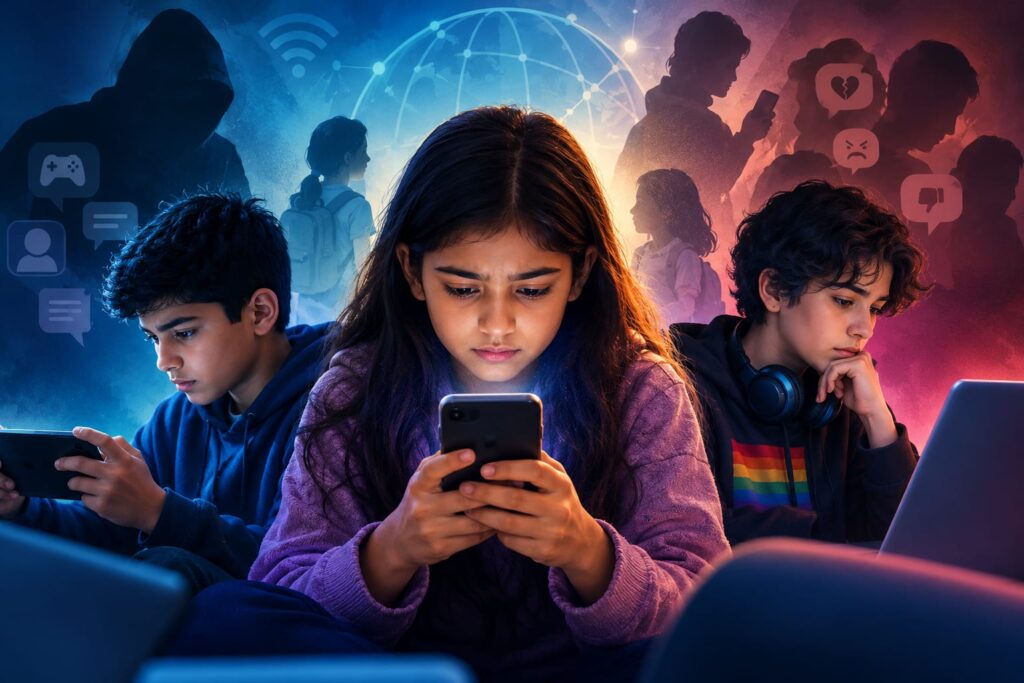
We often talk about keeping children safe online as if all children face the same risks. Don’t talk to strangers. Don’t share personal information. Don’t click on unknown links. Block and report anything that makes you uncomfortable.
All of this matters. But there is another part of the conversation we need to have: children do not enter the digital world on an equal footing.
A girl, a boy and a child questioning their gender or sexuality may be using the same platform, playing the same game or sitting in the same WhatsApp group. But they may experience that space very differently.
As we mark the International Day of the Girl on October 11, this is worth thinking about. We talk about girls’ right to education, safety, opportunity and the freedom to shape their own futures. Today, some of that future is also being shaped online.
The same internet, a different experience
Take something as basic as access.
A 2026 National Council of Applied Economic Research (NCAER) report on digital inclusion among children aged 13–16 shows a clear gender gap. While 68.7% of boys have access to a mobile device, the figure for girls is 61.7%. The gap continues with internet use: 41.9% of boys use the internet compared with 33.6% of girls. On social media, the difference is even wider—26.4% of boys compared with 16% of girls.
It might be tempting to think that fewer girls online means fewer girls exposed to online risks.
But that is only one way of looking at it.
Less access can also mean less access to information, learning, digital skills and opportunities.
There are genuine reasons why parents worry about girls being online. But if the answer is simply to restrict their access, are we really making them safer? Or are we also limiting their ability to use the internet for learning, connection and opportunity?
At the same time, girls face risks online that are closely connected to the way girls are treated offline.
Photographs can be copied or misused. A joke about appearance can quickly turn into harassment. Someone can create a fake account using a girl’s name and photographs. Sexual comments, threats or pressure to share images can affect not just what she experiences online, but how she feels about herself at school and among friends.
Teachers we spoke to as part of our work on children’s online safety shared several such experiences. In one case, a student’s name and photographs were used to create a fake account that sent inappropriate messages. In another, a child who was repeatedly teased in a WhatsApp group gradually withdrew from class and school activities.
The screen does not make the hurt less real.
But we should also be careful not to turn this into a simple story of girls as victims and boys as perpetrators.
Boys can be struggling too
Boys face their own pressures online.
There can be an expectation that boys should be tough, fearless and able to deal with everything on their own. Online spaces can reinforce ideas about masculinity, relationships and what it means to be a “real man”.
Boys can be bullied, sexually exploited, blackmailed or groomed too. But they may be less willing to talk about it because admitting that they are scared, confused or hurt can itself feel like a weakness.
In the teacher survey we conducted, one of the most common reasons children did not speak up about something that happened online was fear that their phone or internet access would be taken away. Others spoke about embarrassment, fear of being blamed or the feeling that adults would not understand.
For children, the internet is no longer a separate space. It is where friendships happen, where they learn and play, where they express themselves and sometimes where they begin to understand who they are.
When something goes wrong there, they cannot simply switch off and leave it behind.
Grooming is a good example.
A child may meet someone through an online game or social media who appears friendly and trustworthy. The person may ask questions, offer attention and gradually build a relationship with the child.
In one case shared by a teacher, a child met someone through an online game who asked for personal information and photographs. In another, a 14-year-old accepted a friend request from someone posing as a classmate. The person spent weeks building trust before threatening the child through a fake account.
The lesson is not that these children were careless.
It is that manipulation works by creating trust.
This is also why LGBTQ+ children need to be part of the conversation. For some, the internet can provide information, friendship and a sense of belonging that they may not easily find offline. But those same spaces can expose them to targeted harassment, outing, manipulation and exploitation.
And what happens online can follow children back into everyday life. Teachers spoke of children withdrawing from friends and activities, losing confidence and, in some cases, seeing their school participation and academic performance suffer after online bullying or harassment.
The internet is not “just a screen” when it is where a child’s friendships, reputation and sense of self are playing out.
Safety cannot mean taking away freedom
So what should we do differently?
We need to move beyond simply telling children what not to do. They need to understand how manipulation works, what harassment looks like and what they can do when something feels wrong.
Girls need to know that harassment is not the price they have to pay for being visible online.
Boys need spaces where they can talk about vulnerability, relationships and consent without being made to feel weak.
And all children need to know that being tricked or pressured into sharing something does not make what happened to them their fault.
Parents have an important role here. But listening has to come before punishment.
If a child’s first experience of telling an adult about an online problem is having their phone taken away, they may simply stop telling us. If our first question is, “Why did you do that?”, we may close the conversation before we understand what actually happened.
Schools also need to look beyond the obvious. A child who suddenly stops participating, withdraws from friends or starts doing poorly may not simply be struggling with exams. Sometimes a change in behaviour is the first sign that something has happened online.
And platforms have a responsibility too. Children should not have to carry the entire burden of making the digital world safe. We need stronger safety systems, easier ways to report abuse and greater accountability from platforms.
There is another part of this conversation we should not lose sight of: access.
NCAER’s research shows that children’s digital participation is shaped not just by gender, but also by geography and parental education. So there is no single “child online”. A girl with her own smartphone, private internet access and parents who understand digital platforms may have a very different experience from a girl who shares a phone with her siblings and has little privacy or support at home.
This is why keeping girls safe cannot simply mean keeping them away from the internet.
If we are serious about girls having the freedom to learn, participate, speak for themselves and shape their futures, they need the skills and confidence to participate in the digital world too.
The question is not whether children should be online. They already are. The question is whether we can make that space safer without making it smaller for them.
Because the internet may not see gender.
But the people who use it do.
And if we want girls to have equal freedom online, we first have to understand why that freedom does not always feel equal to them.
(The author is the Director – East and Volunteer Action, CRY – Child Rights and You. Views expressed are personal)