





















An expert economic analysis examining global debt burdens, IMF austerity warnings, Stephanie Kelton’s deficit myth, and India’s FRBM fiscal targets
Suresh Chandra Sarangi
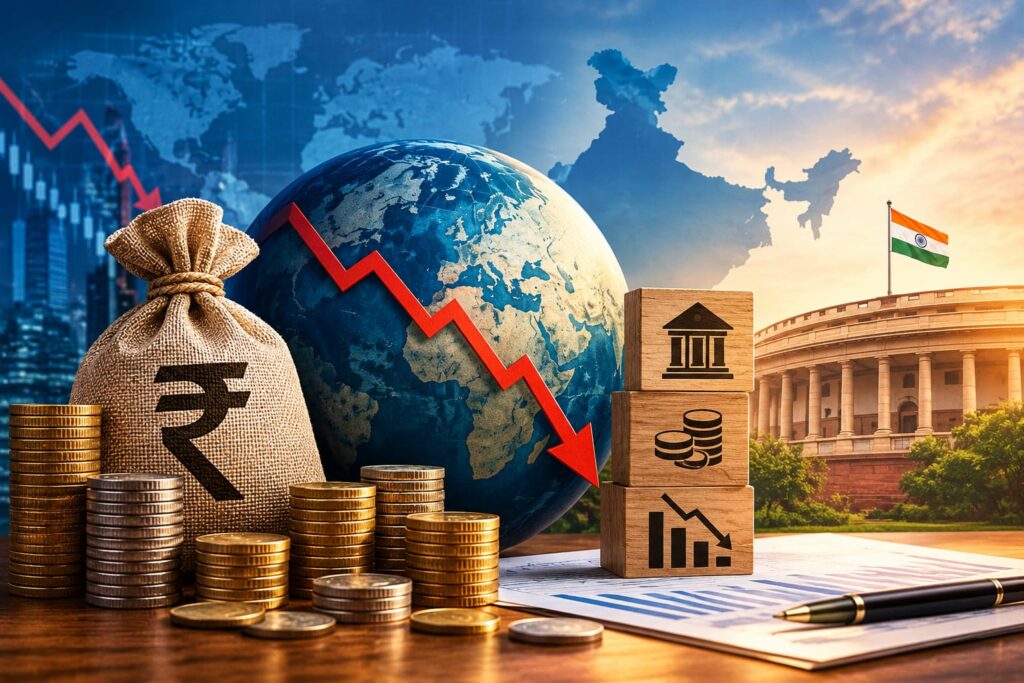
From the ramparts of the conference hall in Bangkok, where the World Bank and the IMF are brainstorming on the world economy during the spring session, IMF chief Kristalina Georgieva has declared that developed and developing nations have to reduce their spending, failing which it will be harder to control the situation in the coming days. That means the IMF is calling on all nations to exercise financial restraint. “Winter is coming,” she said, referring to the Northern Hemisphere. She said that now is the time to repair the house, failing which the cracks will widen. So, the time has come for serious introspection. Now is the time to boost revenues, rationalise spending and improve public financial management, while the whole world confronts a debilitating energy crisis. Countries should maintain price stability, and a prudent hawkish bias is required in many of them.
For deficit countries, she reiterated, they need to save more, cut deficits and cut debt. She also claimed that debt should follow a downward spiral, as the cost of debt servicing is rising and threatening macro-financial stability at large. The recent debt levels of some countries are as follows: the US, 40.84 trillion dollars; China, 22.321 trillion; Japan, 8.95 trillion; the UK, 4.42 trillion; France, 4.26 trillion; Italy, 3.79 trillion; and Germany, 3.62 trillion. India also has a sizeable debt of about 2.55 trillion US dollars and 778.2 billion in external debt. This is an alarming position for the entire world, including India. Global debt remains at 235% of world GDP, as per data released by the IMF. While Japan heads the list at 237–249% of GDP, the US stands at 121–123%, China at 88–99%, and India at 82% of GDP.
This puts all nations in a fix, and managing the twin objectives of deficits and growth is the single highest priority for them. The deficit myth has been ballooning, particularly after the COVID-19 pandemic hit the world. In her book The Deficit Myth, Stephanie Kelton provides a vivid analysis of the deficit syndrome and a roadmap for the future. She was convinced that the COVID-19 disaster was the worst pandemic in a century and caused the sharpest economic downturn in many years.
As a gut-wrenching health crisis, deaths and other tragedies hit the world, employment became a casualty, with massive migration and 22 million households experiencing reduced incomes. This crisis dismantled all the arguments regarding macroeconomic stability, which were thrown to the wind. Most countries’ expenditures skyrocketed to manage a calamity of this proportion, and the pandemic-induced recession made finances more difficult to arrange. That was a calamity like no other, until the rebound in employment, production, trade and commerce.
The massive stimulus packages introduced after the shock threatened equilibrium in the world economy. After all the macroeconomic repairs and support, a V-shaped recovery in output and employment dominated. Some even argued that it was a K-shaped recovery scenario, in which parts of the economy surged upward even as millions fell deeper into crisis. Although monetary policy actions initiated by central banks calmed financial markets and helped larger corporations avoid bankruptcy, a large part of the credit went to governments because of the fiscal policies they unleashed. Thereafter, the deterioration in finances and the resurgence of debt continued, without any sign of normalisation. A high price has to be paid, and restructuring that debt takes time.
Against this background, let us understand the rudiments of public finance and the options available to India to control the deficit myth. Deficits occur when expenditure or national spending surpasses income. Put simply, a deficit happens when costs exceed income. Government income from taxes, fees, commissions, dividends, etc., is not adequate to meet expenses. So, the natural choice for the government is either to create or print more money, otherwise known as monetisation. Governments may also run deficits deliberately to stimulate growth during periods of recession. These budget deficits contribute to national debt. The advantage of deficits is that, despite their potential drawbacks, they help finance public projects and contribute to employment during a downturn or financial meltdown.
The implications are many. Running a deficit either adds to the existing debt load, while surpluses can reduce it. However, excessive or long-term debt is ultimately unsustainable because of the high cost of interest on borrowing. Keynes, the high priest of economics, observed that fiscal deficits allow people to purchase goods and services that can help stimulate the economy, making a strong case for deficits as a useful tool for bringing nations out of recessions. The options before the government are limited. It can either mint more money through monetisation, which can indirectly create inflation as too much money chases too few goods in the market, or it can borrow through the central bank. In the latter case, the RBI sells bonds in the market, which carry a certain amount of assured interest. Sometimes, bond yields increase, as they are doing with American bonds now, throwing fiscal arithmetic into jeopardy.
In India, expenditure has far outpaced revenue over the years. To streamline this, the government has had to put its house in order by rationalising taxes, revitalising collections, increasing direct taxes and initiating other fiscal measures. That is the difficult part of the story, as an increase in taxes brings negative reactions at the hustings. Governments mostly borrow in anticipation of enhanced revenue due to increased economic activity in the future. In India, welfare schemes and freebies play spoilsport. Projects are announced, and expenditure mounts.
The deficits were always increasing, which led the government to institute the Fiscal Responsibility and Budget Management (FRBM) Act in 2004. It stipulated that deficits be kept near and within 4.4%. Thereafter, it was reconstituted repeatedly in 2012, 2015 and 2019 to ensure a framework for maintaining fiscal discipline and fiscal consolidation.
The target was kept at 4.4% of GDP in the revised estimates for FY 2025–26 and projected at 4.3% of GDP for FY 2026–27, continuing the glide path to bring the fiscal deficit below 4.5% of GDP. The framework also aims to limit central government debt to 60% of GDP and state debt to 40% of GDP. State finances are going haywire, and both central and state governments’ non-planned expenditure is on the rise. This Lakshman Rekha has to be maintained and not crossed. The debt-to-GDP ratio, combining both the Centre and the states, is a whopping 94.51% for FY 2025–26.
History is replete with examples, most recently the Greek tragedy, in which the country could not pay off its restructured debt and was forced into austerity measures, with growth becoming a casualty. The Sri Lankan example is of recent origin. The looming threat of debt may jeopardise the world financial architecture. Continuous borrowing by the central bank from the market has a crowding-out effect: fiscal space for the developmental budget gets reduced, growth slows, the risk of a fiscal crisis looms large, investor confidence falters, borrowing costs spike, as is happening in the US, and net household savings get depleted. India has to endeavour to maintain the same threshold limit. The government has to take stern measures to put its own house in order so that the growth momentum continues.
(The writer is a former General Manager of Bank of India. Views expressed are personal.)