






















The Osakothi ritual of Ganjam, Odisha, is a traditional folk practice centred on Goddess Mangala worship, penance and wish-fulfilment, reflecting the region’s rich cultural heritage and community traditions
Kapilas Bhuyan
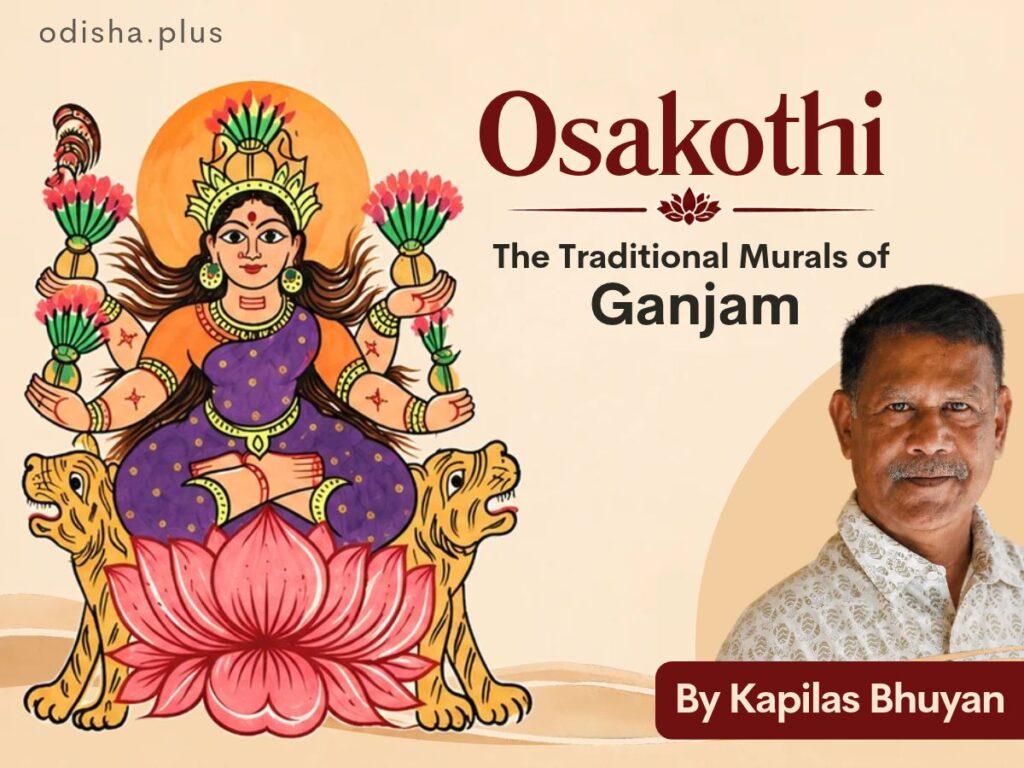
Dr. Eberhard Fischer and Dr. Dinanath Pathy in their book ‘Murals for Goddesses and Gods’ (Pub. 1996/IGNCA, New Delhi) have tried to define in the second chapter ‘The Osakothi Ritual: Customs, Terms and Legends (pp-17) saying that, “Upavasa – as generally understood in Orissa – is to live an austere life, to worship the deity and to listen to the Purana scriptures regularly. In all likelihood, the Sanskrit word Upavasa became Upasa in Oriya and later degenerated colloquially to Osa or Usa.
“… Osa rituals are also thought of as apouranika, because no references were made to them in the Purana texts, moreover they are called avaidika, …Osa therefore denotes rituals that are ‘popular’ or ‘folkish’…”
Whereas this sufficiently proves the fact that Osakothi ritual is out and out a folkish ritual of Ganjam district, it is observed in large scale by the people in the villages for wish-fulfillment “for the attainment of dhana (riches), jana (offspring), gopa (landed property) and lakshmi (fortune).” 1
More often than not, whereas women observe the Osa in their household premise, in case of Osakothi “however, men participate prominently”, 2 and it’s observed outside the home in which the whole village participate to observe the ritual for wish-fulfillment. But yes, the women participate in it minimally, only on the closing day to worshipping the moving goddess Mangala while visiting the village to get her blessings.
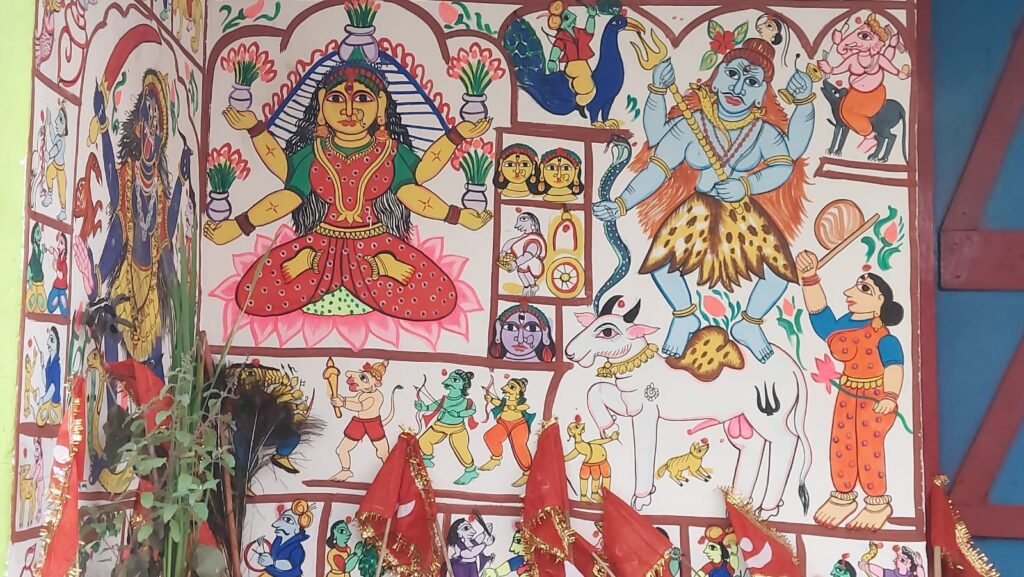
On the other hand, the way Dr. Dinanath Pathy has defined Osakothi is that, “Osa is penance and Kothi refers to a bungalow, a community house (kothaghara). A person who wishes to invite Mother Goddess to his living house or village community house during the days of Dasahara festivity, and keeps a vow of penance for five, seven, fifteen days according to his ability, commissions a painter to execute the murals. The Goddess appears on the wall with her family (Kutumva) and her entire entourage – symbolically thirty-three crores (tetise koti) in number.” 3
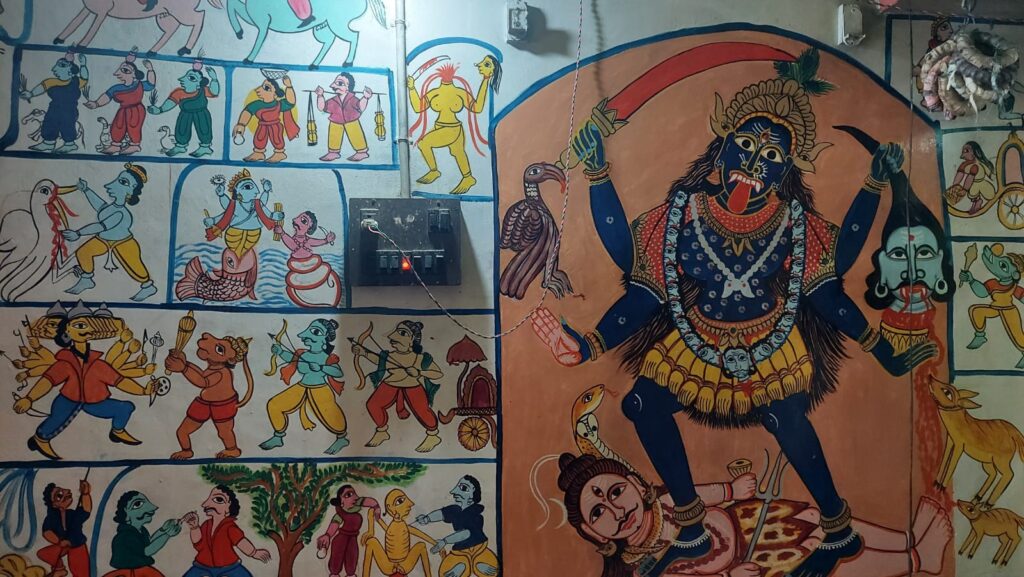
An updated version has slightly modified the number of days of its observance in the recently published book by the State Museum, Odisha – “It is being observed by the farmers and other working-class people in innumerable villages over thirteen or twenty-one days. The number of days is even reduced now a days to five or seven-days depending on the capacity to bear the expenses of the observance. A person of a family or the people of a village who wish to invite the Mother Goddess (‘Thakurani’ or ‘Grama Devi’) to the outer-wall of his living house or the community house during the festivities of ‘Dasahara’ or ‘Durgapuja’and keep vows of penance from five to twenty-one days as according to their ability to observe it for fulfilling their wishes.”4
Fischer, E. and Pathy, D. (1996) Murals for Goddesses and Gods (1 – pp.17)
Malla, Dr. B. (Ed. 2024) Osakothi: The Unique Mural Painting of Odisha (2, 4, – pp.15)
Jena, R. Publisher (2014) Osakothi: Reviving and Relocating (A Note on Osakothi Workshop by Pathy Dr. D – 3 -pp.5)
(The author is a senior journalist, writer, critic and national award-winning filmmaker based in Bhubaneswar. The current story is part of a series of write-ups derived from his Senior Fellowship research under the aegis of CCRT/Dept. of Culture, Govt. of India, New Delhi. The views expressed are personal.)