





















Explore how the information revolution and digital technologies have transformed communication, society, and global economies while raising concerns about misinformation and cyber risks
Suresh Chandra Sarangi
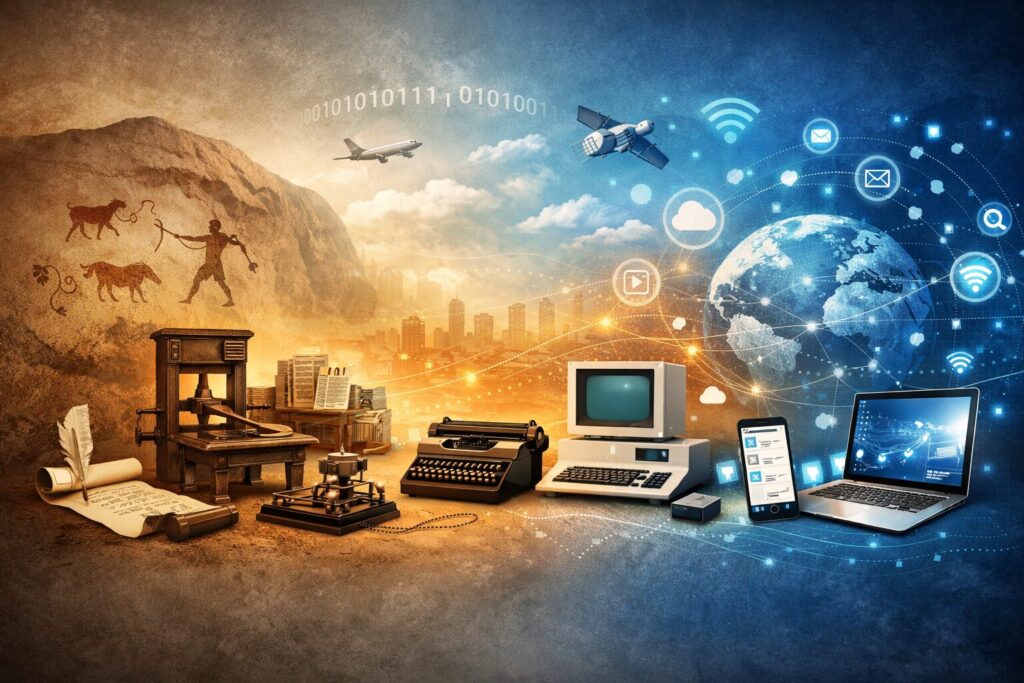
Since the Homosapiens settled on the planet, communication became the key word in socializing human groups. Now, we live in an Information Age. Communication was first verbal, then by symbols, and thereafter, real communication. When printing media appeared, communication was sent through writing. Until the early 21st century, when information became swift, the inflation revolution flooded in, and progress became faster. Certain things became more accurate, less time-consuming, and faster after the invention of the electronic signal. That was like writing the genetic code. From the African talking drums to present-day Wikipedia, from Morse code to “bit” , the story is fascinating and throws light on how information has changed human lives at each stage of human development.
The Philippines was the legendary Greek messenger who is said to have run from the battlefield of Marathon to Athens in 490 BC, to announce Greek victory over the Persians. Died instantly after collapsing due to dehydration. The run involved 25 miles, approximately 40 kilometers, and the marathon was introduced in the Olympics to pay tribute to the legend who carried the news of victory. Since information has undergone many a changes, aided by Agricultural revolution, industrial revolution, the computer revolution and there has been a fundamental change in each stage of technological progress, Overall information is a fundamental shift in man’s thinking,as to how he creates, shares and preserves knowledge and a radical departure in information sharing happened in, by computing and internet technologies.
The biggest achievement of human civilization has been the instances of transfer of information that have shrunk the world in real time. The flow of information is really reshaping economics, society, and daily life. This has affected commerce, education, and economies at large. The biggest shift in the information revolution happened when society transitioned from the Industrial Age to the digital age. We move from simple to complex, but the digital age, as well as the internet revolution, has been too fast, and that changes everything. Advances in technology have led the world and the people at large to enjoy a safer, longer, and more satisfying life, and the Information Age has had a bigger role in that transformation. We have entered a situation where collective intelligence plays a crucial role, and information dissemination plays a significant role.
The speed at which the information moves is mindblowing, unprecedented. The ethical dilemma attached to it poses a bigger question to humanity. This sometimes happens at the risk of a disruption. Even during this decade, information technology will disrupt working patterns, national income, and international relations. The smartphone, the web, and their ancillaries are very crucial technologies in transforming human lives. That is a game-changer. Information brings optimism as well as anxiety. The hacking, the torrent of misguided information or misinformation today, and the cyber risk are going to prove consequential for mankind.
Literacy becomes not an idea but a movement, not due to any other thing, but formation. The misinformation campaign is killing the spirit of a progressive society. Before Trump’s first term, the campaign hit an all-time low so far as moral fiber is concerned, as every falsehood appeared to be the truth, like Goebbels ’ propaganda machine during the Second World War.. The trend was followed.
In Indian politics today, misinformation is the foundation on which a tower of unconnected news stands. Today, social media is spreading those untruths vociferously in advertising, media, and the IT industry. The digital age has introduced the concept of first truth, which is becoming unbearable. Cyber-attacks, hacks, and digital arrests have become commonplace by manipulating data. Data integrity is very much in question, and the Goldie social media has been relentlessly propagating that. The crisis arising from misinformation and information hacking is creating more harm than good.
Demystifying the IT revolution and consequent information revolution is a difficult job. In a digital framework of society, individuals become the key, but are overruled by information. The internet is certainly a great medium of communication, data storage, processing, signal, and image. But one should not fall prey to such type of misinformation.
The World Wide Web has been instrumental in creating an atmosphere for worldwide information flow, which is easily accessible,of course, by the common man. It is said that without the information revolution, civilization would not have progressed into what it is today. The current deluge of news,tweets,images,and blogs becomes too much for the creative human who is overpowered today, with little time for leisure,creativity, and fun.
The future will be decided, and the prospects for humanity will be dependent upon the free flow of information and not compromised, as it happens in many societies. The curb on information in the totalitarian society and under a dictatorship regime is a grim reminder of the fact that we are not free and our information system is under a chain. It may have far-reaching consequences.
In electronic communication, in the long run, every new medium transforms the nature of human thought. To conclude, it would be wiser to say that history is the story of information becoming a catalyst for change, economic progress, cultural revolution, and cyber war. It has a history,it is a theory, and it has flooded the entire world. A cautious optimism is the way out.
(The writer is a former General Manager of Bank of India. Views expressed are personal.)