



















Explore Bijaya Jena’s ‘Winter Interlude,’ a short film connecting personal grief with global migration. A moving journey of healing set against Estonia’s snowy landscapes
Bhaskar Parichha
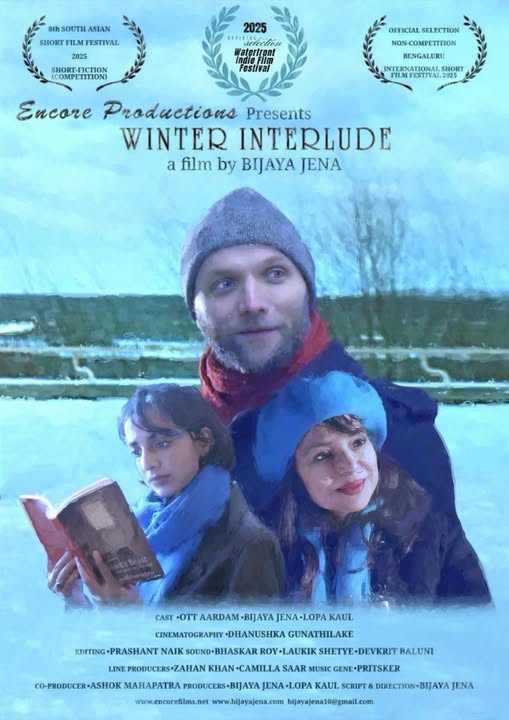
Winter Interlude, directed by Bijaya Jena, is a powerful short film that combines a personal story of loss with larger global issues like migration, identity, and resilience. The film is special because it is one of the first Indian films to talk about places like Ukraine, Crimea, and Bangladesh. It tells an emotional story in a simple but very touching way.
The story is about an Indian woman and her teenage daughter. They travel to Estonia to learn more about the woman’s husband, who died from COVID-19. At first, it seems like a personal journey, but slowly the story becomes deeper. The husband’s boss, who is from Crimea, shares his own experiences about conflict and displacement. At the same time, the woman remembers her mother, who had to leave Bangladesh during Partition. Through these stories, the film shows how migration and loss affect families across generations.
One of the strongest parts of the film is its music, composed by Gene Pritsker. His music is emotional and beautiful, and it supports the story perfectly. It helps the audience feel the sadness, hope, and healing that the characters go through. Pritsker is known for mixing different styles like classical, jazz, and electronic music. He has also worked on the film The Matrix Resurrections, where he collaborated with composers Johnny Klimek and Tom Tykwer.
The film also introduces a new actor, Lopa Jena Kaul, who plays the daughter. She gives a natural and impressive performance. Her character shows curiosity, emotional vulnerability, and inner strength. Lopa’s role adds freshness and energy to the story, especially in the relationship between mother and daughter.
The location of the film, Estonia, plays an important role. Its cold, snowy landscapes reflect the sadness and loneliness of the characters. At the same time, Estonia’s history of strength and cultural diversity adds depth to the story. The film also shows that Estonia can be a great place for Indian filmmakers to shoot visually beautiful and meaningful stories.
Bijaya Jena’s acting as the grieving widow is very subtle and powerful. She expresses deep emotions without overacting. The film carefully connects personal pain with larger political issues. By including stories from Ukraine, Crimea, and Bangladesh, the film shows how big historical events affect ordinary people’s lives.
The film also highlights the idea of global connection. It brings together characters from India, Estonia, Crimea, and Bangladesh, showing that human experiences are connected, no matter where we come from. It encourages viewers to feel empathy and understand others’ struggles.
Another interesting aspect of the film is its use of color, especially red. This can be compared to the film Dodes’ka-den by Akira Kurosawa. In Winter Interlude, red appears in small details like a scarf or a flame, standing out against the cold background. It symbolizes hope and emotional warmth. Similarly, in Dodes’ka-den, red represents moments of joy and imagination in a difficult environment. In both films, red is used carefully to show hope even in sad situations.
This film is also important for film festivals. It talks about the impact of COVID-19, displacement, and political conflict in a meaningful way. It promotes cultural exchange and shows stories from different parts of the world. Festivals that focus on global stories and diversity would find this film very valuable.
The theme of the film is well summed up in a poem by Odisha-born Austrian poetess Sarita Jenamani which adds to the storytelling.
Winter Interlude is a deeply moving film about loss, healing, and hope. It connects personal emotions with global realities. The film demonstrates that Bijaya Jena is a gifted filmmaker and actor. It leaves a lasting impression on the audience.
(The author is a senior journalist and columnist. Views expressed are personal.)