






















The recurring NEET paper leaks have exposed deep structural flaws in the NTA. An analysis of the systematic erosion of merit, public trust, and justice in India
Rabindra Kumar Nayak
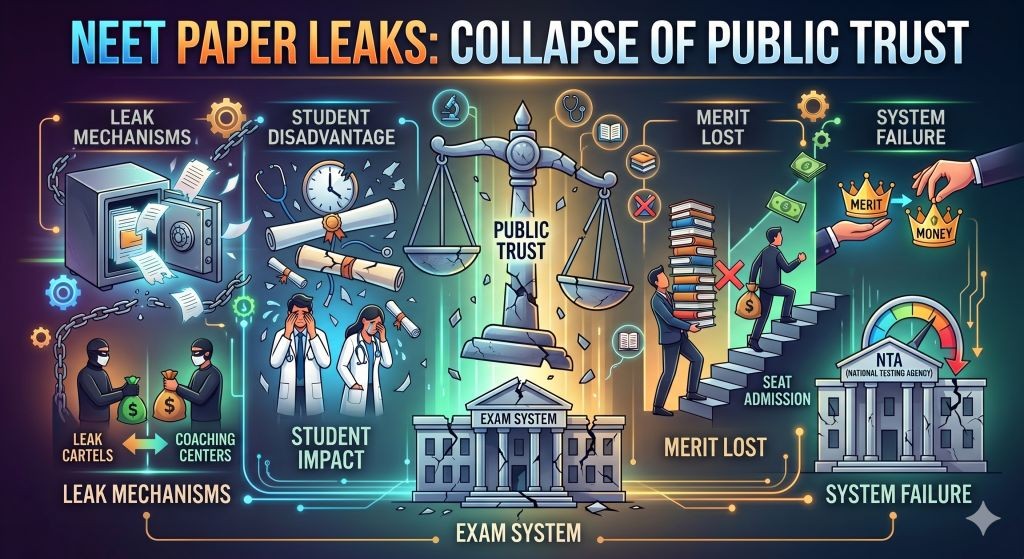
The repeated allegations and confirmations of question paper leaks in the National Eligibility cum Entrance Test (NEET) have exposed a dangerous crisis at the heart of India’s education system. What was once projected as a transparent, merit-based national examination for aspiring medical students is increasingly appearing vulnerable to organised corruption, political patronage, administrative complicity, and criminal manipulation. Every year lakhs of students prepare with extraordinary discipline, sacrifice, and psychological endurance. Yet every recurring scandal raises the same disturbing question: can merit survive in a system where question papers can be bought, leaked, and manipulated?
At the centre of this growing distrust stands the National Testing Agency (NTA), the institution entrusted with conducting some of the country’s most important examinations. Originally established to ensure professionalism, efficiency, transparency, and credibility in national-level testing, the NTA today faces serious questions regarding competence, accountability, and institutional integrity. Repeated controversies surrounding NEET and other competitive examinations have severely damaged public confidence in the agency. While the NTA routinely claims that examinations are conducted with strict security protocols, recurring irregularities suggest either shocking administrative failure or something far more disturbing.
The tragedy lies not merely in the leakage itself, but in the predictable pattern that follows. Public outrage erupts, investigations are announced, selected arrests are made, examinations are rescheduled in some centres or across the country, and officials issue familiar assurances of “strict action.” But after the immediate anger subsides, the deeper nexus often remains untouched. The masterminds rarely face exemplary punishment. The system absorbs the scandal and moves on until the next leak occurs. This cyclical pattern has created a dangerous perception among citizens that paper leaks are no longer isolated accidents but an institutionalised racket functioning under the protection of influential networks.
A competitive examination of NEET’s scale cannot be manipulated by a few isolated individuals alone. The question paper passes through multiple layers—paper setters, moderators, digital systems, printing presses, transportation networks, examination administrators, invigilators, and security agencies. When leaks happen repeatedly, it becomes increasingly difficult for ordinary citizens to believe that such breaches occur without the connivance of powerful actors. In many examination scams across India, investigations have pointed towards the involvement of coaching mafias, politically connected middlemen, corrupt officials, and criminal syndicates operating as organised networks. Such rackets flourish because education has increasingly become commercialised. Medical admission today is not merely an academic aspiration; it has become a multi-crore economy.
In this context, the NTA cannot escape scrutiny merely by issuing denials or blaming local irregularities. An institution responsible for conducting high-stakes national examinations must be judged not by official press releases but by outcomes. Repeated administrative lapses, technical failures, discrepancies in results, grace-mark controversies, and allegations of security breaches indicate deep structural weaknesses within the agency. Critics argue that the NTA increasingly appears more reactive than accountable. Instead of transparent institutional introspection, public responses often appear defensive and bureaucratic.
The social consequences of such failures are devastating. A student from a modest rural family studies for years under enormous financial and emotional pressure. Parents mortgage land, sell jewellery, or spend life savings on coaching institutes. Students sacrifice sleep, recreation, and mental peace for a single examination that may determine the direction of their lives. When such students discover that others may have secured unfair advantage through leaked papers or purchased access, the damage goes beyond disappointment. It destroys faith in justice itself. A nation cannot sustain democratic morality if honest effort repeatedly loses to corruption.
The psychological consequences are equally severe. India is already witnessing alarming levels of stress, anxiety, depression, and even suicides among competitive exam aspirants. NEET has become not merely an examination but a symbol of existential pressure for lakhs of young people. In such an atmosphere, every paper leak deepens insecurity. Students begin to wonder whether hard work has any value in a compromised system. This erosion of confidence creates cynicism at a very young age. A society where youth stop believing in fairness gradually becomes vulnerable to moral collapse.
Governments often respond by rescheduling examinations or cancelling selected centres. While such measures may be administratively necessary, they cannot substitute for structural accountability. In fact, repeated rescheduling frequently punishes innocent students more than actual culprits. Aspirants are forced to undergo renewed stress, uncertainty, travel expenses, and psychological exhaustion. The guilty often remain protected while ordinary students bear the burden of institutional failure. A serious democracy cannot reduce justice to mere rescheduling.
The core problem is the absence of exemplary punishment and institutional transparency. India has witnessed numerous examination scams over the years from recruitment tests to board examinations to professional entrance tests. Yet convictions remain slow, investigations prolonged, and accountability diluted. Frequently, only small intermediaries are arrested while politically influential figures escape scrutiny. This selective enforcement encourages the continuation of the racket. Corruption survives not because laws are absent, but because implementation lacks political will.
There is also a disturbing political silence surrounding educational corruption. Political parties aggressively debate issues of caste, religion, language, and electoral arithmetic, but the systematic destruction of merit rarely receives sustained national attention unless public outrage becomes uncontrollable. Education should have remained one of the most sacred democratic institutions. Instead, it has increasingly become vulnerable to bureaucratic negligence, commercial exploitation, and political opportunism.
The NEET controversy further raises larger questions about excessive centralisation. A single examination determining the future of lakhs of students across a vastly diverse country creates enormous pressure and equally enormous opportunities for manipulation. Any security breach acquires nationwide consequences. Moreover, dependence on expensive coaching industries has transformed preparation into a deeply unequal process where economically weaker students struggle against privileged urban ecosystems. Paper leaks intensify this inequality further.
The government must therefore move beyond symbolic reactions and public relations exercises. India urgently needs an independent and technologically advanced examination security mechanism insulated from political influence. Every stage, from question paper preparation to digital encryption, printing, storage, transportation, and centre management, must undergo real-time monitoring by autonomous agencies. The functioning of the NTA itself requires independent audit and parliamentary scrutiny. Fast-track courts should be established exclusively for examination fraud and paper leak cases. Those found guilty, including officials and politically connected individuals, must face immediate dismissal, lifetime debarment from public office, confiscation of illegal assets, and stringent imprisonment. Unless punishment becomes swift and exemplary, deterrence will remain meaningless.
Equally important is transparency. Investigation reports should be made public. Students deserve to know how breaches occurred, who benefited, and what reforms are being implemented. Democratic accountability demands openness, not bureaucratic secrecy. The credibility of public institutions depends not on claims of perfection but on honest acknowledgment of failure and visible corrective action.
Ultimately, the NEET paper leak issue is not merely about an examination. It is about the ethical foundation of the republic itself. When educational institutions lose integrity, society sends a dangerous message to its youth: manipulation matters more than merit, connections matter more than character, and power matters more than honesty. Such a message weakens the moral architecture of democracy.
India’s students do not demand miracles. They demand fairness. They demand that their years of labour not be reduced to helplessness before organised corruption. If the government and agencies like the NTA continue to treat paper leaks as temporary embarrassments rather than systemic crimes against the future generation, public trust will continue to erode. And once a nation loses the trust of its youth, no economic growth or political slogan can truly compensate for that loss.
(The author is a former Reader in English. Views expressed are personal.)