

























Explore the shift in Odisha’s social celebrations. From simple rituals to extravagant ‘Bollywood-style’ weddings, analyze the impact on cultural identity and debt
Rabindra Kumar Nayak
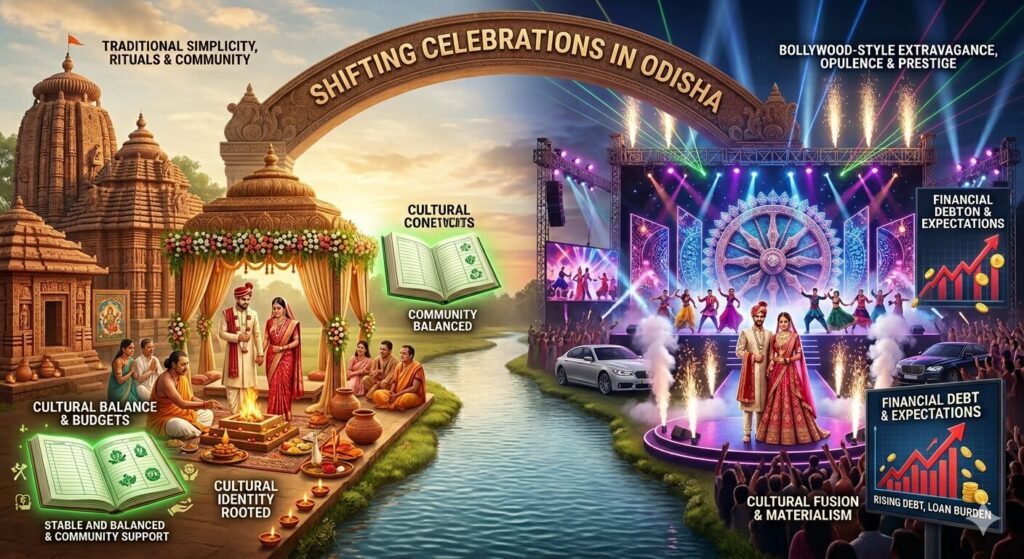
In recent decades, social celebrations in Odisha have undergone a noticeable transformation. What once used to be simple, culturally rooted occasions have gradually turned into elaborate spectacles influenced by external customs and commercial trends. Ceremonies such as cake cutting, ring ceremony, haldi and mehendi functions, now widely seen in Odishan marriages and even in birthday or christening celebrations, were hardly known in the social life of Odisha a few decades ago. These practices, borrowed from other cultures or modern urban lifestyles, have now become so fashionable that many people consider them indispensable. Yet this sudden cultural shift raises an important question: are we unknowingly losing our own cultural nuances and social balance in the process?
Traditionally, marriages and family ceremonies in Odisha were marked by simplicity, intimacy, and deep cultural symbolism. The rituals had evolved organically over centuries, reflecting the spiritual, social, and aesthetic sensibilities of the region. Ceremonies such as Nirbandha, Lagna, Bahaghara, Haata Ganthi, Homa, and Kanyadaan carried profound meanings that connected families, communities, and generations. Similarly, birthdays were rarely celebrated with pomp and glamour. They were quiet occasions marked by blessings from elders, visits to temples, or simple family gatherings. Even naming ceremonies or other social rites were conducted with modesty and reverence.
Today, however, the scenario is dramatically different. The influence of television, cinema, social media, and globalised lifestyles has reshaped the imagination of the younger generation. Weddings are increasingly modelled after Bollywood-style celebrations or Western wedding culture. What was once a sacred social institution is slowly turning into a multi-event festival of display and extravagance. Engagement ceremonies are renamed as “ring ceremonies,” birthdays are celebrated with expensive cakes and themed decorations, and marriage rituals often include elaborate mehendi and haldi events that were never traditionally part of Odishan culture.
At first glance, these practices may appear harmless. Cultural exchange is a natural phenomenon in a dynamic society. Civilisations have always borrowed ideas and practices from one another. However, when imitation becomes blind and excessive, it begins to erode the distinctive character of a culture. What we witness today is not merely cultural exchange but cultural dilution. Indigenous rituals, songs, and customs are gradually being replaced or overshadowed by borrowed ceremonies whose meaning is often poorly understood.
This cultural confusion creates a peculiar dilemma. On one hand, people feel emotionally connected to their traditional customs. On the other hand, social pressure compels them to adopt fashionable practices to avoid appearing outdated or conservative. As a result, many families end up performing a confusing mixture of rituals, part traditional, part borrowed, without fully understanding either. The celebration becomes a hotchpotch of customs that neither reflects authentic Odishan culture nor faithfully represents the borrowed traditions.
The economic dimension of this cultural shift is even more troubling. The growing trend of extravagant celebrations has imposed a heavy financial burden on families. Weddings, birthdays, and other social functions have become occasions for competitive display. People often feel compelled to spend beyond their means in order to maintain social prestige or avoid criticism from relatives and neighbours. Expensive decorations, designer clothing, professional photographers, catering arrangements, and elaborate event management have become common features of these ceremonies.
For many middle-class and lower-middle-class families, such expenditures can be devastating. They may take loans, sell assets, or exhaust their savings simply to organise socially acceptable celebrations. What should have been joyous family events gradually turn into financial liabilities. The pressure does not end with the ceremony; the aftermath often brings anxiety, debt, and economic strain. The celebration that was meant to bring happiness thus becomes a source of stress and regret.
Another consequence of this trend is the gradual weakening of community participation. Traditional Odishan ceremonies were deeply collective in nature. Relatives, neighbours, and community members played active roles in preparing food, decorating the house, singing traditional songs, and performing rituals. These activities strengthened social bonds and created a sense of belonging. Today, many of these roles have been outsourced to commercial service providers. Event managers replace relatives, caterers replace community cooking, and recorded music replaces traditional songs. The emotional warmth of collective participation is slowly disappearing.
More importantly, the erosion of cultural practices leads to a loss of cultural memory. Rituals are not merely mechanical actions; they are carriers of history, philosophy, and social values. When traditional practices fade away, the stories, symbols, and meanings associated with them also vanish. Younger generations grow up without understanding the cultural heritage that shaped their society. Over time, a community that forgets its own traditions risks losing its cultural identity.
This is not an argument for rigid conservatism or cultural isolation. Cultures must evolve and adapt to changing times. However, evolution should be guided by awareness and discernment rather than blind imitation. Borrowing elements from other cultures is acceptable when it enriches our own traditions without displacing them. The real challenge is to maintain a healthy balance between openness and preservation.
What is urgently needed today is a conscious effort to revive and respect indigenous cultural practices. Families, cultural organisations, and educational institutions should encourage awareness of traditional Odishan rituals and their significance. Social celebrations should be guided by moderation rather than extravagance. Instead of measuring success by the scale of expenditure, society should value the sincerity and simplicity of the occasion.
Equally important is the role of social awareness. When communities collectively reject the culture of competitive display, individuals will feel less pressure to conform to extravagant trends. Simpler ceremonies not only reduce financial strain but also restore the emotional warmth and cultural authenticity of social celebrations.
Ultimately, culture is not preserved through grand declarations but through everyday practices. The songs we sing, the rituals we perform, and the values we uphold quietly shape the identity of a society. If Odisha wishes to retain the richness of its cultural heritage, it must learn to celebrate its own traditions with pride and confidence. Otherwise, in the race to imitate fashionable customs, we may gradually lose the very cultural fabric that once gave our social life its meaning and beauty.
(The author is a former Reader in English. Views expressed are personal.)