





















As modern governance shifts from one-way broadcasting to transparent, two-way dialogue, leveraging social media and artificial intelligence is now an essential mandate for transforming passive citizens into active partners in public administration
Nilambar Rath
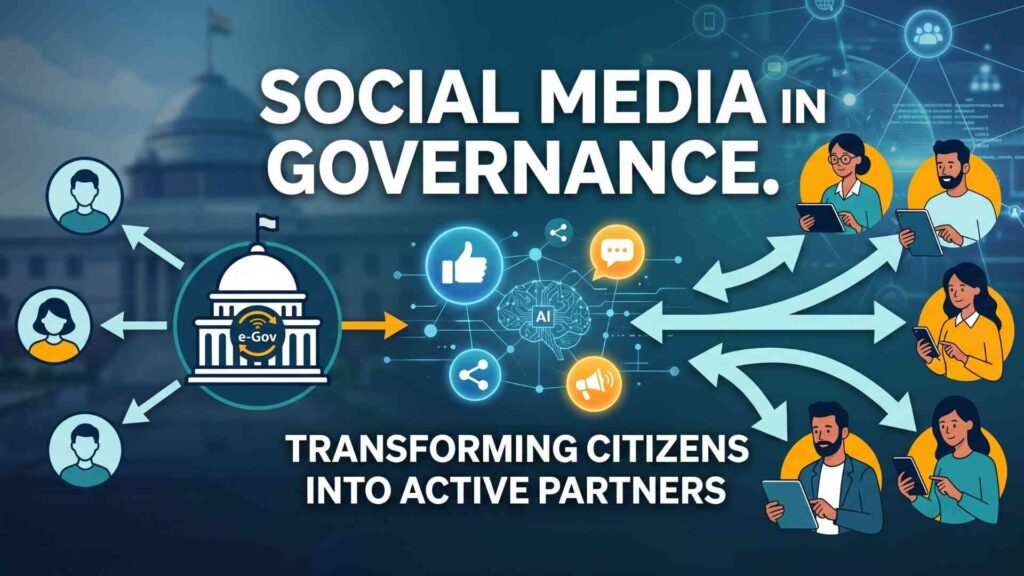
Modern governance in India is no longer merely about administration and file movement; it is fundamentally about perception, participation, and partnership.
As public administration shifts from traditional one-way broadcasting to transparent, two-way dialogue, leveraging social media and artificial intelligence has become an essential mandate. Today, a policy is only as effective as the public’s awareness of it.
Through e-Governance portals and social media platforms, the government is thus evolving from a mere broadcaster into an active facilitator, enabling real-time engagement directly with citizens.
In this digital landscape, social media is no longer just a public relations tool; it serves as the direct, digital front porch of the government. However, navigating this space requires a deep understanding of both technology and audience behavior.
Government communications now compete for attention in an ecosystem governed by algorithms that reward engagement, alongside audiences with incredibly short attention spans. To break through the noise, public service messaging must be highly visual, hyper-relevant, and easily digestible on mobile screens.
Crafting this communication requires a delicate balance of simplicity and empathy. Complex bureaucratic jargon must be stripped away in favor of plain, conversational language that speaks directly to the citizens. Visual storytelling, particularly through short-form videos, has become the undisputed king of current algorithms.
By transforming dense policy circulars into human-centric stories and engaging infographics, government departments can build deeper connections with the public.
Beyond just sharing information, the true power of this medium lies in Social Behaviour Change Communication. Well-structured digital campaigns can shift cultural norms, utilizing emotional appeal and peer influence to encourage safer, healthier community habits. However, this power brings immense responsibility. Because public service touches vulnerable populations, the stakes during a crisis are incredibly high.
Speed and accuracy act as a shield. Utilizing the “Golden Hour” to acknowledge issues, combating fake news with standardized fact-checks, and maintaining verified digital identities are non-negotiable practices for maintaining public trust.
Looking ahead, the integration of Artificial Intelligence is the next frontier for e-Governance. An AI-first approach is becoming essential for modern administration, aiding in rapid content generation, flawless regional language translation, and active social listening to gauge public sentiment before issues escalate.
Yet, none of this digital innovation matters without measuring impact. Tracking reach, views, and especially engagement allows communication managers to stop guessing and invest resources in strategies that actually drive civic action.
Ultimately, successful digital governance relies on convergence, the reality check ensuring that digital promises match physical, on-ground realities. A beautiful online campaign urging citizens to claim welfare benefits is only impactful if local administrative offices are fully equipped to process those claims.
By embracing these strategic digital pillars, we can transform public service delivery and ensure that modern governance truly reaches every citizen.
For a deeper dive into the strategic framework of digital administration, read the extended masterclass article published at the corporate portal of the leading media and communication agency aml Communications.
(This article is based on the author’s presentation at the communication masterclass hosted by Gopabandhu Academy of Administration, Bhubaneswar, the apex training facility meant for civil servants by the Government of Odisha.)
(Author Bio: Nilambar Rath is a senior communication specialist, media educator, and entrepreneur. He is the Founder and CEO of aml Communications, the Founder Editor of OdishaLIVE, and Co-Chair of the IFI Foundation.)