





















Odisha school textbooks face criticism over the inclusion of Bollywood folk songs and 1,678 errors. SCERT initiates corrective measures for future editions
OdishaPlus Bureau
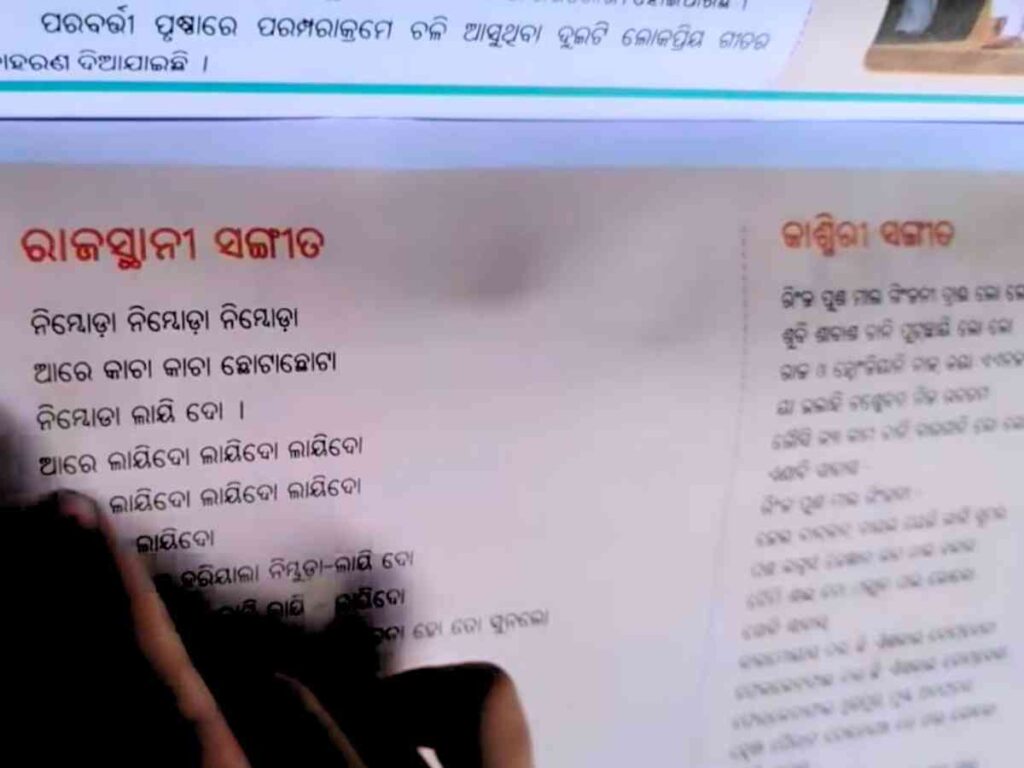
The inclusion of Bollywood songs such as ‘nimbooda…nimbooda’ and ‘Rind Posh Maal’ in a Class 8 Odia textbook has ignited controversy, drawing further attention to a state already facing scrutiny due to errors in school textbooks.
The Class 8 book, titled Kruti (art education), presents the lyrics of ‘nimbooda…nimbooda’, a track from the 1999 Bollywood film ‘Hum Dil De Chuke Sanam’, as an illustration of a Rajasthani folk song. Additionally, it features ‘Rind Posh Maal’, which gained popularity through the 2000 film ‘Mission Kashmir’, as an example of a Kashmir folk song.
The inclusion of these songs, alongside the Odia song ‘Raja Doli’ in the Class 5 English textbook Pallavi and ‘Bumbro…Bumbro’ in the Class 3 book, as representations of folk music, has led to significant debate. All four songs have folk origins, with ‘Rind Posh Maal’ originally composed as a love poem by the renowned Kashmiri poet Rasul Mir in the late 18th century.
In a related note, the Class 6 textbook Kaushala Sikshya (skill education) instructs students on how to make ‘Jhal Mudi’, fruit salad, buttermilk, ‘lassi’, ‘mint chutney’, ‘sandwich’, and ‘Kachumber raita’.
Upon being contacted, a senior official from the School and Mass Education Department stated that the inclusion of the songs aims to introduce students to the diverse cultures of various states.
“It has been implemented under the ‘Ek Bharat … Shresta Bharat’ initiative. Both songs are present in the NCERT books, from which we have adapted them into the textbooks prepared by the Odisha government,” the official remarked, preferring to remain anonymous.
This development occurs amidst heightened scrutiny of the State Council of Educational Research and Training (SCERT) textbooks, following the discovery of 1,678 errors within them.
The Class 8 textbooks, with 705 errors, represent the highest number of inaccuracies, which include factual errors, grammatical issues, spelling mistakes, and incorrect references.

Among the identified errors, the Karnataka Assembly building is incorrectly referred to as the Odisha Vidhan Sabha, Sir Isaac Newton is inaccurately described as the “greatest pilot,” and Hampi in Karnataka is mistakenly identified as the Konark Sun Temple.
In response to the findings of the committee that investigated these errors, the state government has already suspended four senior officials, including the former SCERT director. Additionally, it has announced the implementation of the committee’s 14-point recommendations starting from the next academic session to address the inaccuracies.
Meanwhile, officials from the Odisha Textbook Production and Marketing (TBP&M) wing acknowledged that a portion of the textbook printing was outsourced to private presses for Rs 21 crore. They indicated that the TBP&M alone could not fulfill the entire printing demand for the new textbooks.
Odisha School and Mass Education Minister Nityananda Gond stated that revised pages containing the necessary corrections will be distributed to schools and district education officers. These pages will serve as the official study material, while students will continue to use the existing textbooks in conjunction with the supplementary corrected pages.