
























Explore the gendered hierarchy and traditions during Nuakhai, examining how the festival of togetherness often separates women from the shared plate
Lipsa Sahoo

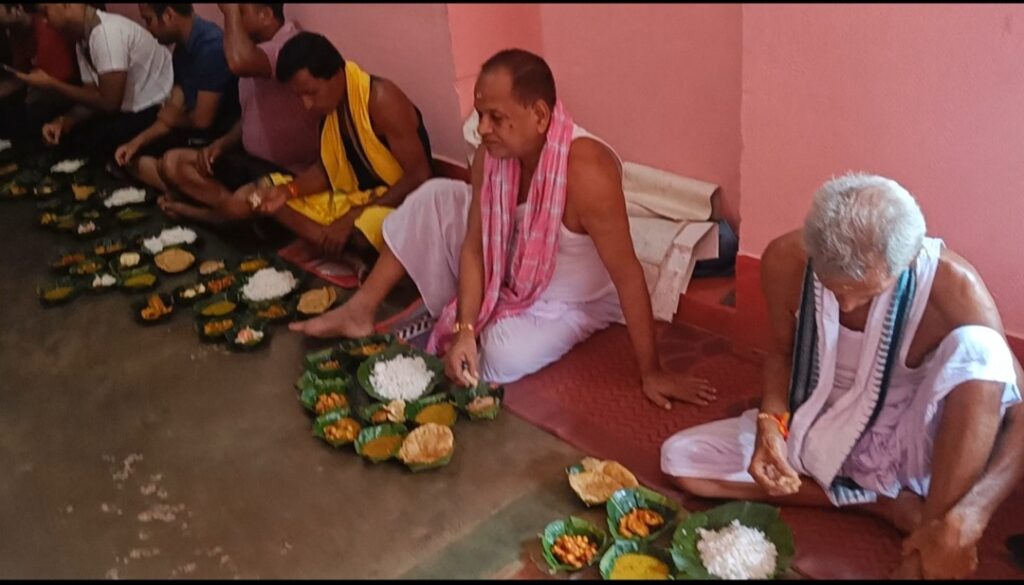
The new food is prepared. The family gathers. The leaf plates are served. It is Nuakhai again. Yet the meal doesn’t begin for everyone at once.
“There isn’t enough space for everyone,” they said. But is it really about space? If it is, there are better alternatives. Perhaps the women could simply eat first for once, or, even better, the family could split into two batches, irrespective of gender. Other households, I am told, manage to sit in a single, unbroken circle, partaking in the harvest as one. But here, somehow, I find myself encountering the same pattern—the men sit down to eat before the women.
“We care about them. It’s our love and devotion,” I’m told. Certainly, there is a sea of care, love, and devotion in the women who hold these households together. Yet beneath it, there exists an underlying layer that often goes unquestioned: a gendered hierarchy. Because affection need not require one person to always eat before the other.
“This is how it has always been, and this is a woman’s place. It is only right that we eat after they are full,” my grandmother tells me.
The order of the meal, however, is only one part of a larger choreography. In the front room, the air is light with laughter, fingertips noisily licked clean in absolute ease, and the fragrant steam rising from warm mounds of Nabanna. A few feet away, just past the curtain, the kitchen air is heavy and trapped. The women do not sit. They lean against soot-stained doorframes, dabbing sweat from their necks with the pallus of their Sambalpuri sarees, watching the leaf plates empty and waiting for the signal to refill them.
The process of preparing for the puja, cooking the meal, stitching the leaf plates, and serving the food largely falls upon the women in the family. Yet to call all of this simply ‘labour’ would be to miss another side of the story. For many women, these acts are also expressions of affection. Or submission? Doing all these chores can be deeply intertwined with what they understand as care, duty, and devotion.
And perhaps that is what makes these traditions so difficult to question. When an act of service is taught as love throughout one’s life, questioning the act itself begins to seem like questioning the love behind it.
But does care have to follow a hierarchy? Must devotion always place one person before the other? If men eating first could be an expression of love, could not eating together be one too?
My grandmother defends it as tradition—a practice passed down through generations. But my newly married young aunt offers me another explanation: “It is because men are the head of the family. They are in charge. I have to treat them with that respect.”
The words make the hierarchy difficult to disguise. What appears, on the surface, to be a matter of space is also a matter of who is supposed to occupy the higher place within the family.
And yet, she does not describe it as oppression. She describes it as respect.
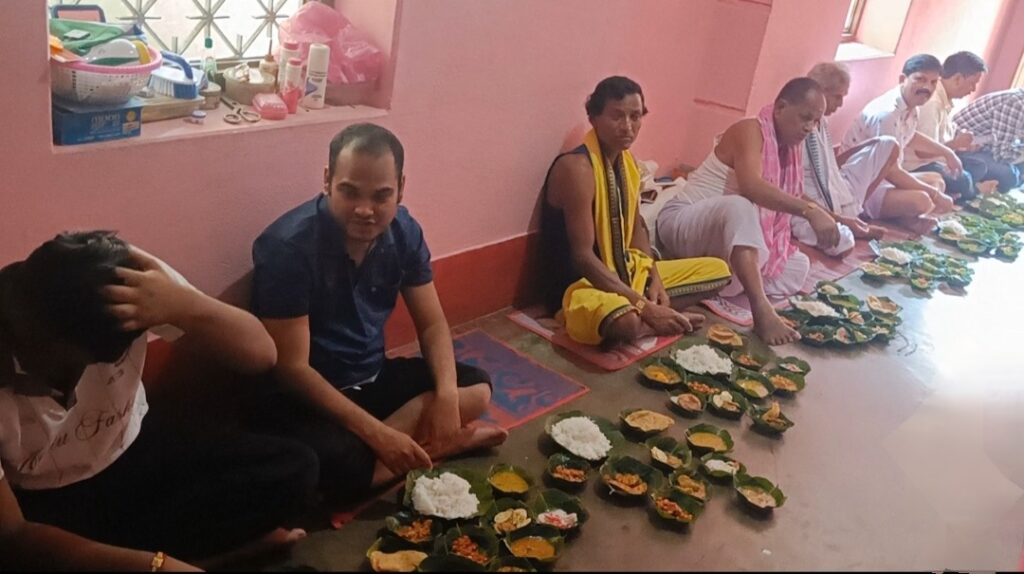
The men in the family, on the other hand, offer their own explanations for their part. “We eat first because it says in the Lakshmi Purana that a woman should only eat after her man,” was one of the responses I received. When specifically asked whether he sees the act of being served first as an expression of love and duty or simply as habit, his answer is flat: “It is how things are done. It is how things should be done.”
The distinction between “are” and “should be” is perhaps where tradition becomes expectation. What begins as a practice inherited from the past can acquire the force of a rule.
Traditions are not static simply because they are old. They survive because there is a conscious or unconscious effort by each generation to carry them forward.
More than an agrarian thanksgiving, Nuakhai functions as a festival of the shared plate. Traditionally, the entire family is supposed to partake in the Nabanna together. Nuakhai is often described as a festival that celebrates togetherness. But we also need to ask whether the togetherness we practise is truly shared when even the meal that brings us together can place us in different positions. Or whether some of us have simply learned to call our place within the hierarchy by other names—love, devotion, duty, tradition, and so on.
(The writer is pursuing a Master’s in English Literature at Rama Devi Women’s University. Views expressed are personal.)