























A journey through Almora’s burning pine forests reveals the ecological cost of forest change, the importance of native oaks and the urgent need to restore springs and biodiversity
Dr. Sulagna Saha & Dr. Goutam Saha
As the Earth warms day by day, natural disasters occur more frequently. Yet Mother Nature whispers solutions to heal herself from this crisis. Against this backdrop, a normal travel story turns into a story of inspection and introspection. Our travel to Almora, witnessing the forest fires, the pines and the oaks, revealed a perspective on how the paradise of nature is lost and how it can be regained. From the state of mangrove forests, we experienced how our state, Odisha, increased its mangrove cover in this decade. On the eve of World Tourism Day, from the land of Jagannath, we recalled our trip that uncovered the ecological reasons for forest fires in Almora with the hope of recovery.
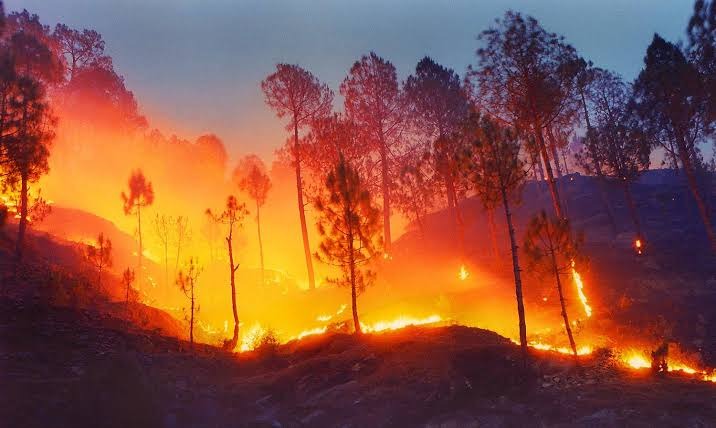
When we reached Almora, we strangely watched a mountain burn for six days. The fire would fade at night, reduced to a faint orange glow on the ridge, then roar back to life with the afternoon heat. In between, we learned that this is not viewed as a catastrophe in Uttarakhand. It is a season. And the people who live in the shadow of the chir pine have learned to shrug.
The journey from Haldwani to Almora takes three and a half hours, winding through eighty-nine kilometres of increasingly steep roads. As the bus climbs, the eucalyptus and sal of the lower elevations give way to something else. Pine. At first in patches, then in sweeping slopes, and finally, it becomes the landscape.
By morning, a column of grey-brown smoke rose lazily into the sky from a distant mountain. Manoj, our homestay host, stood on the veranda watching with an expression I couldn’t quite read. Concern, yes, but also weariness. Resignation.
“Chir pine,” he said, before I could ask. “It burns.”
When we asked an elderly man on the road how the fire would be stopped, he shrugged and pointed to a distant line of trees. “It will stop when it reaches the river,” he said. “Or when it rains.”
Not “when the forest department arrives.” Not “when the fire brigade comes.” Just when it burns itself out.
The resignation is not unfounded. According to official data, the 2026 fire season has recorded 394 major fire incidents across Uttarakhand, destroying 331.12 hectares of forest land. The Garhwal region has been worst hit, with 285 incidents and 241.32 hectares burnt. The Kumaon division, where Almora is located, has seen 74 incidents over 64.05 hectares.
The Uttarakhand Forest Department has attempted to build a more systematic response. An Integrated Command and Control Centre in Dehradun functions 24/7, supported by crew stations, master control rooms and watchtowers on high peaks. For remote areas, field staff have been issued other technological support.
The state has also deployed 5,625 “fire watchers”. These are local residents trained to detect and respond to fires. This year, these fire watchers have been provided group insurance coverage of Rs 10 lakh.
When joint operations do succeed, they require coordinated effort across multiple agencies. It did recently near Basugaon in Uttarkashi, where SDRF, NDRF, the Forest Department and the Fire Service worked together to prevent a fire from spreading to residential areas. Such successes are real, but they are not the norm. The terrain is merciless. The fires are many. And the resources, despite improvements, remain stretched thin.
The reason those fires persist is written into the very biology of the chir pine. Uttarakhand has approximately 25,138 square kilometres of reserved forest area. Of this, nearly 15.45% is dominated by chir pine. In Almora district specifically, pine covers over 81% of the forest area, while native banj oak has been reduced to just 2%.
The chir pine is what ecologists call a fire-adapted species. Its needles, or pirul, are rich in flammable resins and exceptionally slow to decompose. They accumulate on the forest floor in thick, dry mats that are practically designed to burn. The tree itself has thick, insulating bark that allows it to survive all but the most intense fires. In fact, fire helps the pine. It clears away competing vegetation, including the seedlings of fire-sensitive broadleaf trees like the banj oak.
“Pirul,” Manoj said, pointing to the pine slopes. “It is like gunpowder. One spark, and it burns for weeks.”
The government has recognised this dynamic. In 2025, the Forest Department bought 5,532 tonnes of pine needles from villagers at Rs 5.42 crore. The target for 2026 has been increased to 8,555 tonnes. Villagers are paid Rs 10 per kilogram of needles collected. So far this season, 13,003.56 tonnes of pirul have been collected.
Nine pellet and briquette production units across the state are converting this collected pine needle biomass into biofuel, turning a hazard into a resource. But 13,000 tonnes, impressive as it sounds, is a drop in the ocean. The total annual pine needle yield in Uttarakhand is estimated at nearly 2 million tonnes.
However, not everywhere was burning. Between our journeys through smoke-filled valleys, we visited the Jaleswar Temple, an ancient Shiva shrine tucked into a fold of the hills. The road wound through pine. And then, suddenly, it changed.
The canopy closed in. The light softened from harsh white to filtered green. The temperature dropped. And the ground beneath our feet was no longer a carpet of needles, but soft, dark, decomposing leaf litter. Oak!
The grove around Jaleswar Temple is a remnant of what much of Almora once was. Massive banj oaks, their trunks thick with age, their branches spreading wide to create a cathedral-like canopy. Ferns grew in the spaces between the trees. A stream trickled somewhere nearby. “This has never dried,” said a local shopkeeper. “Not even in the worst summers.”
It was a quiet statement, but a profound one. In a region where villages are being abandoned because their springs have failed, an oak-fed spring that never dries is not a curiosity. It is a lifeline.
What we witnessed in Almora is not merely anecdotal. A study from Kumaun University found that oak forests recharge groundwater at nearly three times the rate of pine forests. A 2025 study from the Indian Institute for Human Settlements confirmed that streams in pine-dominated catchments have “lower baseflow to precipitation percentage compared to Oaks”. A 2024 study found that oak root litter decomposes faster than pine litter.
The numbers explain the resignation. The landscape is not merely burning. It has been engineered, over a century and a half of colonial forest policy, to burn. The British planted pine for revenue. A hundred and fifty years later, the people of Almora are paying the price in dried springs, smoke-filled skies, and the quiet resignation of watching their mountains burn.
The Uttarakhand government is focusing on removing pine piruls, introducing pine needle biofuel programmes, constructing small water ponds to create natural firebreaks, recruiting thousands of forest guards to prevent massive forest fires, etc.
But the long-term solution, the only real solution, is to restore the oak. This is not nostalgia. It is hydrology. It is soil science. It is survival. Oak forests hold water, prevent erosion, resist fire, and sustain springs. Pine forests do none of these things.
On our last morning, the fire was still burning. We thought about the 331 hectares already burned this season, and the season was only half over.
Driving down from Almora, we witnessed thirsty pines. Manoj’s voice came back to us from our last conversation: “Plant oak. Protect what remains. That is the only way the springs will come back.”
We leave with the desire to revisit Almora and the hope of finding more oak trees and lost springs.
(Authors are faculty members at the National Institute of Fashion Technology, Bhubaneswar. Views expressed are personal.)