























Kumari Puja celebrates the divine feminine, connecting cultural traditions with the rights, dignity and empowerment of every girl child. On the International Day of the Girl Child, the article highlights the importance of ensuring girls’ education, safety, equality and opportunities beyond ceremonial worship
Dr Aditi Panda
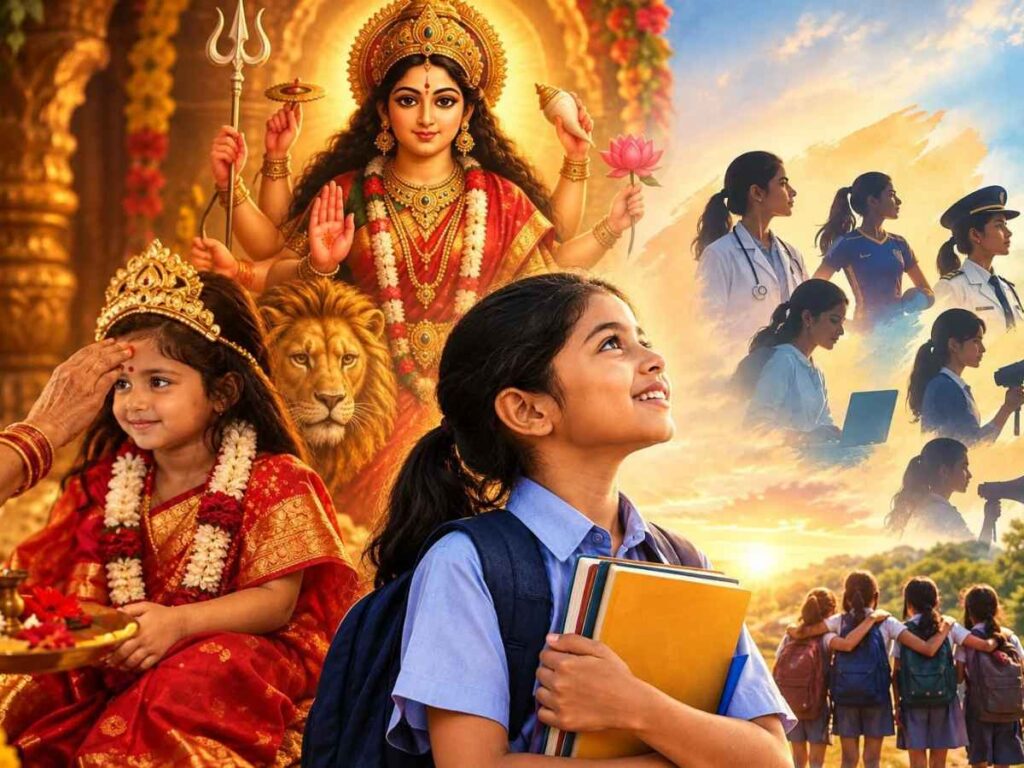
Every year on October 11, the International Day of the Girl Child is observed as a reminder to acknowledge, respect, and empower girls in all facets of life. On the other hand, it is fascinating to observe the deep appreciation for femininity in Indian cultural customs such as Kumari Puja, where young girls are revered as representations of the divine feminine. While Kumari Puja, also called Kanya Puja or Kanjak Puja, represents respect for the divine feminine in the form of a young girl, the International Day of the Girl Child honours the potential, rights, and achievements of girls. Together, they offer a powerful message: every girl deserves not only worship and respect in tradition but also empowerment, opportunity, and equality in everyday life.
Traditionally, during Kumari Puja, nine girls who have not reached puberty are invited. The number nine is revered as a depiction of Goddess Durga and symbolises her nine incarnations (Navadurga), worshipped during the nine days of Navaratri. The nine manifestations are Shailaputri, Brahmacharini, Chandraghanta, Kushmanda, Skandamata, Katyayani, Kalaratri, Mahagauri, and Siddhidatri. They represent feminine vitality, innocence, purity, and potential.
According to a popular traditional story associated with Kanya Puja, a demon was granted a boon that prevented a man from defeating him. As a result, the Goddess took on a female form and ultimately vanquished him. This narrative highlights the rich traditions and customs inherited from our ancient culture. It is frequently interpreted as a reminder that Shakti, the divine feminine power, exists throughout every phase of womanhood, including infancy, and deserves to be cherished and preserved.
In this century, the United Nations General Assembly established the International Day of the Girl Child in 2011, and it was first observed on October 11, 2012, to honour girls’ rights and the particular challenges they face, such as violence, child marriage, discrimination, limited educational opportunities, and unequal prospects. Governments, communities, and individuals are urged to create an environment where girls can develop, learn, participate, make decisions, and reach their full potential. As a result, the day is more than just a celebration of girls; it serves as a reminder of our shared responsibility to protect their equality, empowerment, safety, and dignity.
It is intriguing to observe how a long-standing custom like Kumari Puja has a strong connection with the modern observance of the International Day of the Girl Child. Young girls are honoured as symbols of the divine feminine during Kumari Puja and are treated with dignity, respect, and love. Similarly, the International Day of the Girl Child serves as a reminder that every girl should be respected, safe, educated, and given the opportunity to reach her full potential. While the day uses the language of rights, equality, and empowerment to convey this message, Kumari Puja expresses it through faith and tradition. The underlying message of both is quite similar: a girl is a valuable individual whose dignity, dreams, and future must be recognised and nurtured throughout her life. She is not someone who should only be protected or celebrated for a day.
Over time, there has been a significant shift in the status of girls in society. Compared with the past, when their choices, education, and aspirations were frequently restricted, girls are now more encouraged to study, pursue careers, play sports, assume leadership roles, and dream beyond conventional boundaries. Girls today are breaking stereotypes and succeeding in various male-dominated professions globally. However, much remains to be achieved, as many girls living in the rural pockets of our vast country are yet to experience independence and empowerment. This is the main reason we should not become complacent about the progress made so far.
Despite these achievements, many girls continue to experience prejudice, insecurity, unequal opportunities, early marriage, and restrictions on their choices. As a result, true equality remains a distant goal. To ensure that every girl, regardless of where she is born or the circumstances she comes from, has the freedom, safety, education, and opportunity to determine her own future, we must acknowledge our collective responsibility and recognise that much remains to be done, even as we celebrate the progress we have made.
Can we truly worship the girl child for one day if we do not respect, protect, educate, and empower her every day?
The real celebration of the girl child is not only about placing flowers at her feet.
It is about opening the doors of a school for her.
It is about listening when she speaks.
It is about standing beside her when she faces injustice.
It is about encouraging her ambitions.
It is about giving her the freedom to become the person she was meant to be.
Together, Kumari Puja and the International Day of the Girl Child remind us that every girl carries immense potential and the promise of a better tomorrow. Although we have made great progress, there is still more work to be done. Every step we take to educate, protect, respect, and empower girls brings us closer to a more compassionate and egalitarian society. Let us ensure that the respect we show girls during festivities and rituals becomes a daily practice. When our daughters grow up with self-assurance, independence, and opportunity, they will not only shape their own futures but also contribute to creating a brighter future for all of us. Let us, therefore, pledge not simply to celebrate our girls but also to stand beside them and become their strength.
(The author is a development sector professional. Views expressed are personal.)