




















India’s quiet rise as a global power reflects strategic autonomy, economic resilience, and diplomatic balance amid geopolitical turbulence and global uncertainty
Suresh Chandra Sarangi

We live in a VUCA world. It stands for volatility, uncertainty, Complexity, and ambiguity. There is political and economic turbulence. Alan Greenspan codifies it with the expression, ”The Age of Turbulence”, the name of his magnum opus with the same title. S. Jaishankar, the famous diplomat and India’s foreign minister, says in his book. “The Raisina chronicles”, celebrating a decade of meaningful dialogue, amidst the topsy-turvy world politics and turbulence, makes India a pathfinder in consensus-building.
In the history of world politics, Jaishankar writes,”India brings together voices from across the world,” and how India is navigating global challenges and finding solutions that are acceptable for a turbulent world makes interesting reading. For some time,India has been ascending quietly and is now the fourth-largest economy in the world, with a 4.18 trillion dollar economy, and beating the leaders of the East. It appears India has been leading the change, and the effect of the dialogue to a considerable extent has influenced the global network of nations.
The global risk matrix is escalated. Climate change risk has seen more of its violent imprint on the planet. War has become an everyday reality. Global economy,after Trump’s tariff,two back-to-back wars, aggression of the US against Venezuela, is walking a “tight rope”. Oil appears to be on the boil after the aggression. In the aftermath of the COVID Pandemic, growth had slowed down,inflation had raised its ugly head,Trade tensions swelled,President Trump’s tariffs threw new challenges, market spinning, and each country’s supply chain was in disarray. The average US tariff of 17.39%,the highest since 1934, upsets everything despite some truce somewhere. Debt eats away the vitality of nations, and the US in high alert with its bigger debt ensemble. The trade wars are increasing, and the trade bubble may burst anytime. Stock markets across the world are most volatile. Currencies are under pressure.
Under such global conditions, very adverse and staggering, India is ascending in the global politics and economy, quietly. It is said that America and China are fighting over global dominance, while Europe is fighting with its energy crisis, and India has been playing a superb role in creating its own history. The world’s largest democracy is playing the most sophisticated game that the world is not able to fathom. It is an emerging economy, not focusing only on domestic growth, but trying to create a flutter in the world economy. Yanis Varoufakis of Greece and a noted economist, states that India has been orchestrating a great power politics, beyond the vision of world leaders. Nobody sees it coming, but India is making a strategy to ride the wave. It is expected that India’s economy will reach 7 trillion US dollars by 2030,quietly knocking down Germany and securing the third position.
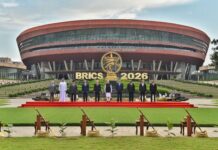
The fact remains that India is not choosing sides; it’s choosing its own course, oblivious of the Superpowers like China and America. While India is with US, Japan, Australia etc, in the Quad format, at the same time, it is in Brics, where China and Russia are members and still not influenced by any of the power blocks or military blocks, rather pursuing a policy of “strategic autonomy”, that is a policy of rediscovering its own strength, backed by centuries of dialectis. But, it is really difficult to understand how India is as important to maintain its alliance with Western powers, while at the same time, pursuing alignments and partnerships with China, America, and Russia to further its national interest, without compromising its cultural ethos and national character. To some, it may appear a bit conflicting, based on double standards, but in geopolitics, it is made possible by India, and in pursuing its strategic autonomy. This is a beautiful strategy to continue independent policies and maintain its sovereignty, in an unstable world, polarised and broken by the policy of hegemonism, and it is working spectacularly for India.
India could garner 40% of its energy needs in 2024, from Russia, while Russia faces sanctions, and that too, with US pressure, India has not succumbed to the pressure. This has, no doubt, kept the Russian economy afloat, but at the same time, it is saving billions in energy bills and helping out its consumers. It is A smart Way of managing the economy, while Western powers dependent on Russian energy are making a hue and cry. Economies around the world feel it. Despite the fact that it receives American technology and technology transfer that keeps its economy lubricating, it is indeed incredible that the policy of strategic autonomy and pursuing one’s national interest is veritably coming to the rescue of India. America needs India to contain Chinese hegemony, Russia needs India to receive its dollars in exchange for oil, China needs India to isolate American influence, but still trades to have a better trade surplus, and reduce the importance of the dollar, and Europe wants India to be an alternative manufacturing hub for their entry as well as trade requirements.
China, for a long time, was the world’s factory, manufacturing hub, but that is gradually changing, with India’s policy of boosting manufacturing. Examples are that iPhone has made India the largest manufacturing hub, and Samsung has made India its largest manufacturing hub. This is no trade confrontation, rather a policy of attraction and sounds of positivity, in India’s favour, with a benign tax regime attracting foreign capital. So Goods that were passing through Chinese ports are now going through Indian ports, a large number of Indians get employment, and foreign capital flow remains continuous. It is becoming the centre of a global manufacturing hub. It is becoming an innovation centre, Google’s AI centre, Amazon’s innovation hub, Microsoft’s India office, which tempts other European countries and Japan to have their hubs in India. It is not an outsourcing or assembly Centre, rather it is becoming a global hub of design and innovation. It is not only the flow of global capital, but the interplay of global intellectual capital, that finds expression, boosting employment.
This is because of the fact that India is a beautiful place for the English language, which is more trusted in India’s free enterprise and reliability than the Chinese political restrictions. It is a demographic dividend at its best. Beautiful Industrial transition. While China faces an aging population, Japan faces labour problems, and Europe faces other obstacles like labour and energy shortages, India is reaping its demographic dividends. India has more doctors, more engineers, and more programmers who keep India’s economy running to the astonishment of the world. Unicorn status is a regular phenomenon. CEOs are at the helm of affairs of Microsoft, Google. India is the center of consumption, and with the middle class marching towards 60% of the population, India’s consumer market will explode.
The biggest revolution in India today is the phone pay, pay phone, underpayment interface platform, which is unique in the world. This revolution that has given Indian entrepreneurship in the rural village to trade and participate in the market, making possible a million mutinies, is a crucial interconnection for its place in the Sun. The entire world’s big investment is flowing towards India, and it is so widespread that the withdrawal by anyone will not affect India’s industrial breakthroughs. Militarily, India integrates military technology from the entire world, and any single country’s isolation is meaningless. In the matter of defence, India is integrating global institutions, acquiring the best of technology, and thus having a competitive advantage.
The G20 leadership speaks of the global South’s importance. This is leadership without hegemony and influence without domination. It is a partnership without domination and forging of leadership with mutual interest and respect. This is reshaping global expectations and rocketing India’s Goldilocks moment. Countries are making partnerships with a shared philosophy. Despite Trump’s tariff, India is becoming the leader of South and the 21st century may well witness an Indian renaissance, with global leadership and an emerging superpower status.
(The writer is a former General Manager of Bank of India. Views expressed are personal.)