























An analytical look at how funds managed by the Compensatory Afforestation Fund Management and Planning Authority (CAMPA) are driving ecological restoration and wildlife conservation across Indian states
OdishaPlus Bureau
As India accelerates its economic growth and infrastructure development, the inevitable diversion of forest lands for non-forestry purposes poses a complex ecological challenge.
The Compensatory Afforestation Fund Management and Planning Authority (CAMPA) was designed not just to offset the loss of green cover but to proactively restore and enrich India’s diverse landscapes.
A close examination of the recent publication, “Glimpses of Success Stories of CAMPA 2022-24,” provides a comprehensive overview of how these funds are being operationalized across various states to protect and nurture forests, wildlife, and the broader environment.
The overall impact of CAMPA supported projects extends far beyond mere tree planting. It encompasses a holistic approach to ecological restoration, including soil and moisture conservation, biodiversity management, wildlife habitat improvement, and the stabilization of fragile terrains.
Furthermore, these initiatives have proven to be significant socio-economic catalysts, generating millions of employment opportunities for local communities and forest dwellers. By increasing the production of non-timber forest products, minimizing human-wildlife conflict, and improving groundwater recharge, CAMPA interventions are directly contributing to the climate resilience and economic stability of rural India.
Demystifying CAMPA: Vision, Setup, and Focus
Born out of the Compensatory Afforestation Fund (CAF) Act, 2016, CAMPA was established to manage the massive corpus of compensatory levies collected from user agencies that divert forest land for developmental projects. These levies include the costs of compensatory afforestation, Catchment Area Treatment (CAT) plans, integrated wildlife management plans, and the Net Present Value (NPV) of the diverted forest ecosystem.
By the end of March 2023, an amount of Rs. 55,292.40 crore had been transferred to 34 States and Union Territories. These funds are non-lapsable and interest-bearing, apportioned in a 10:90 ratio between the National Fund and the respective State Funds, ensuring that the lion’s share of the resources is deployed locally where the ecological loss originally occurred.
At the state level, CAMPA operates through a setup comprising a Governing Body, a Steering Committee, and an Executive Committee. The Executive Committee formulates the Annual Plan of Operations (APOs), detailing physical and financial targets, which are then scrutinized by the Steering Committee and finally approved by the National Authority. This structured approach helps monitor that funds are strategically utilized for artificial and assisted natural regeneration, forest protection, infrastructure development, forest fire control, and crucial wildlife habitat improvements.
Key Initiatives and Sectoral Focus
The 2022-24 success stories showcase a diverse array of site-specific interventions. In Chhattisgarh, the state utilized GIS and remote sensing to treat over 6,755 streams, generating 1.22 crore man-days of employment between 2019 and 2023. Furthermore, the state modernized its forest protection with the deployment of 250 Forest Strike Force vehicles and the establishment of 92 high-tech, remotely monitored forest barriers.
In Jharkhand, CAMPA has proven to be a vital tool for enhancing climate resilience. A remarkable achievement was the use of CAMPA funds during the COVID-19 pandemic under the Garib Kalyan Rojgar Abhiyaan (GKRA), which generated over 4 lakh man-days of employment for migrant laborers across districts like Hazaribag, Giridih, and Godda.
The valuation of ecosystem services from surveyed CAMPA plantations in Jharkhand is estimated at a staggering Rs. 18,506 million per year.
Wildlife conservation is another critical sector. Rajasthan has utilized these funds for the highly sensitive conservation and breeding program of the critically endangered Great Indian Bustard in Jaisalmer, alongside constructing predator-proof fencing.
In Goa, CAMPA funds have scripted a turnaround by restoring 55 hectares of mined-out land within the Netravali Wildlife Sanctuary.
Tripura developed the Forest Incident Reporting Module (FIRM) app for real-time spatial mapping of wildlife sightings, forest fires, and timber seizures.
Up north, Uttarakhand has directed resources toward the conservation of ‘Bugyals’, the ecologically significant and highly vulnerable high-altitude alpine meadows.
In Madhya Pradesh, a significant portion of the fund has been dedicated to strengthening the grassroots foundation of forest protection by constructing residential and office buildings for frontline staff.
Restoring the Coastal Guardians: The Mangrove Ecosystems
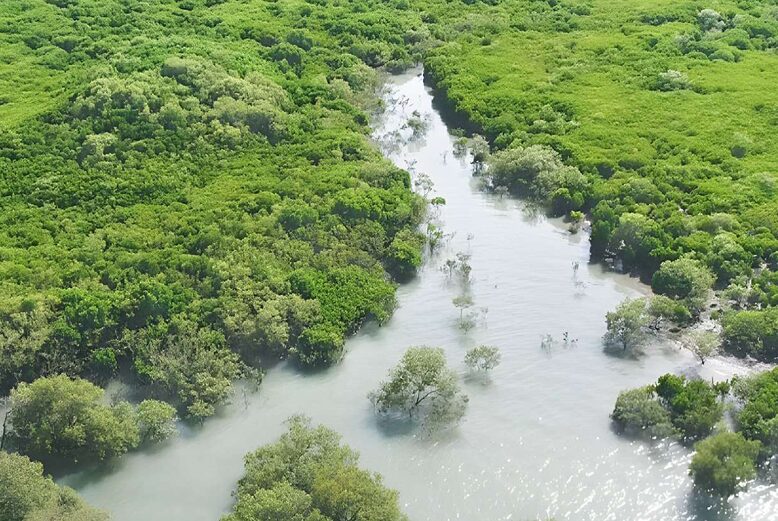
Recognizing the vital role of mangroves in shoreline protection and marine biodiversity, CAMPA has heavily invested in their restoration, particularly in Odisha, Gujarat and Tamil Nadu.
Gujarat ranks second in the country with a mangrove cover of approximately 1175 square kilometers, which has increased from 397 square kilometers in 1991. To safeguard these ecosystems, the Mangrove Initiative for Shoreline Habitats & Tangible Incomes (MISHTI) scheme has been implemented.
Gujarat State CAMPA uses scientific and satellite-based methods to identify over 33,000 square kilometers of suitable sites for mangrove plantations. In the year 2023-24 alone, around 1000 hectares of mangrove plantations were undertaken under the MISHTI project in Kori Creek and Koteshwar Creek.
The state employs various planting techniques suited to the high tidal amplitude, such as mound planting and direct seed sowing. Additionally, the state has recorded fourteen major species of mangroves and their associates, such as Avicennia marina and Rhizophora mucronata, primarily found in South Gujarat and the Gulf of Kutch.
Tamil Nadu has the distinction of being the first state in India to introduce mangrove restoration and initiate the fish bone type method for mangrove plantations. This technique effectively distributes water through feeder and distribution canals, helping to stabilize mangroves in the coastal belt.
Odisha has also shown massive outcome in terms of mangroves restoration with a high concentration in Bhitarakanika in Kendrapara district, supported by CAMPA funds.
The state’s mangrove restoration efforts began in the early 1990s and have been extensively used since 2001.
Spotlight on Odisha: Relocating for Wildlife Conservation
Odisha’s interventions under CAMPA offer a compelling case study in the realm of wildlife habitat consolidation and the minimization of human-wildlife conflict. A standout achievement during 2021-22 was the successful, voluntary relocation of 400 families from four villages located deep within the Debrigarh Wildlife Sanctuary by the Hirakud Wildlife Division.
Executing village relocations from protected areas is historically fraught with administrative and social complexities. However, Odisha managed this through extensive mobilization, conducting over 280 meetings with villagers between August 2021 and March 2022 to sensitize them on the long-term benefits.
The process culminated in a 100 percent consent rate from the Gram Sabhas. Ensuring adequate rehabilitation, each eligible family received a compensation amount of Rs. 15.00 lakh directly into their bank accounts, with many families placing the majority of this sum into fixed deposits.
This strategic relocation has led to the recovery of 480 hectares of prime forest land. This recovered area is now undergoing meadow development, transforming into an ideal, undisturbed habitat. Furthermore, land outside the sanctuary was identified for the construction of a permanent colony for the resettlement of these families.
The CAMPA 2022-24 success stories report serves as a vital digital reference, illustrating the vast potential of well-funded environmental governance. It outlines a clear vision where compensatory funds are transformed into tangible ecological assets, from the stream networks of Chhattisgarh and the mangroves of Gujarat to the critical wildlife habitats of Odisha.
(Editorial Note: The information and approach highlighted in this piece are based on the National CAMPA report, “Glimpses of Success Stories of CAMPA 2022-24”. OdishaPlus intends to inform the public on the diverse and relevant work being supported and promoted by National CAMPA through the State mechanism and extended partners and stakeholders.)