















Discover how the Punjabi community helped build Bhubaneswar after Independence, contributing to iconic landmarks, infrastructure, and the city’s growth story
OdishaPlus Bureau
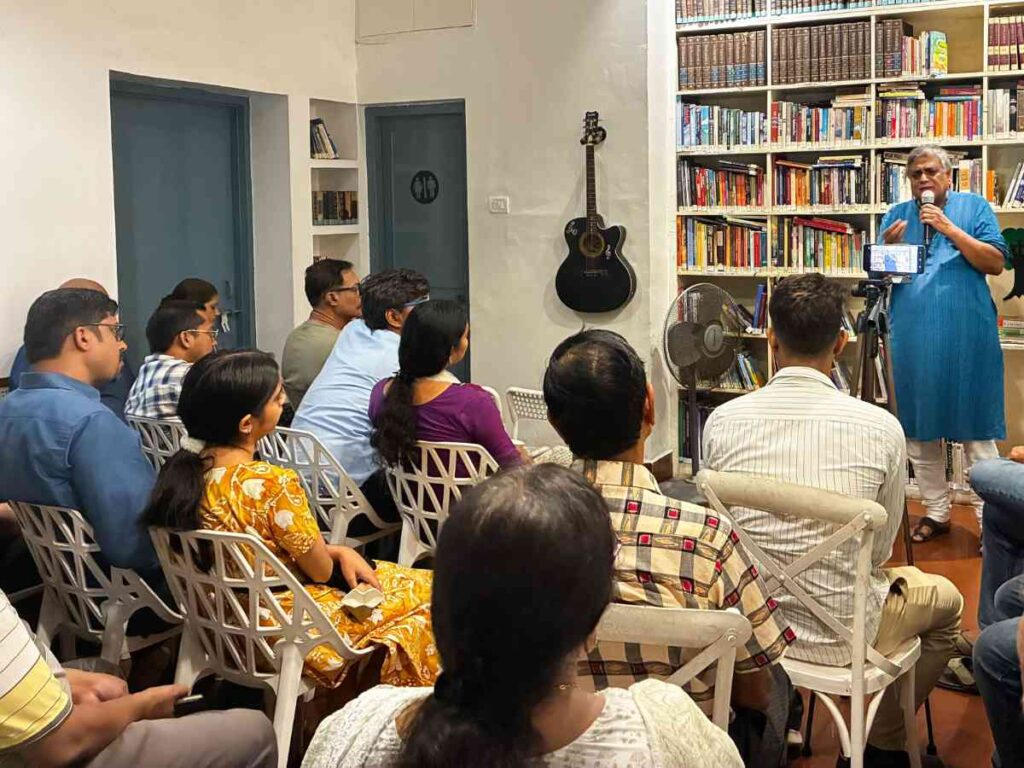
The story of Bhubaneswar’s transformation from a planned post-Independence capital into a thriving modern city cannot be told without acknowledging the remarkable contribution of the Punjabi community, said noted researcher and heritage enthusiast Anil Dhir during an engaging session of the Ekamra Talkies series held at Café 16, Satyanagar.
The event, jointly organized by Bakul Foundation and Café 16, brought together historians, community members, senior citizens, and students to revisit a little-known yet significant chapter in the history of Odisha’s capital.
Welcoming the gathering, Bakul Foundation founder Sujit Mahapatra highlighted the objective of the Ekamra Talkies initiative, launched in 2024 to document and celebrate the memories, stories, and lived experiences of Bhubaneswar’s residents during the formative decades of the now 78-year-old city. He also recalled earlier sessions that explored the city’s culinary culture and early social life.
In his presentation, Dhir traced the arrival of Punjabi families to Bhubaneswar during the city’s formative years in the late 1940s and 1950s. He explained that the construction of a new state capital created unprecedented opportunities for skilled professionals, engineers, contractors, and entrepreneurs from across India.
Many Punjabis, particularly those displaced by the trauma of Partition, brought with them expertise in railway construction, infrastructure development, and large-scale building projects. According to Dhir, several iconic government structures, including the Secretariat and the Odisha Legislative Assembly, were built under the leadership of Punjabi contractors, making them key contributors to the city’s physical and economic development.
“Bhubaneswar was not built by Odias alone. It was shaped by people from different parts of India who came here with hope, skills, and determination. The Punjabi community played a vital role in that story,” Dhir observed.
Adding a deeply personal dimension to the talk, Dhir recounted his childhood memories of growing up in Punjabi Colony, Satyanagar — the only neighbourhood in Bhubaneswar that evolved around a specific migrant community. His father, who moved to the city when Dhir was barely a year old, was among the pioneers who encouraged Punjabi families to settle in Bhubaneswar. At its peak, the colony was home to nearly forty Punjabi families.
Painting a vivid picture of the city’s early years, Dhir described a landscape where development coexisted with wilderness. The area near the railway tracks was sparsely populated, and encounters with wildlife, including jackals and even the occasional tiger, were not unheard of. His recollections offered a fascinating glimpse into a Bhubaneswar that was still finding its identity while expanding rapidly.
The talk also touched upon a more painful chapter in the community’s history. Dhir reflected on how the anti-Sikh riots of 1984 created fear and uncertainty among many Sikh families, prompting several of them to leave Bhubaneswar and relocate elsewhere. As a result, a once-vibrant community presence gradually diminished, leaving behind memories of an important era in the city’s evolution.
The event witnessed the participation of several members of Bhubaneswar’s Punjabi community, including Hardaman Singh, whose family migrated from Rawalpindi during Partition. Prominent citizens such as Deboo Patnaik, former Chief Commissioner of Income Tax Ashok Bal, and former Director General of the National Archives of India Lalitendu Dasmohapatra were also present, alongside young students eager to learn about the city’s hidden histories.
The session sparked lively discussions and reflections, underscoring the importance of preserving stories that often remain outside mainstream historical narratives. More than a talk about one community, it became a reminder that Bhubaneswar’s identity was forged through the contributions of diverse groups who made the city their home and helped shape its future.
As Bhubaneswar continues to evolve into a global urban centre, conversations such as these serve as a powerful reminder that its foundations were laid not only with bricks and mortar but also through the resilience, enterprise, and dreams of migrant communities who became an inseparable part of the city’s story.