





















PUBLIC RELATIONS HAS EVOLVED INTO DEMOCRACY’S “FIFTH PILLAR,” FOSTERING TRANSPARENCY, TRUST, AND DIALOGUE. BY BRIDGING INSTITUTIONS AND CITIZENS, IT ENABLES INFORMED PARTICIPATION, ACCOUNTABILITY, AND ENGAGEMENT IN AN INCREASINGLY COMPLEX, DIGITAL SOCIETY
Dr. Fakira Mohan Nahak
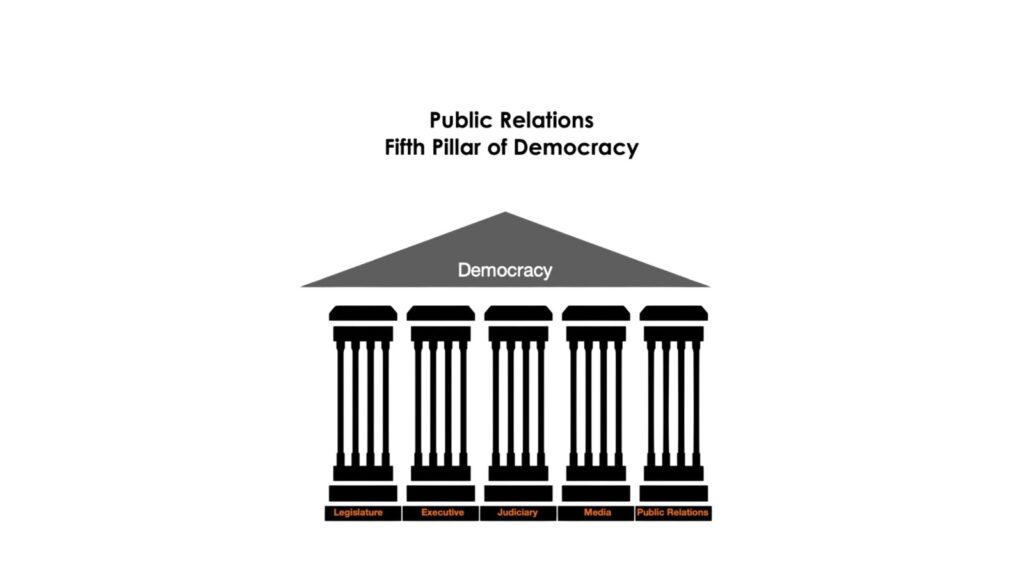
Democracy thrives on informed citizens, transparent governance, and active public participation. Traditionally, the pillars of democracy have been the Legislature, Executive, Judiciary, and Media. In recent decades, however, Public Relations (PR) has emerged as a vital force that strengthens the connection between institutions and the people, earning its place as the “Fifth Pillar of Democracy.”
As we celebrate the 58th National Public Relations Day, it is an opportune moment to reflect on the evolving role of public relations (PR) in contemporary society. While the traditional pillars of democracy, the legislature, the executive, the judiciary, and the press—are foundational to the functioning of a state, a compelling argument has emerged that Public Relations has evolved into the “Fifth Pillar of Democracy.” In an era defined by information overload and complex societal challenges, PR serves as the essential bridge between institutions and the public, fostering the transparency, dialogue, and mutual understanding necessary for a healthy democratic ecosystem.
The Nature and Scope of Public Relations
At its core, Public Relations is the strategic management of communication between an entity—be it a government body, a corporation, or a non-profit—and its various publics. Far from being merely a tool for promotion or “spin,” modern PR is rooted in two-way symmetrical communication.
The scope of PR has expanded exponentially. It is no longer confined to issuing press releases; it encompasses crisis communication, public affairs, corporate social responsibility (CSR), stakeholder engagement, and digital reputation management. In a democracy, the scope of PR extends to ensuring that the voice of the citizen is heard by the decision-makers, and that the rationale behind public policy is effectively communicated, thereby closing the trust gap.
The Core Functions: Bridging the Divide
Public Relations serves several critical functions that strengthen democratic institutions:
• Facilitating Informed Consent: Democracy relies on an informed citizenry. PR professionals distil complex policy information into accessible formats, empowering citizens to participate in meaningful discourse.
• Crisis Management and Accountability: In times of uncertainty, PR provides clarity. By ensuring timely and accurate communication, PR practitioners prevent the spread of misinformation and help institutions remain accountable to their stakeholders.
• Building Consensus: By identifying mutual interests between diverse groups, PR acts as a mediator, helping to build consensus in a fragmented social landscape.
• Promoting Civic Engagement: Through strategic campaigns, PR can mobilize the public for social causes, encouraging active participation in democratic processes like voting, public consultations, and community initiatives.
The Contribution to Democracy
The contribution of PR to democracy lies in its ability to nurture social capital. Democracy thrives on trust. When institutions communicate with integrity, transparency, and consistency, they build a reservoir of public trust.
PR professionals act as the “ethical conscience” of an organization. By prioritizing long-term reputation over short-term gains, they ensure that organizations remain aligned with societal values. Furthermore, by giving a platform to marginalized voices and facilitating feedback loops, PR helps institutions adapt to the changing needs and expectations of the public, which is the very essence of a responsive democracy.
Opportunities in a Dynamic Field
The landscape of Public Relations is undergoing a paradigm shift, creating unprecedented opportunities for those entering the profession:
• The Rise of Digital PR: With the proliferation of social media, PR has moved into the realm of real-time interaction. Opportunities exist in leveraging data analytics, sentiment analysis, and AI-driven insights to tailor communication strategies that resonate with specific demographics.
• Focus on Purpose-Driven Communication: Modern consumers and citizens demand authenticity. There is a growing demand for PR professionals who can craft narratives around ESG (Environmental, Social, and Governance) goals and authentic CSR initiatives.
• Public Affairs and Advocacy: As the relationship between government and private sectors becomes more intertwined, there is an increasing need for professionals who specialize in policy advocacy and navigating complex regulatory environments.
• Global Connectivity: In an interconnected world, the ability to manage reputation across borders and cultures is a highly valued skill, opening doors for international PR careers.
Hence, on this 58th National Public Relations Day (celebrated every year on 21st April), we recognise that public relations is far more than a corporate function; it is a vital democratic instrument. By fostering transparency, managing the flow of information, and encouraging genuine dialogue, PR practitioners are the architects of public trust.
As we look toward the future, the discipline of PR must continue to embrace the values of truth, accountability, and ethical engagement. By doing so, it will continue to solidify its position as the Fifth Pillar of Democracy—a pillar that supports, informs, and sustains the voices of the people in our journey toward a more perfect union.
(The writer is a Professor, Journalism & Mass Communication, Manipal University Jaipur, Rajasthan.)