



















Understanding the behavioral risks behind uncontrolled high blood pressure is the first critical step toward mitigating India’s growing Brain Stroke crisis
Nilambar Rath
- One in every four people will experience a stroke in their lifetime, making prevention a global and national imperative.
- A recent PLOS One study reveals that unhealthy behaviors like alcohol use and high body mass index negate hypertension medications in nearly half of treated Indian adults.
- Aligning with the global “Stroke Action Now” initiative, the Government of India and State Governments must prioritize urgent policy action to build a stroke ready nation.
Brain stroke remains one of the most devastating public health challenges under India’s Non-Communicable Disease (NCD) umbrella. While the healthcare narrative often shifts toward acute stroke management and emergency response, the absolute bedrock of stroke prevention lies in managing its primary catalyst. That catalyst is high blood pressure.
Globally, the statistics surrounding this health crisis are staggering. One among every four persons will experience a stroke in our lifetime. This alarming data point highlights a universal vulnerability that ignores geographic and economic boundaries.
To combat this escalating crisis, the Global Stroke Coalition led by the World Stroke Organization has championed the “Stroke Action Now” campaign. This global movement demands immediate and coordinated efforts across all levels of society to prioritize stroke prevention, acute care, and rehabilitation. Making stroke action a priority is no longer an option but a critical necessity for public health systems worldwide.
However, there is highly positive data embedded within this challenge. We can significantly reduce stroke risk by proactively managing several modifiable risk factors. The most impactful of these strategies include the strict management of hypertension and the commitment to keeping an active lifestyle. Prevention is entirely possible when individuals are equipped with the right awareness and tools.
A highly analytical study published in PLOS One in January 2025 provides critical insights into why managing high blood pressure is proving exceedingly difficult at the population level in India. The research sheds light on the behavioral dynamics that lead to uncontrolled hypertension. This directly escalates the risk of cerebrovascular accidents across the country.
The comprehensive research was authored by a dedicated team including Kuppli Sai Sushma, Shubham Kumar, Chaitanya Gujjarlapudi, Vennam Bodhi Srividya, Madhur Verma, N. G. Nagamani, Kishore Yadav Jothula, Nidhi Jaswal, and Sonu Goel.
Their study analyzed data from the National Family Health Survey (NFHS), specifically looking at individuals who are already taking prescribed medication to lower their blood pressure. The data reveals a deeply concerning reality. The proportion of uncontrolled hypertension stands at 49.5 percent among males and 36.8 percent among females.
This means nearly half the men and over a third of the women on medical treatment are still living with dangerously high blood pressure. From a strategic communication perspective, this shatters the illusion that securing a medical prescription equates to systemic safety.
For stroke prevention initiatives, this highlights a critical gap in our healthcare delivery. The medical infrastructure, though largely inadequate and unprepared, is dispensing the treatment, but without simultaneous behavioral interventions, the treatment fails to control the vital metrics. This leaves these individuals at an imminent risk of a brain stroke.
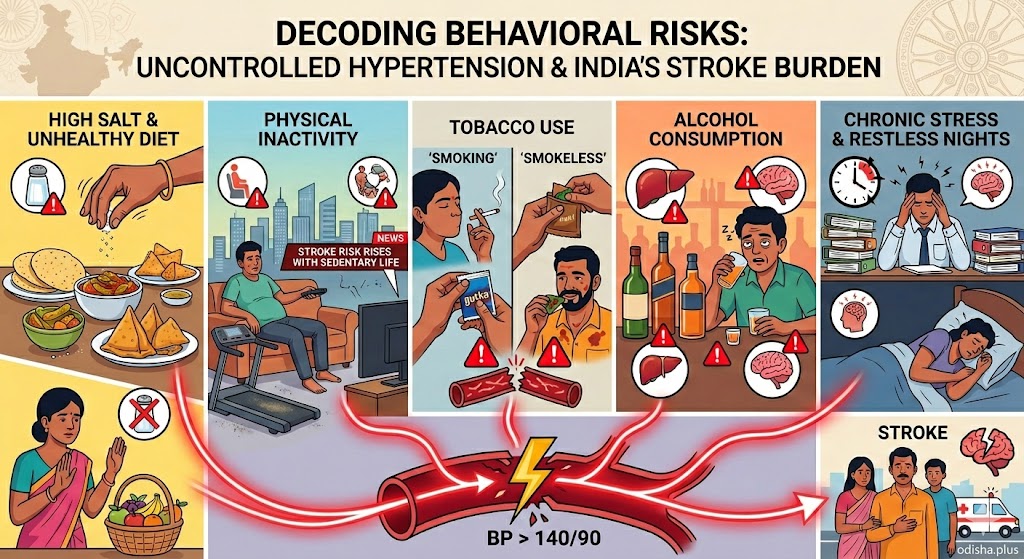
The researchers successfully identified specific modifiable unhealthy behaviors that actively negate the protective effects of hypertensive medication. For men, alcohol consumption and a high Body Mass Index were significantly associated with an inability to control blood pressure.
For women, the matrix of risk was even more complex. Tobacco usage, alcohol consumption, high BMI, and the presence of comorbid conditions like diabetes and heart disease played a significant role in uncontrolled hypertension. These behavioral patterns are exactly what comprehensive awareness campaigns must target.
A stroke does not occur in a vacuum. It is often the culmination of years of unchecked lifestyle choices. By identifying alcohol, tobacco, and obesity as the primary saboteurs of blood pressure control, the study provides a clear mandate. Public health communicators must design highly targeted and community specific interventions.
Perhaps the most alarming data point for outreach campaigns is the age correlation. Individuals aged 45 and above have significantly higher odds of experiencing uncontrolled hypertension. Men in this age bracket face odds 7.6 times higher, while women face odds 6.08 times higher, compared to younger populations.
Furthermore, the study uncovered a socio-economic paradox. Higher odds of uncontrolled hypertension were found among the wealthiest wealth quintile compared to the poorest. This suggests that affluence in India is bringing with it highly sedentary lifestyles and dietary shifts that exacerbate cerebrovascular risks.
Tackling this massive stroke burden requires us to look upstream at these behavioral risks. The insights from such studies must be deeply integrated into the broader framework of the National Programme for Prevention and Control of Non-Communicable Diseases, also known as the NP-NCD championed by the Ministry of Health and Family Welfare, Government of India.
The Government of India and all State governments must take decisive action by elevating stroke control to an urgent priority within this national policy framework. Policy action must go beyond passive medical distribution and basic screening.
States need to prioritize health budgets for dedicated behavioral counseling at the primary care level, actively addressing the exact lifestyle risks that negate medical treatments. Furthermore, the NP-NCD mandate must be aggressively executed by state governments to ensure that a fully functional, stroke ready infrastructure is available at every district hospital across the country. The healthcare personnel, across roles, also need to be oriented and skilled to deal with stroke patients during the treatment and in after-stroke-care.
We at IFI Foundation have been actively advocating for this exact policy action. A multipronged strategy under public health initiatives by the government is essential to reduce the overall stroke burden. We must prepare the nation with timely medical interventions and comprehensive post stroke management, including long term rehabilitation and care.
Advocacy must also be paired with grassroots behavioral change. Apart from producing relevant information in video format for the online media for mass education on stroke, IFI Foundation takes the message directly to the community.
We host university level programmes to prepare and promote the youth as stroke spotters and save lives in their communities. By training young people to identify the critical signs of a stroke (BE-FAST), we empower them to act quickly. A trained young person can monitor whether their parents in the high-risk demographic are truly managing their blood pressure through lifestyle choices.
By combining aggressive national policy action with localized, actionable community dialogue, we can successfully shift the narrative from late-stage hospital management to early stage empowerment and prevention with a mandate – #StrokeActionNow.
(The author is a Communication Specialist, Public Health Advocate and Co-founder IFI Foundation. He leads the IFI Stroke Initiative as a member (stroke support organization) of the World Stroke Organization (WSO). Views expressed are personal.)