

























Your social circle and digital environment quietly shape your ambitions, financial choices, and spiritual growth. Choose your influences wisely
Monalisa Dash Dwibedy
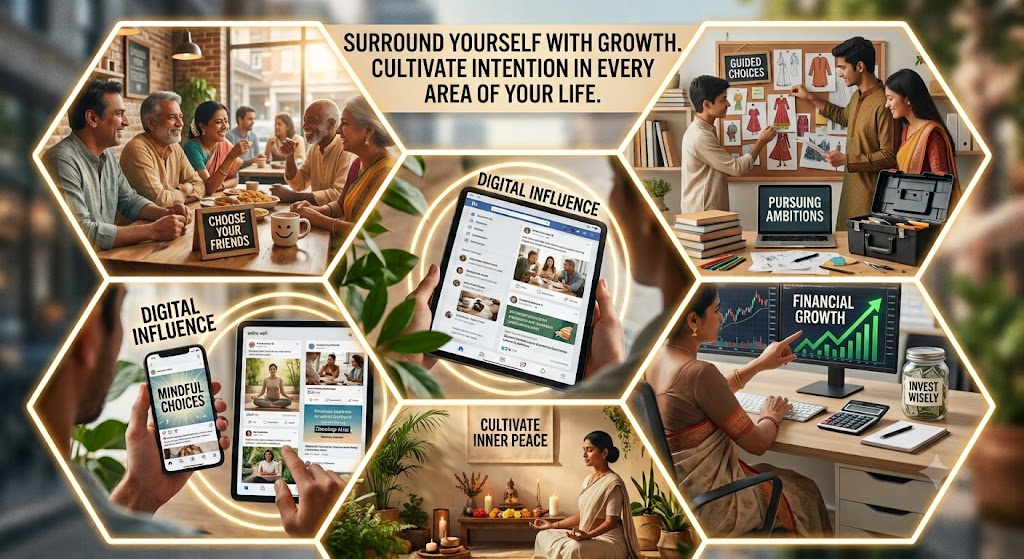
Every human being longs to belong. We naturally seek a circle of people around us—our family, friends, relatives, colleagues, mentors, and communities. These relationships enrich our lives, but they also do something far more profound: they influence our thoughts, shape our beliefs, and ultimately determine the direction of our lives. Whether we realize it or not, our circle of influence quietly molds our ambitions, our fears, our priorities, and even our definition of success.
Take a moment to observe the people you spend the most time with. Are they optimistic or cynical? Do they encourage growth or celebrate mediocrity? Are they driven by purpose or merely by comfort and show-offs? Do they value spiritual growth or do mere material possessions satisfy them? The answers to these questions reveal far more about your future than you may imagine.
If your circle is largely unambitious or content with mediocrity, you may gradually develop an unconscious fear of succeeding beyond them. Human beings are social creatures. We instinctively fear isolation. Deep within us lies a concern that if we become more successful than our peers, we may no longer fit into the group that gives us a sense of belonging. As a result, many people unknowingly limit their own potential simply to preserve their social acceptance.
This is why consciously choosing your circle of influence is one of the most important decisions you will ever make. However, choosing the right circle is easier said than done. Relationships cannot always be replaced overnight, nor should they be. Instead, the goal is to intentionally create and maintain a circle that aligns with your material and spiritual aspirations at every stage of your life.
Imagine that after years of disciplined work, careful investing, and thoughtful financial planning, you decide to retire early. Your investments generate enough passive income to support your lifestyle, allowing you to leave your nine-to-five job and devote your time to pursuits that truly matter to you—travelling, learning, volunteering, writing, creating, or simply enjoying life.
Now imagine that someone in your close circle is relentlessly chasing wealth. Every conversation revolves around making more money, buying bigger houses, earning promotions, and accumulating status. They repeatedly warn you about inflation, future uncertainties, changing lifestyles, and the risks of retiring early.Their concerns may be genuine, but over time they begin to influence your thinking. Slowly, you start questioning a decision that once brought you peace. Without realizing it, you begin living their priorities instead of your own.
The danger isn’t that they are wrong. The danger is that you have unconsciously adopted someone else’s definition of success. Every life has a different purpose. When you are financially content and wish to pursue higher goals, constantly surrounding yourself with people whose only measure of achievement is money can pull you away from the very life you intentionally designed.
The same principle applies even more strongly to your social media circle. Social media was created to connect people. Ironically, it has become one of the greatest sources of comparison. Imagine that on your job loss day, you open Instagram and see a close friend celebrating the purchase of a luxury car. Moments later, another friend shares breathtaking vacation photographs from Italy. Neither friend knows about your job loss. Neither intended to cause any harm. Yet the emotional impact can be overwhelming. Instead of processing your own situation calmly, you begin comparing your life with everyone else’s highlight reel.
Now imagine the same “job loss” day without social media. After returning home, you would spend time with your loved ones. Together with your family, you will discuss the next steps. Perhaps you decide to take a short vacation in the countryside—a break you had postponed for years because of work. You might use the time to reflect on life, assess your finances, review past investments, and calculate your monthly expenses. You may discover something reassuring. Your years of hard work have provided you enough financial security to support your family for quite some time.
Then you begin to take long walks every morning. Start a kitchen garden in your backyard. Attend a music festival or watch a Broadway show or read the books you never had time for. You utilize this career break to reconnect with yourself. Meet your friends and extended families. What initially appeared to be a crisis slowly transforms into an opportunity for renewal.
But that peaceful journey never begins. Instead, after seeing photographs of your friends’ luxury cars and exotic vacations, anxiety takes over. You rush to update your résumé and immediately begin applying for jobs—not because you genuinely need one, but because comparison has convinced you that you are falling behind.
Ironically, neither the luxury car nor the Italian vacation had ever been among your life’s priorities. Those desires were borrowed from someone else’s social media posts. You forgot that expensive cars had never defined your happiness. You forgot that you have already travelled to twenty-five countries and that Italy would always be there whenever you wished to visit. Most importantly, you forgot that life had presented you with something incredibly valuable: “Time”. Time to heal. Time to think. Time to rediscover yourself. Time to become a more joyful and conscious human being. Instead, you surrendered that opportunity to comparison.
This is the invisible power of our circle of influence. Whether it exists physically around us or digitally through our screens, it shapes our decisions every single day. Social media itself is not the enemy. It is merely a tool. Like every tool, it can either build or destroy. Use it to learn, stay connected, discover new ideas, and support your goals. Never allow it to dictate your aspirations or define your self-worth. The moment you begin measuring your life against carefully curated moments from other people’s lives, you stop living your own.
Beyond material success lies an even greater challenge—spiritual growth, which only human beings are capable of . Spiritual success demands extraordinary discipline, honesty, humility, and self-awareness. It requires us to constantly be aware of our intentions, thoughts, and actions.
If the people around you lack integrity, constantly complain, indulge in gossip, chase external validation, or encourage shortcuts, your spiritual journey becomes significantly more difficult. Every conversation pulls your attention outward instead of inward. On the other hand, surrounding yourself with people who value truth, compassion, simplicity, gratitude, and self-discipline naturally elevates your own consciousness. Your environment either nourishes your evolution or quietly weakens it.
There comes a time in every person’s life when growth requires courage—the courage to outgrow certain environments, reduce unnecessary influences, spend more time in solitude, and intentionally seek people who inspire the highest version of ourselves. Changing your circle of influence does not mean abandoning people. It means becoming conscious of whose voices you allow to shape your mind.
The quality of your life is rarely determined by a single decision. More often, it is determined by the people, ideas, and influences you repeatedly allow into your world. Choose them wisely. Because your circle of influence ultimately becomes the architect of your destiny.
(The writer is an IT Consultant living in Toronto. Views expressed are personal.)