
























What began as a satirical social media response to a perceived slight transformed into a 37-day masterclass in democratic dissent. Here is an inside look at how a generation of digital natives, rallying under the banner of the ‘Cockroach Janata Party’, brought New Delhi to a standstill and secured an unprecedented political concession
OdishaPlus Bureau
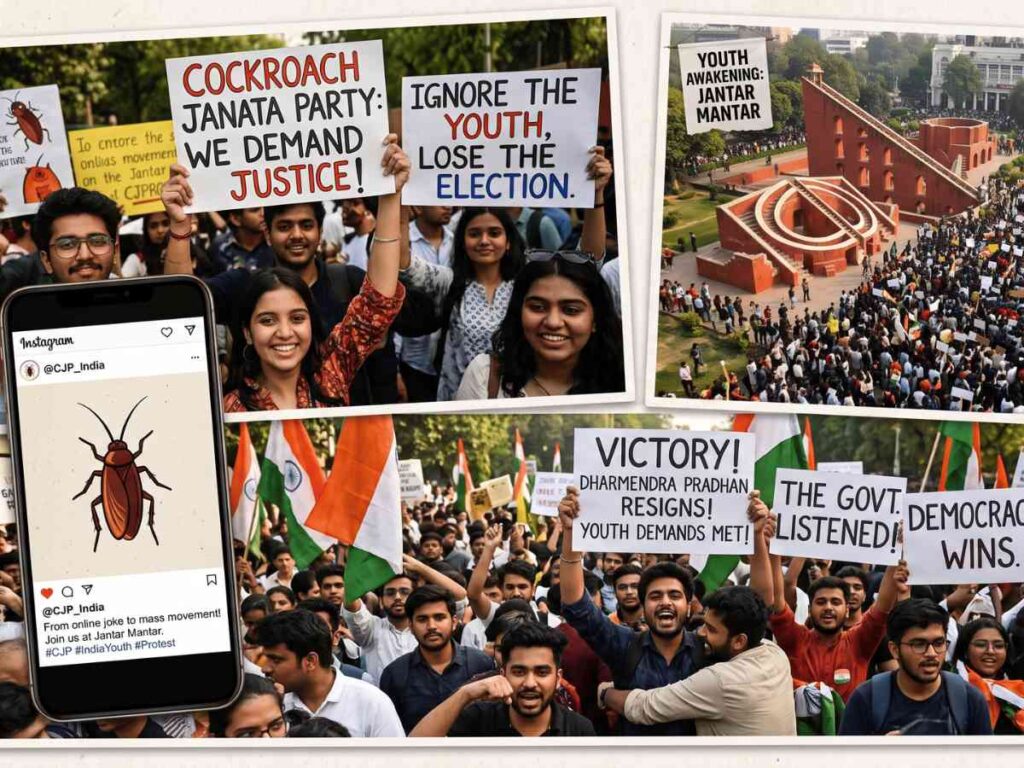
By late Saturday, July 25, 2026, the barricades at New Delhi’s Jantar Mantar—once tools of containment—had been repurposed into victory chariots. A month-long standoff that pitted India’s youngest voters against the formidable machinery of the ruling Bharatiya Janata Party (BJP) had come to an abrupt, historic end. Union Education Minister Dharmendra Pradhan stepped down from his cabinet position, marking an extraordinarily rare capitulation by a government known for its unyielding posture.
The resignation was the central, non-negotiable demand of the Cockroach Janata Party (CJP), a youth-led movement that materialized from the ether of the internet to challenge systemic failures in India’s education and examination infrastructure. Shortly after Pradhan’s exit, the CJP officially called off its agitation, citing the government’s acceptance of its remaining demands—including the withdrawal of FIRs against peaceful protesters and financial compensation for the families of students who died by suicide following the NEET-UG paper leak.
For political analysts and global observers alike, the events of the past seven weeks offer a profound case study in modern democracy. It proved, unequivocally, that when digital fluency is paired with boots-on-the-ground endurance, the youth cannot be ignored.
From Punchline to Political Powerhouse
To understand the magnitude of this movement, one must look at its highly unconventional origins. The CJP was never conceptualized in a smoke-filled political war room. It was born as a tongue-in-cheek reaction to a controversy involving Chief Justice of India Surya Kant, who was alleged to have compared the nation’s unemployed youth to “cockroaches”. Though the Chief Justice later clarified that his remarks were misconstrued, the damage in the court of public opinion was already done.
For a demographic grappling with a crisis of unemployment and a heavily compromised competitive examination system—highlighted by the egregious NEET-UG paper leak in May—the term struck a nerve. Enter Abhijeet Dipke, a 30-year-old Boston University graduate whose viral social media post reclaimed the slur. Within days, the Cockroach Janata Party was formed. It was a masterstroke of Gen Z irony: taking a derogatory label, weaponizing it through memes, and turning it into a badge of honor.
On June 6, 2026, Dipke returned to India from the United States, carrying a copy of the Constitution, and headed straight to Jantar Mantar. What started as a digital expression of angst quickly evolved into a highly coordinated physical protest. The CJP leveraged social media platforms to outmaneuver traditional political parties, overtaking both the BJP and the Congress in Instagram following within days. Their communication strategy was a blend of relentless humor, biting memes, and sharp critiques of governance, which resonated deeply with millions of frustrated young Indians.
The Crucible of Jantar Mantar
By late June, the protest had grown from a gathering of disgruntled students into a massive, organized agitation. The movement gained critical legitimacy and momentum on June 28 when prominent climate activist and education reformer Sonam Wangchuk joined the site, launching an indefinite hunger strike. Wangchuk’s presence bridged the gap between Gen Z irreverence and traditional, Gandhian civil disobedience.
However, the state’s response was characteristically stern. As the crowd swelled to an estimated 50,000 people by late July, the Delhi police heavily barricaded the area, denying protesters permission to march on Parliament. Confrontations ensued, featuring baton charges and teargas, while the closure of 18 metro stations disrupted daily life in the capital.
Yet, the “cockroaches” refused to scatter. The protesters exhibited a remarkable degree of self-organization, establishing supply chains for food and water, and even distributing meals to the police officers deployed to monitor them. They stripped away the traditional “sanskaari” (cultured/traditional) expectations placed upon Indian youth, chanting rhyming, irreverent slogans that laid bare the pent-up anger of a generation that felt chronically ignored and stereotyped.
As the monsoon heat and humidity battered the capital, the youth held their ground. Their persistence eventually forced the political establishment to reconsider its strategy. The opposition, led by Rahul Gandhi, seized the moment to escalate criticism, pointing out that India had witnessed 152 exam paper leaks over the past decade with zero convictions. The movement, which had steadfastly refused to align with any political party, was suddenly dictating the national agenda.
The Government Retreats
For Prime Minister Narendra Modi’s government, the CJP presented a unique and highly volatile challenge. The BJP is a party that prides itself on projecting strength and rarely makes concessions to street agitations—the notable exception being the repeal of the farm laws in 2021. Initially, the ruling party viewed the protests as being sponsored by opposition forces, but the sheer scale and organic nature of the youth participation made it impossible to dismiss as a mere political stunt.
The government attempted to quell the anger through institutional promises. PM Modi took to social media to vow the establishment of “fast-track courts” to punish those involved in the paper leaks, declaring that “those who try to harm the future of our youth will not be spared”. However, the CJP swiftly rejected this as a “Band-aid” solution, pointing to the clogged nature of the Indian judicial system and reiterating their core demand: ministerial accountability.
Behind closed doors, a pragmatic realization set in among the BJP brass. The risk of the protests spiraling into violence—and the potential political fallout of youth casualties—was too high a price to pay. As one senior minister reportedly noted, they had to “swallow the bitter pill” because the issue fundamentally concerned students and their families across the nation.
On Saturday afternoon, just hours before a scheduled third round of talks with the CJP, Dharmendra Pradhan issued a two-page resignation letter. In his statement, addressed directly to “my young friends,” Pradhan stated that his departure was not a matter of personal prestige. Rather, he framed his resignation as a necessary step to prevent “anti-national forces” from exploiting the unrest at Jantar Mantar and to protect the broader interests of the students.
A Victory for Direct Democracy
The reaction at Jantar Mantar was instantaneous and euphoric. The resignation was the vindication of a 37-day struggle fought not with vast financial resources, but with smartphones, satire, and sheer stubbornness. CJP founder Abhijeet Dipke took to the stage to announce to the cheering crowds, “Democracy wins!”. Sonam Wangchuk, ending his 26-day fast, echoed this sentiment, describing the outcome as a triumph of “direct democracy… straight from the streets”.
The government’s subsequent agreement to provide honorable compensation to the families of NEET suicide victims, withdraw criminal cases against the protesters, and commit to further dialogue on systemic educational reforms cemented the CJP’s victory. As CJP spokesperson Saurav Das noted, the agitation was withdrawn “in good faith,” with the explicit expectation that the government would honor its reform timeline.
The Broader Implications
The Jantar Mantar episode of 2026 will likely be analyzed by political scientists for years to come. It serves as a stark warning to governments worldwide: the traditional playbooks for managing civil unrest are rapidly becoming obsolete. Gen Z protesters do not operate through conventional hierarchical structures, nor are they easily intimidated by state machinery or political rhetoric.
They are highly decentralized, fluent in the language of the internet, and capable of turning a momentary gaffe into a sustained, nationwide movement. Furthermore, by stripping their movement of traditional partisan leanings, the CJP made it exceedingly difficult for the state to delegitimize them. They were not political rivals vying for a constituency; they were citizens demanding accountability for their futures.
While the protesters have now packed up their tents and returned to their homes and universities, the systemic issues that drove them to the streets—unemployment, corruption, and an overburdened education system—remain largely unresolved. The resignation of a cabinet minister is a monumental symbolic victory, but the true test of this movement will be whether its pressure can translate into lasting, structural reforms in India’s examination system.
Regardless of what happens next, the youth of India have successfully altered the political equilibrium. They have proved that accountability can still be extracted from the highest echelons of power. The ‘cockroaches’ didn’t just survive the heat of the capital; they roared loud enough to make the establishment listen. And in doing so, they have redefined the contours of democratic protest for the 21st century.