
























One organ donor can save up to eight lives. Greater awareness about brain death and organ donation can help overcome fear, dispel misinformation, and save countless patients
Dr. Pratap Rath
A human body is the greatest of natural creations. With over hundred billion cells in the cerebral hemispheres to process the input from over more than 13 different kinds of sensors and take appropriate decisions, store it and retrieve it. While it has a powerful maintenance and recovery process in place, fighting back disease creating elements and repairing broken parts are quietly done. Recovery without any outside intervention is still being researched into but the major thrust is applying technology evolving in other areas to replace some parts which were once thought to be inevitable and natural aging, working for 67 years on an average. Yes, we have developed from 47 years of average life expectancy in the post-independence era to 67 years now.
The biggest challenge of medical intervention and technology has been to reproduce the human organs with something artificial and therefore reproducible. There have been bigger machines like the heart-lung, the ventilator, dialysis that have extended human life further. But these are far too big to be sustainable for a large population.
A brief understanding of human body is necessary for every human being. Often lack of understanding, fear, unsolicited advices and stories of misuse reported in the media stop the development of a proper understanding. If we break the human body into two parts it becomes easier. Starting from the spinal cord running down the back right in the middle to the two cerebral hemispheres we identify as the brain. That is the Central processing unit which makes our conscious and subconscious decisions possible. All other organs through autonomic nervous system function more or less independently. Some processes like maintaining blood pressure, heart rate, temperature do not require any specific decision making by the brain. Anybody who studies wonders how beautifully and in coordination all the parts of human body function.
The good news is we have been able to decode the functioning to such a great extent that any organ below the brain has become replaceable. A failed heart requires just another heart to replace it and you go on your way living life almost as normal. Of course, there are diet restrictions, medicine to counter failure etc. But most of us, if we are living a pain-free and contributing life would like those extra years. The bad news is we have to have it from a living body. We cannot have it (unfortunately called harvesting in English) from a really dead body.
We hear more about kidney transplant because we understand now there is already some redundancy built in. We have two kidneys and we can manage with just one! So, the life of a near and dear one can be saved if one is willing and is capable of donating one kidney. It is now becoming routine in the multi-specialty hospitals. A failure of liver is being countered by donating a part of the liver. Recently we came across two hands being transplanted in India. These wonders of medical interventions are possible because a living human being is willing to part with a part of his/her body (there is no gender-bias there) out of love. Frankly, it could be out of necessity but that is a different area of human ethics.
Because of growing population, changing adverse environment, unhealthy life style, competition and human greed, there are a large number of persons who are suffering from failure of different organs and are desperately looking for donors. Death stares at them in the face; either a transplant or a painful death. The situation is helpless. But often human tragedy is turned into opportunity by the human brain and technology. It enables humanism to emerge to stand over misinformation and fear.
The brain-dead:
Dying is inevitable. We all know that. We have over 3000 religions, prescribing ways to dispose of the human body in their specific ways. We do not embalm other dead bodies to keep it forever. In some way or other it gets disposed else it will stink and become repelling. We do not want our dear ones to be hated. But we cannot keep the dead body no matter how much we loved the person. It is estimated that about 1.72 lakhs of people die every day! If only we could get some of the organs before they are buried and burnt or otherwise, we could be saving a number of young people from certain death.
Article 21 of our Constitution spells out right to life and personal liberty. It has been expanded to become right to life with dignity. It is not surviving but living as a fully functioning human being. If not that at least a feeling, responding human being. As described earlier, the brain must be functional. The other organs can be made to function as they are mechanical (natural in structure) devices. Without the brain function they gradually wither away and cannot be used for transplant.
In certain conditions like severe brain injury because of road accident, high blood pressure, blood clot etc. human beings become brain dead. It simply means for all practical purposes the person is dead. You may be seeing the body but the life with dignity is meaningless as no recovery to come back to normalcy and living is possible. There are specific and strict medical tests to define a brain dead situation.
This is the time of decision for the near and dear ones. They decide whether to allow the body to waste away and disposed of or to allow other desperate people to live by using the organs this brain-dead (dead body – cadaver) body can yield. It definitely hurts to talk about it but it also means giving life to persons. We have been donating blood, without thinking and becoming anxious. We never specify who gets the blood. But we know, stored properly, it is saving thousands of people through the blood banks. The other not-so-evoking bank of human organ is eye bank. Giving vision to someone is almost giving a new life.
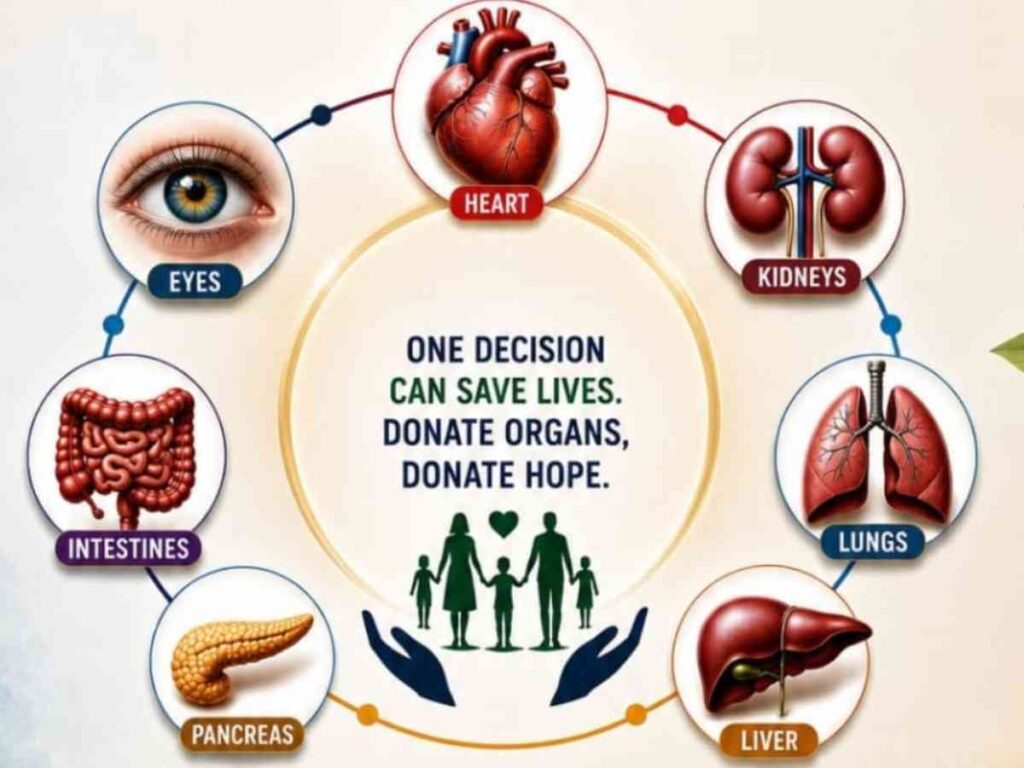
But now we see that one human body can save the lives of eight persons at least! Two lungs, a heart, two kidneys, pieces of liver, the skin and even two hands as we heard in the news. This is not taking away this person’s life but simply to stop it from being wasted and disposed of. How is that more a sign of love of any one?
Some misinformation about being born without a limb in the next life goes round in such time. Think! We value the life of a soldier who gives his life for the country. A bomb or crash explodes his body into small pieces. Do you think such a person will be born (if true) in the next life in pieces? Some people spread misinformation without a shred of evidence. The evidence is wherever and whenever the near and dear ones are willing to donate the organs of a brain-dead relative, it is saving a number of lives.
The role of State Authority:
Yes, we also hear about racketing and seen films about people being pushed into coma to harvest organs. Movies have one purpose, to make money. Here, in India, only a few hospitals are recognized to undertake such activities because they meet set standards. And there are Acts to control the activities.
Further, it is not as if the organs can be given to the highest bidder by the hospital. After the responsible family members agree to donate, the state authority is informed. The State Organ and Tissue Transplant Organization is the authority which oversees the transplant taking place in the state. It maintains also the least of recipients. The motto says “donating life – one organ donor can save 8 lives”. Frankly, we have miles to go to achieve that as we do not have the infrastructure
Rather than writing about all the details, it should suffice to say that the government understands the importance of promoting such organ donations. It even offers a financial incentive to the next of kin and waives the need of any post mortem if it is a case of accident etc.
The Role of Voluntary Organisations:
The role of human groups of all kinds including the CSOs is very important as they are the wherewithal of carrying the message, continuously to the public so that the misinformation is countered. People, being citizens of the 21st century must get over these unwarranted fears and must promote “live and let live” life style.
(The author is an academician and President of Odisha Rationalists & Secretary, Open Learning Systems, Bhubaneswar. Views expressed are personal.)