


















A review on Migrants and Other Poems by Prasenjit Mukherjee as a profound exploration of migration, identity, faith, and existential uncertainty. Through restrained yet evocative poetry, the collection reflects on displacement, modern alienation, and the search for meaning in a changing world
Nandini Sahu
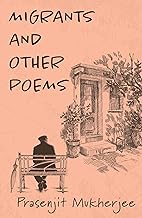
Book Name: Migrants and Other Poems
Author: Prasenjit Mukherjee
Publisher: Penguin Enterprise
On a lighter note, sometimes a reader’s dopamine level may plausibly and ardently go a bit high after reading a book. One such book that I read last week was Migrants and Other Poems.
Migrants and Other Poems by Prasenjit Mukherjee is a quietly stimulating and fittingly attentive poetry collection that situates itself at the intersection of displacement, metaphysical uncertainty, and the erosion of meaning in late modernity. The introductory image of the old man seated on a veranda, staring into a horizon that no longer promises return, is not exactly anecdotal. It is emblematic of the book’s governing consciousness. This figure is a metonym for a historical and existential condition that resonates with postcolonial displacement, urban alienation and what Martin Heidegger might describe as Geworfenheit, or ‘thrownness,’ into a world stripped of stable certainties.
Mukherjee’s poetry does not dramatize migration through spectacle or political slogans; instead, it internalizes exile, rendering it as a slow, corrosive presence that seeps into memory, faith and everyday perception. The collection’s strength is precisely in this refusal of excess, choosing instead a poetics of restraint that allows sorrow, doubt and ethical unease to surface through pared-down images and meditative rhythms.
The architectural progression of the book, keeping pace with the complex narratives of Travel Literatures–Migrants, Moorings, Passages, Interludes, Transitions and Ending–is itself a narrative of movement that mirrors both the migrant’s flight and plight and the philosophical journey from belief to scepticism, from rootedness to ontological drift. In Initiation, the opening lines enact a rite of passage that is as spiritual as it is historical: “The final movement away from fear / brought us here.” The diction of ritual and faith, ‘private god,’ ‘desert faith,’ “apprehension of peace or death”, invokes both Eliade’s idea of sacred time and the Bhakti tradition’s intensely personal relationship with the divine. Yet Mukherjee destabilizes these frames by collapsing peace and death into consistency, suggesting a post-metaphysical exhaustion where transcendence no longer offers resolution. From a Western theoretical standpoint, this resonates with existentialist thought, particularly Camus’s notion of the absurd, where human longing for meaning confronts a silent universe. The migrant’s initiation, to me, is not into a new world; it leads him into an awareness of meaning’s fragility.

This tension between cyclical belief and irreversible loss is pronounced in The Dispossessed, where the speaker stands before the ‘twenty-two steps’ of a temple, an image that unmistakably evokes Indian ritual of the Jagannath Cult, cosmologies and the sacred geometry of pilgrimage. The claim that “the cycle…has come full circle” is ironic, while Hindu philosophy posits samsara as cyclical continuity; Mukherjee’s poetic consciousness exposes this as a comforting narrative threatened by some sort of a historical rupture. The temple steps, “white in the summer heat,” are bleached of transcendence, becoming relics beyond conduits of faith. Read through a Subaltern Studies lens, this moment exposes how inherited structures of meaning fail to accommodate the lived realities of displacement and dispossession. The poems do not reject tradition outright; they interrogate its adequacy, suggesting that ritual memory cannot fully restore what history has violently dislocated.
The bleakness intensifies in Encounter, where the speaker rejects the sensuous plenitude of nature, monsoon rains, birdsong, and rivers in favour of an uncompromising declaration that “only darkness reigns.” This repudiation of Romantic and even Tagorean nature symbolism marks a decisive break from consolatory aesthetics. Nature does not heal; it is subject to the same mortality and erasure as human attachments. From an ecocritical position, this refusal of the poet may appear nihilistic, but it is better understood as ethical honesty, a resistance to aestheticizing suffering. The darkness that reigns is not cosmic; it is historical, echoing Adorno’s insistence that lyric poetry after catastrophe must remain acutely aware of its moral limits. Mukherjee’s voice is impassive in such cases, wary of beauty that distracts one from loss. Some T S Eliotian layers, indeed!
In Apocalypse, the poem’s speculative questioning of whether the light one reaches for might still elude articulates a crisis of epistemology as much as faith. The ‘grease-wood’ relic suggests a fossilized past, an archive of belief that no longer ignites illumination. This is a profoundly modern anxiety, let me say that this a war-like anxiety, aligning with Post-Structuralist scepticism about stable meaning while also echoing the Upanishadic inquiry into knowledge and illusion (maya). The poem’s refusal to resolve its central question reinforces the collection’s philosophical integrity; Mukherjee does not manufacture an epiphany where none is ethically available.
The travel-poem The ITDC Tour II, set in Tirukkalikundram, sharply critiques commodified spirituality and the tourist gaze, exposing how sacred spaces are reduced to spectacles that cannot sustain belief. The “gypsy-dance in the pelting rain” is a disturbing parody, unsettling the speaker’s ‘created fiction’ of faith. This poem is especially effective in its dialogic self-interrogation, culminating in the devastating question, “Is this the agnostic’s reward?” Here, the Indian philosophical way of stoicism, Charvaka-like doubt, meets Western secular disenchantment. The poem refuses nostalgia, acknowledging that agnosticism is not liberation; it is another form of burden. Why do I remember Herman Hesse’s novel Siddharth now?
Urban alienation spreads its most haunting articulation in Spring, where the city waits endlessly for renewal that never reaches the center. The image of kites tangled in electric wires is a powerful visual metaphor for arrested transcendence, echoing Walter Benjamin’s concept of modernity as a space of suspended possibility. The foreboding hush before nightfall captures a collective anxiety, a city caught in permanent anticipation without fulfilment. Mukherjee’s urban landscape is not merely physical. It is psychological, a site where hope has been structurally deferred.
The collection concludes with Passing, a poem of stark minimalism that reduces human continuity to hollow ritual. “Only the rituals live on,” the poet declares, stripping ceremonial acts of their ethical and communal purpose. From an Indian Knowledge Systems perception, this is a devastating inversion of karma-kanda, where ritual without consciousness is redundant and an empty repetition. Simultaneously, it aligns with Durkheim’s view of ritual as social residue, persisting even after belief has eroded. The poem’s bleak clarity serves as the book’s ethical closure, repudiating transcendence but demanding awareness.
I understand, as a connoisseur of poetry, that Migrants and Other Poems is an intellectually disciplined and emotionally resonant work that resists easy succour. Mukherjee’s achievement is in his ability to hold Western existential ideas and Indian philosophical inquiry in a very productive tension, manufacturing a kind of poetry that is at once local and universal, intimate and historical. The collection does not offer solutions. It offers something rarer and more valuable, an honest articulation of uncertainty that respects the dignity of suffering without aestheticizing it. In an age of performative empathy and war-torn politicized identity, Mukherjee’s poems stand out for their quiet ethical seriousness, presenting this book as a noteworthy contribution to contemporary Indian poetry.
(Prasenjit Mukherjee topped in Master’s in English from Utkal University and retired as a civil servant. Prof. Nandini Sahu is Vice Chancellor, Hindi University, West Bengal. Views expressed are personal)